5 Great new family cars to consider
New cars have been coming in hard and fast towards the end of last year, and a slew of new models are still in store for 2023. Here are a few impressive new family cars I've driven in the last few weeks that are highly recommended for families.


It's been a busy year so far for new model launches and test vehicles, with many more waiting in the wings - so much so that it's impossible for every person on the team here at AutoTrader to drive each and every new car - but we do try!
The cars listed below are some of my favourite family cars I've driven recently, although I still have a few significant new models to take for a test run, such as the handsome new Ford Ranger and Everest models (Sean's Everest review can be read here).
Related: New-generation Ford Ranger launched locally
Mahindra XUV700

The seven-seater Mahindra XUV700 blasted into SA in November last year and South Africans were placing orders long before it even became available on dealership floors. Apart from looking refreshingly contemporary (we’re not quite used to Mahindras looking this way), it also comes heavily decorated, wearing the Indian Car of the Year winner’s sash, along with a full five-star rating for adult occupants, with child passenger protection rated at four stars. Sean attended the launch of this new vehicle - read his first drive impression here.

The XUV700 is built brand new from the ground up so it rides on an entirely new platform and is the first Mahindra to wear the stylish new ‘twin peaks’ logo. It goes head-to-head with more established seven-seaters such as the Toyota Fortuner and Mitsubishi Pajero Sport, and is sure to ruffle some feathers in the coming months. If you see the interior, you’ll immediately pick up some influences from other brands like the electric seat adjustment which is almost identical to what you’d find in a Mercedes-Benz, for example, while the fully-electric door handles in the AX7 L, channel Land Rover. It also competes with the Chery Tiggo 8 Pro and Haval H6, which we compare it with here.
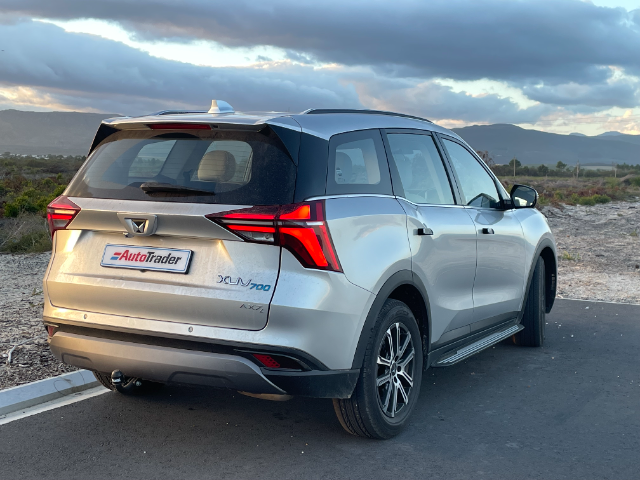
Our test model, the flagship XUV700 AX7 L, is priced at a mere R559 999 but is filled to the brim with tech, comfort, and convenience features as well as self-driving technology, making it superb value in a cutthroat segment. Tech-orientated families will be thrilled by the two digital screens in front that make up one slick-looking unit. One of the highlights, without any doubt, is the stunning Skyroof that stretches all the way to the rear of the car. Pricing for the three models are as follows:
Mahindra XUV700 AX5 – R474 999,
Mahindra XUV700 AX7 R524 999,
Mahindra XUV700 AX7 L – R559 999
Also consider: Haval H6, Toyota Fortuner
Nissan Qashqai

The Qashqai wasn’t an oil painting when it launched in SA many moons ago, but looking at its futuristic, chiselled face today, you can hardly tell that these cars are even related (read our 2022 launch report on the Qashqai here.)

What I love the most about the Qashqai is its clever packaging and the way it cocoons you when you plonk your bottom down on its luxurious driver’s seat which even offers a lumbar massaging function. You’d think the inside is cramped given the car’s compact shape, but Nissan’s designers have made sure it is very spacious indeed, and its boot is massive too, much larger than most cars in this segment. I am also a huge fan of the large, rectangular screen with Apple CarPlay functionality.

The latest Qashqai is loaded with features such as Nissan's Autonomous Driving Level 1 technology (Nissan ProPILOT), which can help you navigate traffic, as well as Predictive Front Collision Warning and Lane Keep Assist which gently steers around bends, and Nissan makes it all very user friendly for the not-so-tech-savvy. These features are found in both Acenta and Acenta Plus models, along with surround-view cameras for easy parking, negating the need for a car guard’s guidance or a potential trip to the panel beater!

The Qashqai not without its faults, however - it’s a bit heavier on fuel than we’d like and it is no longer considered to be very affordable, but as a daily driver, it ticks all the right boxes. The Qashqai was recently reviewed by Lawrence and you can view his article here, where he touches on its fuel economy and powertrain.
Pricing for the new Qashqai is as follows:
Nissan Qashqai 1.3T Visia, R568 200
Nissan Qashqai 1.3T Acenta, R639 300
Nissan Qashqi 1.3T Acenta Plus, R670 600
Aching for a pre-loved diesel model? We review the brilliant, previous-generation Qashqai 1.5 DCI Tekna here.
Volkswagen Tiguan Allspace

The Allspace is the seven-seater sibling of the garden-variety Tiguan, and it is aptly named - there really is a lot of of space inside. For starters, the second row is actually capable of seating three adults side by side quite comfortably on lovely wide seats, whereas the central passenger would normally need to be way underweight to fit in the centre seat of most other SUVs. And, when the third row is in use, there is enough room for some of the carpooling kids’ school bags, which can’t be said for the Mahindra XUV700, unfortunately. Fold the third row flat too, and there are 760 litres for whatever you need to bring along, making it ideal for families who love to camp. The Allspace also competes with the Chery Tiggo 8 Pro and Haval H6 GT, so be sure to read our running cost comparison here.

Another plus point for the Tiguan is the way it drives - it feels solid and planted in the corners, and with regard to the cabin, there’s a feeling of understated elegance, class and quality, despite looking very functional and a bit clinical, even. Small details, like swiping your finger across the airconditioning controls to set temperature and fan speed, imparts an upmarket ambience.

To give the interior a modern feel, the vehicle is equipped with the Digital Cockpit Pro as standard, an updated multi-function steering wheel and an infotainment system with an 8.0 inch colour screen. The 3-zone automatic climate control system is controlled from a new module with touch panels in the centre console. - VWSA
We tested the Tiguan Allspace 1.4TSI R-Line which will set you back R767 400 without any options, but you can add semi-autonomous tech like VW’s IQ Drive which comprises Adaptive Cruise Control, Forward Collision Warning with Autonomous Emergency Braking, Lane change assist, Lane Assist, Traffic Jam Assist and Emergency Assist.

Despite being a large and bulky vehicle, the Allspace isn’t too thirsty, using an average of 8.3 litres per 100 km while in our care, with our personal best being 7.3 and our worst, 9.3 litres per 100 km, when I was testing its tarmac-clinging and overtaking abilities, which it passed with flying colours. It’s not too tardy for a 1.4-litre turbo (with 110kW and 320Nm) and will take 9.2 seconds to complete the obligatory 0-100 km/h sprint. All in all, you could probably get away without those expensive options and still own a kicker of a family car - you don’t need to buy the R-Line, even.
Also consider: Ford Everest (read Sean's review here), Mitsubishi Pajero Sport.
Pricing for the Tiguan Allspace is as follows:
Volkswagen Tiguan Allspace 1.4TSI 110kW, R629 200
Volkswagen Tiguan Allspace 1.4TSI 110kW Life, R712 800
Volkswagen Tiguan Allspace 1.4TSI 110kW R-Line (tested), R767 400
Volkswagen Tiguan Allspace 2.0TSI 132kW 4Motion Style, R774 100
Volkswagen Tiguan Allspace 2.0TSI 162kw 4Motion R-Line, R838 300
Also consider: Isuzu mu-X, Mitsubishi Pajero Sport
Isuzu D-Max 3.0Ddi Double Cab V-Cross

With so many over-the-top lifestyle bakkies on offer, it was only a matter of time until Isuzu joined in the fun - this time with their very own locally-built D-Max, in vicious V-Cross guise! (Read our first drive review on the 2022 D-Max here.)
Currently in its 7th generation, the D-Max is built in Gqeberha. Isuzu has a massive following in South Africa and KB/D-Max aficionados have been waiting with bated breath for a souped-up Isuzu double cab to become available.
In V-Cross trim, the D-Max looks ready to take on whatever surface you can throw at it, with gun metallic finishes for the grille, fender flares, door handles, mirror caps, roof rails and stylish hooped sports bar, but it’s the semi-self-driving assistants on board that impress - it has Forward Collision Warning, Autonomous Emergency Braking, Adaptive Cruise Control, Lane Keep Assistance, a Blind Spot Monitor, Rear Cross Traffic Alert, Parking Aid and a Multi-Collision Brake that applies the brakes when the airbags deploy (the V-Cross has 8 airbags on board). The V-Cross (and LSE models) can also be started remotely from the key fob if you are within 10 metres of the bakkie. (The D-Max competes with the Mitsubishi Triton and Ford Ranger, so be sure to listen to our AutoBattle Double Cab podcast.)

Other premium features include leather seats with eight-way power adjustment, automatic high beam activation, a 9-inch infotainment system with smartphone connectivity, and dual-zone climate control. The all-black leather interior and dashboard layout are new and improved, but thankfully there’s still a cosy, very Isuzu feel to it all! Maybe I’m old-fashioned but I also prefer the analogue speedo and rev-counter to the fully-digital units in other cars, besides, there is a digital TFT screen display between the two gauges.
Related: New Ford Ranger Raptor, driven in Namibia!

Driving the D-Max is effortless - its suspension is soft and comfortable and it laughs in the face of potholes. The cabin is well-insulated from most exterior noise but there’s still that signature Isuzu diesel-engine clatter which brings back happy memories (if you grew up around Isuzus!). The automaker has also revised the 3.0-litre diesel engine and it packs quite a serious power punch with 140 kW of peak power at 3 600 r/min, with a maximum of 450 Nm available from 1 600 to 2 600 r/min - yet fuel consumption came to around 9,8 litres per 100 km which was the figure we managed to get with the previous KB250 model (which has a smaller engine).
Pricing for the V-Cross models are as follows:
Isuzu D-Max 3.0 Ddi Double Cab V-Cross HR A/T, R799 900
Isuzu D-Max 3.0 Ddi Double Cab V-Cross 4x4 A/T, R857 700
Also consider: New Ford Ranger, New Toyota Hilux, Nissan Navara
Toyota Corolla Hybrid

Sedans, the celebrated family cars of yesteryear, are now the un-sung family hero-cars of today. The Corolla is one of the world’s best-selling models, and in hybrid form, it just makes perfect sense. There’s more room on board than you know what to do with, it drives like a dream, it has a mammoth boot, and it sips at fuel as slowly as you would sip on a Margarita at a five-star hotel bar on the French Riviera. You don’t need to plug it in either, you just get in and drive it, while regenerative braking (which happens every time you hit the brake pedal) recharges the battery. You can also drive on battery power alone in slow-moving traffic situations!

The Toyota Corolla Hybrid sedan was enhanced towards the end of last year (read about the introduction of a trio of hybrid models from Toyota) and now employs the brand’s fifth-generation 1.8-litre petrol-electric powertrain along with a new Lithium-Ion battery with improved cooling capacity. The new engine offers a bit of a power boost over the old one; the total output is up by 13kW for a total of 103kW - and yet you’ll never pay the full price for the power on tap, because you are in a hybrid. Our average consumption came to an average of 4.5 litres per 100 km (my colleague managed 5 in the previous model, below), and there was plenty of highway driving thrown in.

The interior has also enjoyed a mild refresh - Xs models get the larger 7-inch touchscreen while higher spec models keep the existing one, and leather is standard across the board. Those who prefer a traditional ICE powertrain will be glad to hear that the non-hybrid 2.0 Xr CVT model, can be had at R517 100.
Related: VW Polo sedan vs. Toyota Corolla Quest vs. Honda Ballade - running cost shootout

Pricing for the Toyota Corolla sedan hybrid models are as follows:
Corolla 1.8 Xs Hybrid - R 502 600
Corolla 1.8 Xr Hybrid - R 521 800
Also consider: VW Polo sedan
Sell your old car, fast!
If you're after a new car, surely you would need to sell your current car first? Find out how easy it is with our Instant Offer tool, here.