Understanding helmet weight and cervical spine trauma
The weight and construction materials of your helmet can have a profound effect on your well-being during a motorcycle crash. We dig into the science of accident injuries and how you can avoid them by choosing the right helmet and using a neck brace.



One of the most common injuries sustained during a motorcycle crash, outside of the typical road rash, is injuries to the neck and spine. Whether you're team no helmet or head protection all the time, the forces involved in a bike accident take their toll on the backbone of the rider.
Related: Helmet safety standards - What is ECE and DOT certification?
Understanding the physics of a motorcycle or high-speed impact crash reveals a high-stakes tug-of-war between protection and anatomy. While a helmet is essential for preventing traumatic brain injury (TBI), its mass introduces specific risks to the cervical spine or neck during a rapid deceleration event.
Neck brace vs. Neck roll: Which motorcycle protective gear is safer?

The Physics
In a crash, your body is subjected to massive G-forces. When the torso is suddenly restrained or hits an obstacle, the head continues to move at the original velocity.
Momentum: A standard helmet adds roughly 1.5kg to 2kg to the mass of the head. In a high-speed impact, this additional mass significantly increases the linear momentum that the neck must counteract.
The lever arm: The cervical spine acts as a pivot point. Because the centre of gravity of a helmeted head is further from the base of the neck than a bare head, the torque applied to the vertebrae is multiplied, ie, the heavier the helmet, the more force it induces.
- Therefore, a lighter helmet will cause less damage to your spine when the physics speak louder than words.

How cervical spine trauma happens
When the neck reaches its physiological limit of motion, the kinetic energy must go somewhere. This leads to three primary types of trauma:
Hyper-extension/Hyper-flexion: The head is whipped forward or backwards beyond the neck's natural range, often resulting in "whiplash" or vertebral fractures.
Axial loading: If the rider lands on the crown of the head, the helmet transmits the force directly down the spinal column, potentially causing "burst" fractures of the vertebrae.
Lateral distraction: This occurs when the head is pulled away from the shoulders, stretching the spinal cord—a common cause of catastrophic nerve damage.
How a neck brace saves you
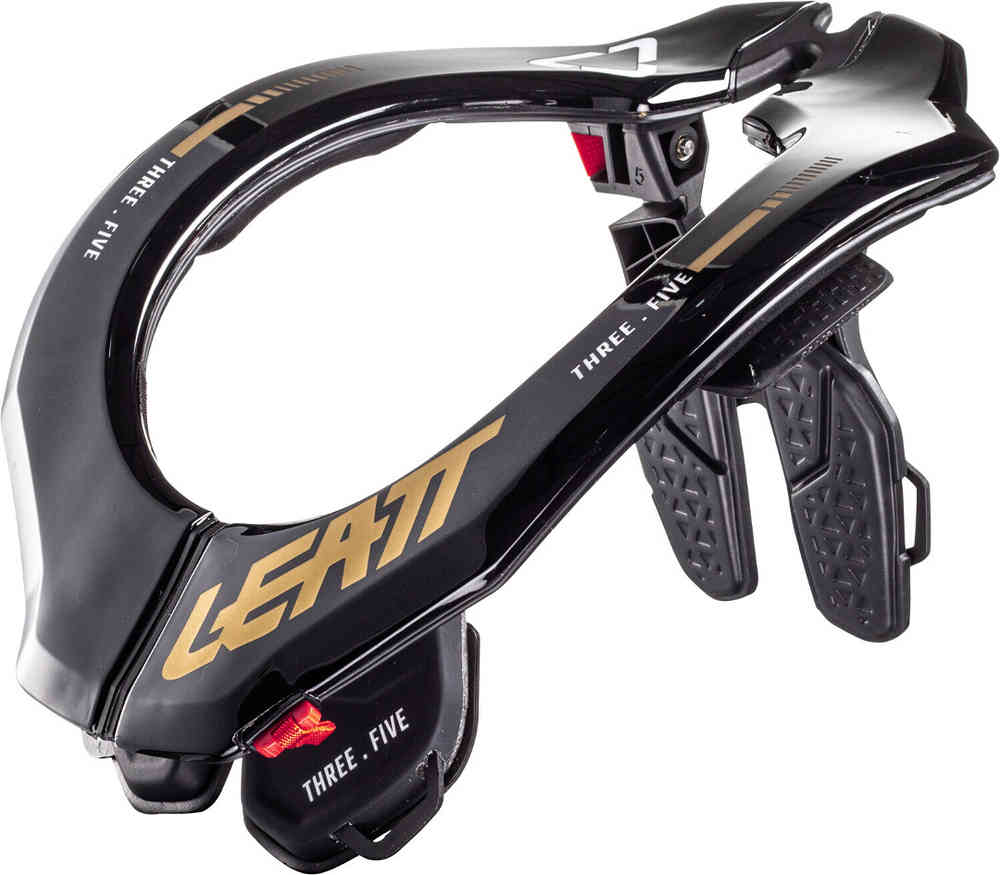
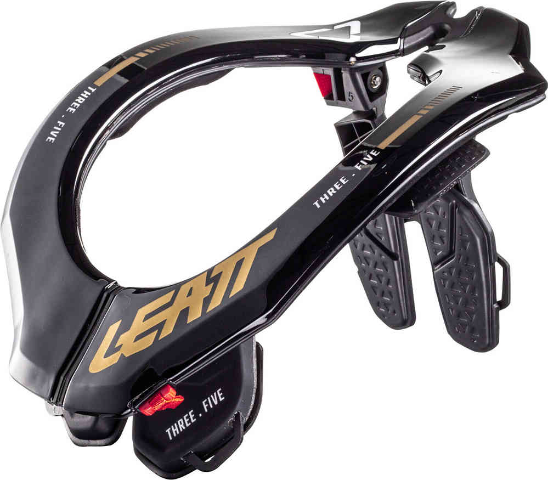
A neck brace or Head and Neck Support (HANS device), does not just cushion the neck; it functions as an Alternative Load Path (ALP).
Load distribution
Instead of the neck muscles and vertebrae absorbing 100% of the force, the bottom of the helmet contacts the brace. This transfers the energy from the helmet directly to the sturdy bones of the shoulders and chest, bypassing the vulnerable cervical spine.
Range of motion limitation
The brace acts as a physical hard stop. It is engineered to catch the helmet's rim before the neck reaches the critical failure point of hyper-extension or flexion.
Comparison of Forces
| Force Type | Without Brace | With Brace |
| Cervical compression | High (Direct spine load) | Low (Redirected to shoulders) |
| Tension (pulling) | High (Head pulls on neck) | Reduced (Brace supports helmet weight) |
| Torque (twisting) | Unregulated | Limited by brace geometry |

Summary
The helmet protects the contents of the skull, while the neck brace protects the spinal cord. By managing the pendulum effect of the helmet's weight, the brace prevents the safety equipment from contributing to secondary injuries during a crash. What you are essentially looking for is a helmet that is a balance of proper protection and weight. Check the ECE sticker at the base of the helmet for its weight in Grams, and balance this with the helmet's construction material. You should also consider a properly fitted HANS system compatible with your helmet for the best possible protection.