Telematics takes a leap forward
Liebenberg is bullish about the local commercial vehicle (CV) industry’s prospects, after national restrictions last year forced Iveco SA to rethink its business principles for assisting clients remotely. “Integration of telematics with vehicles, drivers, calls centres, and service dealers has gained momentum and taken great strides – most notably in the speed of development of telematics solutions, eyes on clients’ vehicles, and more direct interactions,” he notes. “These technologies have been around for years but should develop as a focal point going forward.”

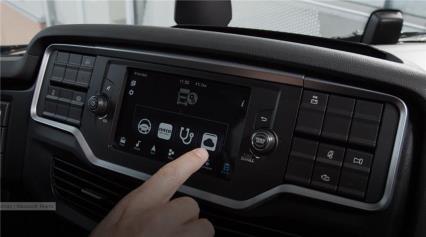
On an international front, Iveco has even launched Iveco Driver Pal, its pioneering vocal driver companion, on its new Daily and Iveco S-Way ranges. Available overseas for the time being, the solution provides drivers with a helpful voice Artificial Intelligence experience on the road, enabling them to bring their digital life on board and interact with their trucks through voice commands. Iveco Driver Pal is designed to help the driver optimise their route and stops, adapting to events on the way by relying on real-time information from the Iveco driver community, Iveco support services and the web. This enables them to conduct secondary tasks while keeping their hands on the wheel and their eyes on the road.
Repair and maintenance contracts restructured
Returning to local developments, Liebenberg has high praise for Iveco SA’s human resources and information technology teams, who have revamped remote working possibilities and engaged with clients to minimise their exposure, for example by offering restructured repair and maintenance contracts and alternative payment plans. Liebenberg believes that this has created a culture within which the company is determined to maintain a focus on keeping clients’ wheels turning, no matter what challenges may arise.

He also echoes the sentiments of a number of CV manufacturers, that overall, 2020 was a good year for their brand: “It was an interesting year for us, with many milestones reached. We managed to grow our heavy business, and enjoyed excellent sales on our Daily range, driven by a massive demand for Covid testing units, patient transporters and various ambulance derivatives,” he notes.
Sales volumes climb
Despite entering 2021 with a conservative volume prediction, Iveco SA soon saw enough positive progress to restructure its market view and is currently seeing numbers closer to 2018 and 2019 levels. But Liebenberg cautions that – at this stage – it is still too early to make fully informed predictions on year-end CV sales, due to the many potential impacts remaining both locally and internationally.
In response to this uncertainty, there has been a shift towards pre-owned vehicles in good condition across the commercial vehicle industry, with customers opting for pre-owned offerings due to both the unavailability of new units and uncertainties regarding contract lifecycles. Liebenberg also reveals that demand for the Iveco brand in right-hand drive (RHD) Africa markets is steadily increasing: “This is driven by strong commodity pricing, but these markets are turning to South Africa as an excellent source instead of buying from RHD European markets.”
Looking to the future, Liebenberg notes that the more mature European markets, which react quicker to change, have seen record results for Q1. During the first quarter of 2021, the EU commercial vehicle market expanded by 21,6%, with 501 703 units registered in total. All key markets improved their cumulative performances, with France (+32,6%), Spain (+11,1%) and Germany (+4,9%) moving back into positive territory and Italy further consolidating its positive result (+38%).

Push for alternative fuels
He attributes some of this growth to government initiatives. “I believe that the government-supported push for alternative fuels in Europe has been a major contributor in bringing those markets back to stable levels,” he says. The local market, however, has lacked this governmental support for alternative fuels, and this could represent a potential source of market growth and stability in the years to come.
Despite this shortcoming on the local market, Liebenberg remains confident of steady and constant business growth over the next three to five years. Manufacturers with a diverse portfolio catering to South Africa’s varied sectors and specialised niche markets will have advantages because this will enable them to engage with a wider spectrum of clients and boost their customer base.
“We need to find local solutions to our problems and reignite local industries to produce instead of importing finished goods,” says Liebenberg, while he urges against complacency as the local market continues to deal with issues including shortages in raw materials and semi-conductors.
Onwards and upwards!
He concludes, however, that South Africa’s culture of resilience is cause for optimism: “Our transport industry has demonstrated this resilience many times: there is no doubt that we will continue to find new and innovative ways to strengthen and grow through changing environments.” Let’s hope he’s right!