Real-world relevance
The MAN eTGM is big news because it takes battery-electric technology into a segment critical to daily fleet operations. Neither a small van nor a long-haul heavyweight, a 16-tonne truck occupies a highly practical middle ground. It handles the heavy lifting of urban logistics: delivering to stores, running municipal routes, moving building materials, collecting waste, or supplying regional customers.

Completing the electric line-up
With the eTGM, MAN now boasts an all-electric truck portfolio stretching from 12 to 50 tonnes. The newcomer slots between the lighter eTGL and the heavier eTGX and eTGS, giving MAN a more complete battery-electric range built around a modular, cross-series technology concept.
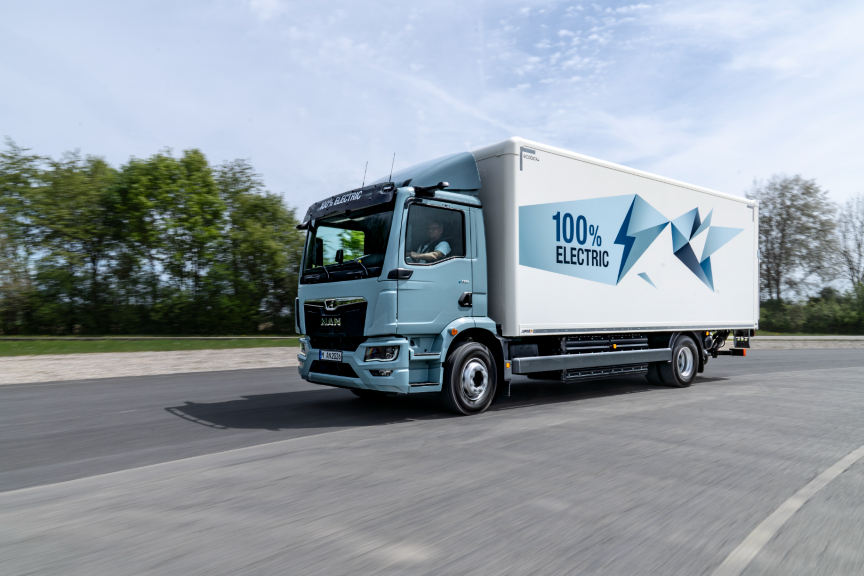
That is an important industry signal. Electric trucks are no longer being presented merely as experiments or niche city vehicles. Manufacturers are building proper model ranges with diverse weight classes, body options, and operational roles. For fleet owners, the question is shifting from “can electric trucks work?” to “where can they work best?”
The payload question
For operators, payload capacity is where the excitement either becomes serious or falls apart. Batteries add weight, and every kilogram used by the vehicle itself is a kilogram that cannot be sold as cargo.

MAN says the eTGM has a permissible gross weight of 16.01 tonnes (with an optional 16.5-tonne rating) and a chassis payload of up to around 10.6 tonnes. That gives the truck ample room for a wide range of bodies and applications. Furthermore, a gross combination weight of up to 33 tonnes adds flexibility, meaning the eTGM isn't limited to city streets—it can thrive in regional distribution where trailers are required.
The range that changes the discussion
The eTGM’s modular battery system can be configured with two to four battery packs, offering up to 320kWh of usable capacity. Depending on the setup, MAN claims a range of up to 480km.

While real-world range always depends on route profiles, payload, weather, and driver behaviour, an upper limit of 480km is enough to make transport operators pay attention. Because many distribution fleets run predictable depot-to-depot routes, a truck that can complete its shift and return to base for overnight charging makes electric logistics remarkably easy to plan.
Built for working bodies
A truck is rarely just a cab and chassis; operators require refrigeration units, refuse equipment, or specialized distribution setups. If an electric truck cannot be bodied easily, its utility drops. To solve this, MAN involved body manufacturers early in development, engineering the eTGM with body-friendly interfaces, optimized wheelbases, and an available mechanical power take-off shaft.

Powering the vehicle is MAN’s eCD210 electric drive, which produces 210kW and 800Nm of torque paired with a MAN TipMatic 2 transmission. High energy recuperation performance is built-in to maximize efficiency during the stop-start cycles common in urban delivery.
The South African context
In Europe, the MAN eTGM arrives in a market shaped by strict emissions targets, CO₂-based toll advantages and growing pressure on fleets to cut transport-related carbon. South Africa’s operating environment is different. MAN Truck & Bus South Africa has not announced a local launch for the new-generation eTGM, so it should be viewed as an international benchmark rather than an imminent addition to local line-ups.

That does not make it irrelevant. MAN South Africa is already active in electromobility through the locally adapted Lion’s Explorer E electric bus, while local industry discussions increasingly recognise where battery-electric commercial vehicles make the most sense: urban distribution, depot-based operations and predictable regional routes. Those conditions are already present in parts of South Africa’s 16-tonne segment, including supermarket logistics, municipal services, beverage delivery, waste collection and urban construction support.

The constraints remain significant. Heavy-vehicle charging infrastructure is limited, EV truck incentives are weak, CO₂-linked operating benefits are absent and electricity supply certainty remains a concern. For now, those factors make the business case more selective than in Europe. Even so, the eTGM shows where distribution transport is heading and gives South African fleets a clearer view of what could become practical as infrastructure, policy and operating models mature one day.