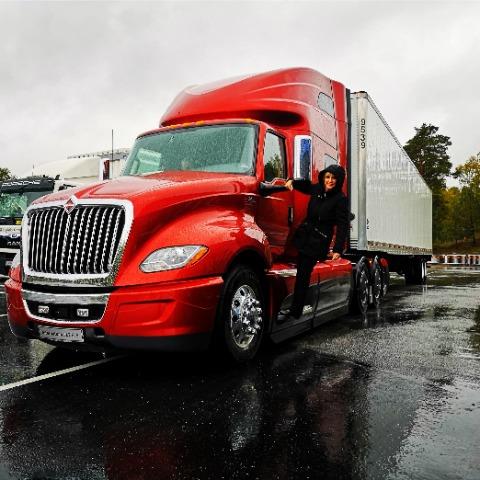
Daimler: your one-stop trucking shop!
Daimler Trucks & Buses Southern Africa has always been perceived to be a supplier of premium vehicles. And yes, this will continue in the future. However, as Michael Dietz, the company’s CEO, reveals in this exclusive interview, he wants to business the company as a one-stop trucking shop.



The product portfolio
On a global front, Daimler Trucks & Buses is massive! It employs around 100 000 people in 35 primary locations around the world, and it markets seven brands. Those are Mercedes-Benz (light, medium and heavy trucks as well as city, intercity and touring coaches), Setra (intercity, long-distance and premium coaches), Freightliner Trucks (trucks in weight classes 5 to 8), Western Star (heavy trucks for specialized and long-haul transport) and Thomas Built Buses (light- to medium-duty buses). Over in Asia, it has BharatBenz in India (trucks in the weight classes 9 to 55 t and medium- and heavy-duty buses) and Fuso, headquartered in Japan (trucks and buses).
Here in South Africa, we’re most familiar with Mercedes-Benz and Fuso, although we have seen a smattering of the other brands dip their toes in our market from time to time.
Irrespective of the brands that have been sold here in South Africa, there’s been one common theme with all products to emerge from the local Daimler stable: they’re premium products that carry an appropriate price-tag.

Growing the range
While Daimler has no intention of deviating from that course for products such as Mercedes-Benz, Dietz wants more. “We want to be positioned as a full line supplier and the message to transport operators is this: we can take care of all your requirements – from a workhorse to a high-end truck. I’m still talking about vehicles that boast top-notch quality and reliability. But we work with all kinds of customers with varying needs. Some want a workhorse; others want a high-end truck tractor. We want to be able to service all these segments of the market,” he says.
Naturally, this will entail extending the product range and – while exact product planning is always confidential – Dietz reveals that the Fuso range will grow. “We will launch additional variants for the FJ range. This product, which is very similar to the Axor, is getting excellent feedback from the market,” he reports. The Fuso trucks will still hail from India.

Newcomers to the FJ range will be joined by “lots of additional Arocs variants”. Already last month, alongside the launch of the new Actros, Daimler Trucks & Buses Southern Africa launched six new Arocs models, namely three freight carriers (the Arocs 3336/48, the Arocs 3340/48 and the Arocs 3352/45), an 8x4 tipper (the Arocs 4145K/51) and two all-wheel-drive off-road vehicles (the Arocs 1845AE/45 and the Arocs 3345AE/45).
“Initially introduced in 2019, the Arocs has set the benchmark in reliability, efficiency and safety within the distribution segment, while raising the bar in relation to reliability, robustness and bodybuilder friendliness within the construction segment,” notes Dietz.

What about Freightliner?
While the Actros and Arocs continue to enjoy widespread appeal, many South African transporters will reveal that another truck is right on top of their Christmas wish list, namely the Freightliner.
“It is an amazing truck and a fantastic brand. I have discovered that South African transport operators are passionate about the vehicle. Alas, the main hurdle is the fact that our American colleagues only produce bonneted versions of this vehicle. The North American Free Trade Agreement (Nafta) markets are focused on the bonneted trucks and, due to local legislation, bonneted trucks don’t work here. If there was a requirement from the Nafta region for a cabover truck, Freightliner could rethink that topic – and start producing right-hand trucks for our market. But, until then, I’m afraid Freightliner returning to South Africa is not on the cards,” says Dietz.
And the eCanter?
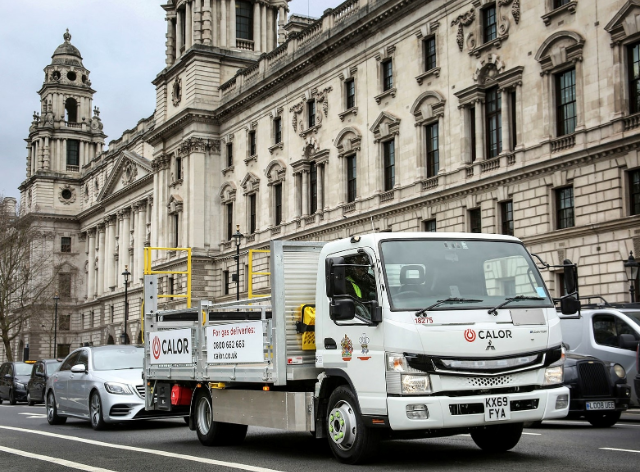
Earlier this year, SAB and AB InBev Africa tested Fuso’s 7.5 t eCanter etruck. We have driven the vehicle before and it’s quite astounding (it offers lots of instantaneous torque and it’s absolutely silent too, so drivers don’t get as fatigued). It is obviously also as green as a truck can get.
The first of its kind in the world, the eCanter has a range of about 100-120 kilometres per charge. The electric drive system carries a motor (maximum output: 135 kW; maximum torque: 390 Nm) and six high-voltage (370 V, 13.8 kWh) lithium-ion battery packs.
It has found favour in many countries – including Germany, Japan, Ireland, England and Portugal. Next stop South Africa? “We are in discussion with several customers; if they want the vehicle, we will certainly bring it to South Africa. We don’t envisage any homologation issues – so it could be launched here in a relatively short period of time,” reveals Dietz.
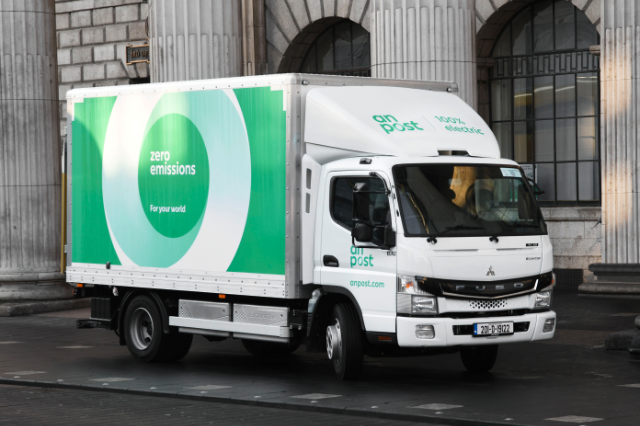
Because of the cost of the vehicle (it is roughly twice as expensive as a regular Canter), it is likely to be rented or leased to customers (as opposed to an outright sale). “With quick-charging stations, the vehicle only takes approximately 1.5 hours to fully recharge, but we envisage that customers using the truck here would charge it overnight. That’s ideal for the battery,” says Dietz.
So, there you have it. More premium Mercedes-Benz trucks. More Fuso workhorses. And even a zero-emission truck. It sounds as though Dietz is well on his way to achieving one-stop trucking shop status for Daimler Trucks & Buses Southern Africa.