The dawn of cameras in South Africa
Cameras first appeared on trucks in South Africa back in 2020 when the fifth-generation Mercedes-Benz Actros was launched. That Actros came with a system called MirrorCam, which continues to be offered on Daimler’s trucks today.

In 2022, the company launched the second generation of MirrorCam at the IAA Transportation exhibition in Hannover, Germany. It has much shorter arms (the camera arms on both sides were shortened by 10cm) – which makes reversing in a straight line easier. This is thanks to the fact that MirrorCam’s perspective is now even more akin to that of conventional mirrors. They’re also less likely to get damaged.
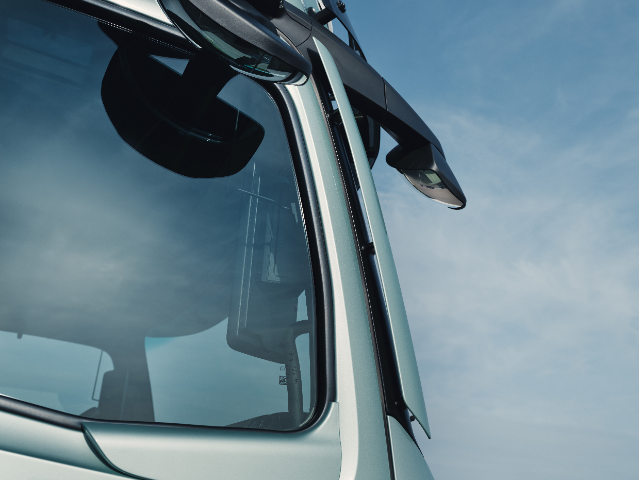
Since mirrors first started disappearing, many other companies have gone the same high-tech route. In 2021, for instance, MAN launched what it calls the OptiView mirror replacement system on its TGX, TGS, TGM and TGL trucks. DAF followed suit the next year.
In January this year, Volvo Trucks South Africa announced that its range of heavy-duty trucks – the Volvo FH, FM and FMX models – was being upgraded with new technologies and the latest in camera monitoring.
Why cameras count
So, cameras are now relatively widely used – which is all very well. But why is this significant? Is this just a piece of tech to up the “cool” ante? Or do cameras have other benefits too?

The cameras – although far more costly than regular mirrors – have numerous advantages. However, in general terms, they reduce fuel costs and improve safety.
Fuel costs are lowered because of an improvement in aerodynamics (as is commonly known, a truck's aerodynamics play a crucial role in its fuel efficiency and environmental impact). Camera monitor systems, by reducing air resistance compared to traditional side mirrors, can therefore significantly lower fuel and energy consumption.
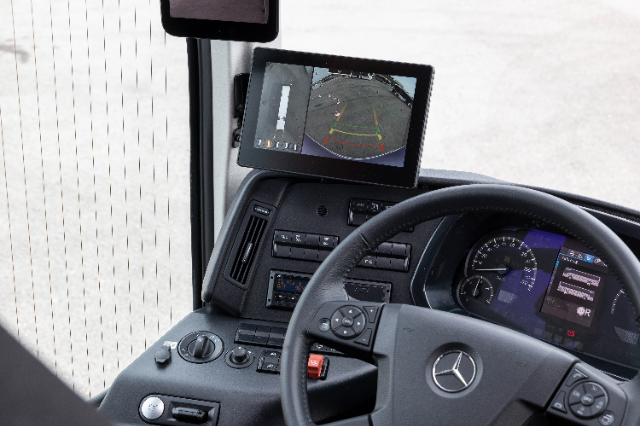
When Daimler first launched its cameras, we were told that MirrorCam alone contributed as much as 1.5% to the overall fuel savings of the new Actros. MAN’s figures are even more impressive; the MAN OptiView mirror replacement system, when combined with the MAN CruiseAssist driving assistant, promises additional fuel savings of up to 3.7%.

The experts at Volvo agree. “There are potential fuel economy savings over the vehicle’s lifetime that long-haul operators will appreciate,” says Hayder Wokil, Safety & ADAS (Advanced driver-assistance system) at Volvo Trucks. “It may translate into considerable cost reductions if you operate a long-haul fleet of several vehicles, but it will also save costs for an owner-operator.”
Safety is improved
When it comes to visibility and safety, cameras provide a distinct advantage. Unlike physical mirrors that can obstruct the driver's view, cameras offer unobstructed sightlines, which is especially beneficial in complex traffic scenarios or when vulnerable road users are nearby. Additionally, cameras can facilitate automatic or manual trailer tracking, aiding in manoeuvres such as reversing, a feature not possible with side mirrors. They can also provide built-in reference lines for lane changes, helping drivers navigate with precision.

Unlike traditional convex mirrors that may distort images, cameras offer clearer and more accurate representations, as image distortion can be corrected digitally. Moreover, camera monitor systems are terrific when it comes to security (the driver can see what’s going on outside without drawing back the curtains or leaving the truck).
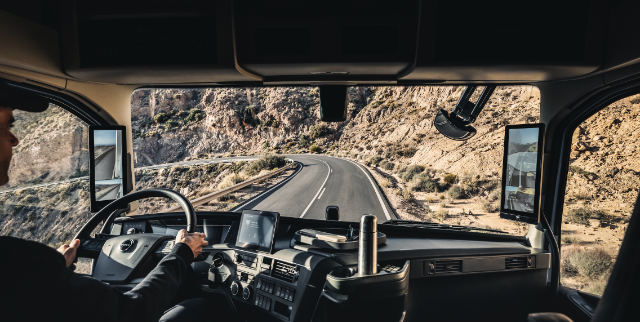
In adverse weather conditions or darkness, cameras maintain their effectiveness. Furthermore, cameras offer better visibility during rain, as the lens is shielded within the camera arm, and their ability to operate in low-light conditions enhances night vision, providing an added layer of safety.
Experts give cameras the thumbs-up
Experts around the world are unanimous in their praise of the cameras. “It really improves the driver experience,” says Volvo’s Wokil. “I’ve spent many hours test-driving the system, and it has considerably better direct vision, even when light or weather conditions are demanding.”
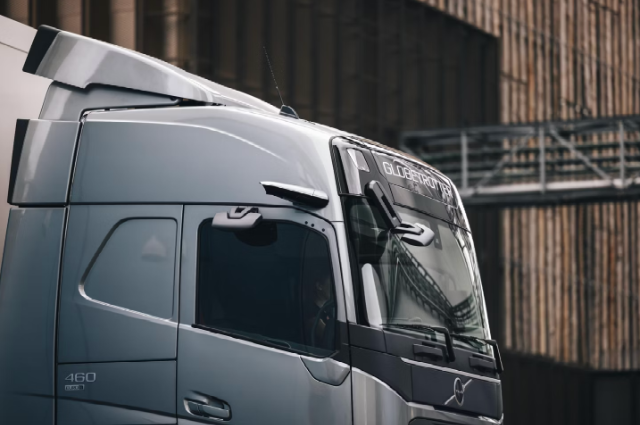
Wokil has test-driven trucks equipped with Volvo’s Camera Monitor System north of the Arctic Circle during winter, as well as going uphill and downhill in southern Spain in a +40° Centigrade heatwave. “The basis of our testing is always how our customers will use the solution, which can vary greatly even across the same customer segment. We have representation in roughly 180 markets worldwide, with different climates, operations, and truck usage cultural conditions. It’s quite a wide range of requirements to fulfil.”

Wokil concludes that cameras will benefit operators and drivers, especially in the long-haul sector.
“Mainly on the fuel economy, but the system will enhance safety, hopefully reduce accidents, give more uptime, improve visibility, aid in manoeuvring, and potentially impact insurance premiums and the driver experience,” he says. What a win!