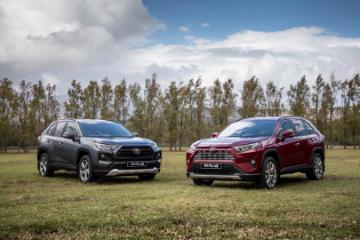
Toyota RAV4 2.5 Hybrid GX (2021) Review
The Toyota RAV4 needs no introduction: it's one of SA's favourite family vehicles and has proven its worth over and over again. 21 Days with the new RAV4 Hybrid has changed the way I look at cars - should you even consider another 'regular' car from the C-SUV segment ever again?


Half-electric, full-on value
Remember what it was like when fuel was more affordable? Your holiday budget would be so much less restricted, and there would be money for road trips and impulse buys, not just grudge purchases like fuel! Is a hybrid the answer, or is it still too darn expensive? We put the RAV4's hybrid's petrol-saving prowess to the test and came to a whole new conclusion.
Styling

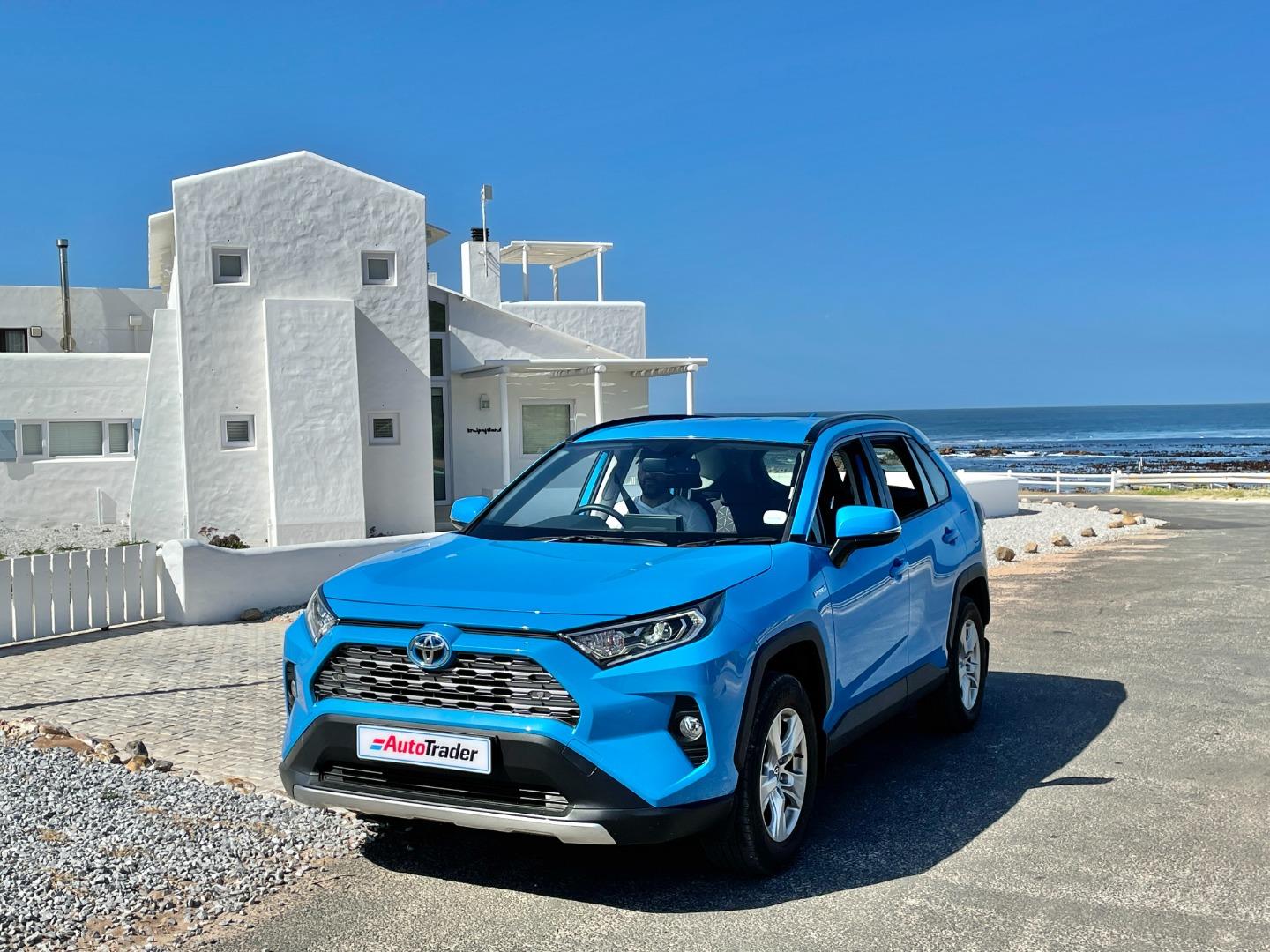
The December holidays were already in full swing when the boxy, yet chiselled RAV4 Hybrid in Caribbean Blue silently pulled up in my driveway. I've always admired the RAV4's design - it is stylish and attractive, but its fashion-forward design does not infringe on its functionality. The cabin’s square design means that all five passengers have an excellent vantage point (no need for an upward-sweeping beltline for a more sporty look) and rear headroom has not been impacted by a silly coupé roofline either. Roof rails, scuff plates and a rear spoiler add to the overall outdoorsy appeal. This is cleverly packaged, no-nonsense motoring that also manages to be sexy!

The RAV4 hybrid is visually differentiated from the rest of the lineup by its HYBRID lettering at the back and its blue-tinged Toyota badges in the front and rear, which blends in with the bright exterior colour. I was also grateful for properly-sidewalled 17-inch alloy wheels, instead of city-orientated low-profile tyres that tend to be both noisy and harsh on the spine. Besides, why bother buying an SUV if you don't plan on taking it off-road?
Interior

The RAV4's interior is an upmarket, fuss-free affair where practicality and good ergonomics trump trendiness. That's not to say that the RAV's cabin is boring, it's just sensible in its approach. The dashboard's elegant triple-layer effect offers a handy recess just above the cubby hole, while the semi-integrated touchscreen, placed at the perfect height, is quite straightforward to use. A deep, rubberized cubby underneath the air-conditioning controls prevents your smartphone from sliding around while you drive.

The RAV4 has built-in wifi, and everyone on board can connect to the system. Via the MyToyota App, you can top up data once the initial package runs out. The RAV4's 6-speaker infotainment system also comes with Apple CarPlay/Android Auto, as well as one USB port in front, two inside the large central armrest cubby (wide enough for arm-wrestling competitions), and two additional USB ports in the rear for second-row occupants. This delighted the kids and instantly raised the RAV4’s status among their friends who also tagged along on outings from time to time.

Space and comfort

My offspring, currently 14 and 12, are not each other's greatest fans at the moment and appreciated the amount of space between them on the rear bench. Fitting a third child or even an adult in-between is very doable as there is also legroom for days. The middle-rear seat has a three-point seatbelt and all the ISOFIX hooks are exposed, making it quick and frustration-free to fit a child seat (I asked a new mom about this and she confirmed). Other highlights include the dual-zone climate control and rear air vents, the tilt & telescopic, leather-covered steering wheel with satellite switches, as well as keyless entry and push-button engine start.

The seats are covered in patterned grey and black material that feels soft to the touch, yet durable, and also prevented many a scorched bottom after the car had been baking in the hot sun at the beach. And speaking of the beach, the RAV4’s boot is even bigger than it looks on paper - 580 litres! Two boogie boards, two skimboards, four folded picnic chairs, a large beach bag, towels, and a large cooler bag had no problem accompanying us on coastal day trips. Should you be a camping enthusiast, you’d easily squeeze in a compact tent, air mattresses and sleeping bags as well, if you pack wisely.

The drive

Driving a hybrid differs considerably from how you would pilot a ‘normal’ petrol or diesel car, but Toyota has perfected it in the petrol-electric RAV4. It’s a little-known fact that the RAV4 Hybrid’s 2.5-litre, A25A-FXS engine is shared with its Lexus relatives, like the swanky Lexus ES sedan and NX300h crossover.
If you have a relaxed driving style, a hybrid car will suit you well. Not only will you save on petrol by driving like time's on your side, but you’ll also gain electric power for future EV-use as you coast along. The RAV4 Hybrid isn’t a plug-in hybrid, so you can’t charge it from an external power source. Instead, the battery is charged while you drive, specifically when driving downhill with your foot off the accelerator pedal.

Should you need instant acceleration, the RAV4 is happy to oblige and the electric motor will give you that immediate burst of power without noise or complaints from the CVT gearbox (in the Corolla Cross hybrid it whines loudly when you put your foot down). The RAV4’s electric motor offers 88kW and 202Nm (when fully charged) and the internal combustion (petrol) engine generates 131 kW and 221 Nm. Together, these energy centres offer a highly responsive 160 kW for a 0 -100 km/h sprint time of only 8.4 seconds and swift overtaking manoeuvres. Drive Mode Select lets you choose between Sport, Normal, and Eco modes for spirited, regular, or more demure driving, and there is quite a considerable difference between the three: Eco mode reduces throttle response to limit harsh acceleration, while Power mode uses the hybrid battery to boost the petrol engine.
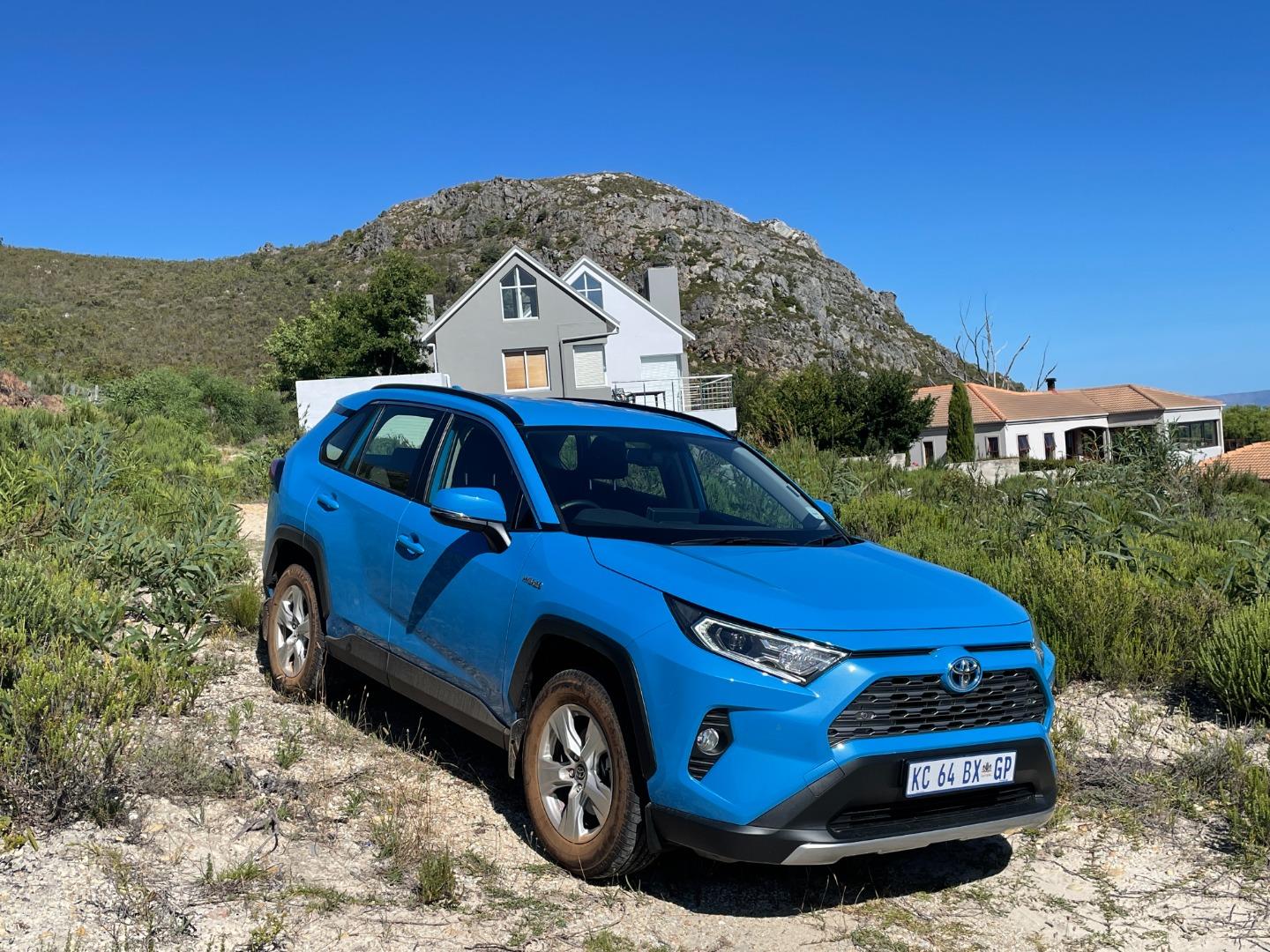
Petrol-electricity aside, the RAV4 has an easy, comfortable, sure-footed ride over dirt, gravel, and tar. To beat the N2 holiday traffic, I often took a detour through the mountains via the Viljoenshoop/Highlands farm roads that pass along boutique wineries like Iona, Paul Wallace, and Oneiric Wines. Recent heavy rains had caused the dirt and gravel sections to become quite rutted but the RAV4 just sailed smoothly over the potholes and corrugations. Its suspension (McPherson strut up front, double-wishbone in the rear) is well-balanced and the tyres grip well enough around corners, while no body-roll can be detected in the whisper-quiet cabin.
Safety

The RAV4 is fully specced with safety features such as ABS, EBD, brake assist and vehicle stability control, along with Park Distance Control in the front and rear (along with a rearview camera), Trailer Sway Control, Hill Assist Control and cruise control. Seven airbags protect occupants from harsh impact. The RAV4 has a five-star safety rating from EuroNCAP.
Fuel consumption

Here’s where we get to the nitty-gritty: One of the reasons you’re considering a hybrid is to save on expensive petrol, not so?
In order to ensure that I was driving optimally for conserving fuel, I kept my eye on the central info screen which shows you where the power is coming from at any given moment (if you choose that specific view - see image below). You also get a score for your driving at the end of your journey, which I guarantee you’ll try to better every time you go somewhere. Conservative driving is key, so that means no unnecessarily hard acceleration and then slamming on the brakes, which wastes energy from both sources. You also have to anticipate moves from other drivers and look far ahead so you can react as needed and start braking early if you need to come to a stop. What you’re also doing is saving your car’s tyres, brake pads, and many other wear-and-tear items by driving patiently and defensively.

It’s in traffic where owning a hybrid makes the most sense. Over December, Hermanus residents can hardly drive to the supermarket without getting caught up in bumper-to-bumper traffic. Our experiment from my house to the Gateway shopping centre, approximately 5 km away, yielded fuel consumption of 0.8 litres per 100 km, because I was driving in EV (full electric, emission-free) mode and under 40 km/per hour. (You should also bear in mind that you can only drive in EV mode if there’s been a fair share of coasting to charge the battery.)

Normal, mixed driving in the suburbs, highways, and in town raised our average to 6.2 litres per 100 km. That was our highest consumption figure in 3 weeks - a smidge higher than Toyota's official 4.7 litres per 100 km, but still excellent!
Pricing
Hybrids are expensive, right? Well, let me start by saying that the RAV4 2.5 Hybrid GX (R560 900) isn’t even the most expensive RAV4 in the line-up, in fact, it’s the third-most affordable model of the six RAV4s available, coming in at R40 100 less than the RAV4 2.0 VX model, which retails for R601 000. So, it’s not like you have to buy the expensive flagship model to get the benefit of the frugal-yet-powerful hybrid system.
The RAV4 Hybrid’s internal-combustion competitors include the Hyundai Tucson 2.0 Executive (R554 900) Kia Sportage 2.0 EX (R558 995), Honda CR-V 2.0 Comfort (R556 100), the Subaru Forester 2.0i-S ES (R564 000), and Opel Grandland X 1.6T Edition (R576 900).

Why not buy the more competitively-priced Toyota Corolla Cross 1.8 Hybrid at R413 000 then, you ask? For starters, the Cross is smaller inside and considerably less powerful, plus it's a lot noisier when you press the throttle hard. Those with small families seeking entry into the hybrid lifestyle can’t go wrong with the Corolla Cross, but buyers who need more sophistication, space, and pulling power will undoubtedly find the RAV4 hybrid model unbeatable.
Verdict

After spending around 21 days with the RAV4 hybrid and having to fill up only once before giving it back (I received the car with a full 55-litre tank), I was more reluctant than ever to hand back the keys. If you want your bread buttered on both sides, the RAV4 Hybrid is the one to get - I would choose it over any of its above-mentioned competitors, any day of the week. Apart from the silent 'whoosh' as the RAV4 pulls away, not having to spend megabucks on fuel is the real deal-sweetener.