
2019 Suzuki Vitara 1.6 GLX Review: Everything you need, with extra frosting
Since its local arrival at the end of 2015, the fourth-generation Suzuki Vitara has proven to be a popular choice among value-conscious buyers with a strongly practical slant. The reason is very simple: it offers lots of space, class-leading fuel efficiency, and low running costs, all wrapped up in a handsomely-styled bodyshell. Now, following its (very modest) mid-life facelift, the Vitara seems poised to continue its winning ways. But is this enough to face the challenge posed by newer rivals?


We all know that compact SUVs and crossovers are all the rage in today’s motoring landscape. In fact, this segment is one of very few to actually show incremental market share growth in a marketplace which is constrained by tough economic conditions and a lack of consumer confidence. Consequently, just about every mass-market manufacturer has at least one offering in this segment.
However, some manufacturers have a head start in this field, simply because they’ve been building such models for decades. In fact, Suzuki had a compact SUV in their range many years before the craze actually took off. First launched in 1988, their Vitara appealed to those who wanted real off-road ability along with some creature comforts, all wrapped in a package with sensible dimensions.

And so the Vitara trundled along through two more generations, growing progressively larger and more plush with each iteration, and gaining a “Grand” badge in front its name along the way. But, while the third-generation Grand Vitara is still a capable off-road machine, it’s eventually became rather geriatric and quite a bit larger and more expensive than its predecessors. Fortunately, Suzuki recognised that the market was moving away from the off-road trails and into suburban driveways, and they responded in the most appropriate way: they turned the Vitara into a smaller urban warrior.
All of which brings us to the latest Vitara line-up: still predominantly front-wheel driven (although on-demand all-wheel drive is still available), the current generation has recently received a mild facelift to address some of the criticisms levelled at the pre-facelift cars. It looks nicer inside and out, and features updated technology, but remains the same capable compact crossover underneath its subtly enhanced appearance. Are these changes enough to fend off increasingly appealing competition, though? Let’s find out.
Styling
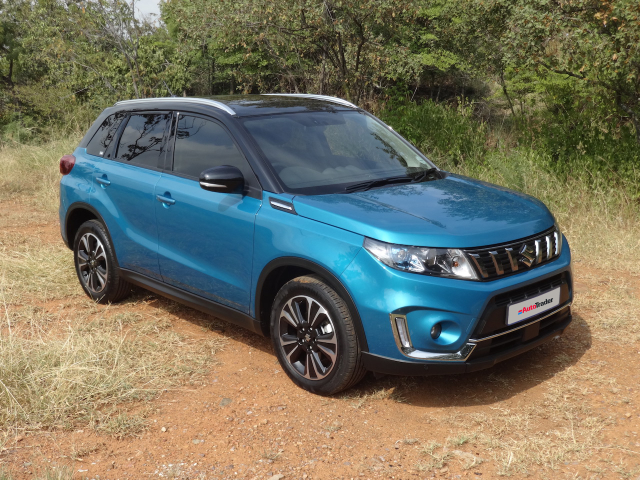
It will probably take a die-hard Suzuki enthusiast to tell the updated Vitara apart from the pre-facelift version. Absolutely nothing has changed to its sharp-edged and blocky bodyshell, with the revisions amounting mostly to detail variations (and new wheels, in our GLX-grade test car).

The front-end revisions are perhaps the most obvious, with a raised and re-profiled bumper featuring an enlarged central air intake, and upright DRLs mounted outboard of the fog lamp surrounds. Headlight clusters benefit from new clear lenses, and bracket a redesigned radiator grille with discreet vertical trim strips to add a 3-D touch to the Vitara’s rather blunt nose.

Apart from the new alloy wheel design and re-profiled side skirts, there’s nothing much to report as far as the facelift Vitara’s profile view is concerned. The revised nose section blends neatly into the established clamshell bonnet line, which leads into deep side glass and pronounced fender flares – just as it was before, then. The blacked-out roof pillars also remain, and serves to break the monotony which might otherwise have resulted from that square-cut, blocky greenhouse.

The rear end changes are no more dramatic than any of the others, with the most noticeable difference being new, LED-based tail lamp clusters. And... uhhh... that’s it, really. That said, it’s not like the outgoing Vitara was unattractive in any way, so maintaining the status quo isn’t necessarily a bad thing. For what it’s worth, there are still some Range Rover Evoque overtones to its front end, so the Vitara ends up looking a fair bit more posh than it actually is.

The Drive
Seeing as the Vitara has absolutely no sporting pretentions, it follows that the driving experience is more gentlemanly than spirited. That doesn’t mean that it’s dull to drive, though, because while the suspension is clearly tuned for comfort, there’s still enough composure to string together a series of bends surprisingly quickly.

In spite of its nose-heavy weight distribution, smooth-riding suspension and comparatively tall, skinny tyres, the Vitara valiantly resists the onset of understeer, and its overall handling balance is mostly neutral. While it’s unlikely that many buyers will ever explore those handling limits, it’s reassuring to know that the Vitara can negotiate corners far more capably than its square-cut appearance would suggest.
Instead, those buyers will likely appreciate the Vitara’s composed ride quality and generally muted noise levels far more than its potential cornering abilities. In spite of its lightweight construction, there’s adequate noise insulation for most driving conditions, and even with those 17-inch tyres, there’s enough ride compliance to filter out most road surface disturbances.
Performance
Our test car was equipped with the Vitara’s mainstay engine (a naturally-aspirated 1.6-litre 4-cylinder petrol mill) paired with a 6-speed torque converter automatic, with the power sent to the front wheels only. It’s not exactly a powerhouse combination, with 86 kW and 156 Nm on tap, especially because the autobox prioritises economy and smoothness over outright performance.
Fortunately, the Vitara also has a relatively low kerb weight of only 1120 kg in GLX trim (as tested), so the mild-mannered engine does a better job of providing motive power than you might expect. Suzuki claims a 0 – 100 km/h sprint in 12.5 seconds and a maximum speed of 180 km/h for this configuration, and on-road performance support these claims.
These modest performance figures are largely as a result of the gearbox programming, which tends to keep the engine speed low under most conditions, clashing with the engine’s slightly peaky power delivery (maximum torque only arrives at 4400 r/min). Push down on the accelerator pedal, and it will drop a cog or two to give reasonable overtaking performance, but this isn’t something a driver would necessarily want, as engine noise can become intrusive at higher revs. Alternatively, the steering wheel-mounted shift paddles could be used to override the gearbox’s own brain.
Complaining about the 1.6-litre Vitara’s relaxed performance is a moot point, though, as it can now also be had with a much more potent 1.4-litre BoosterJet (turbo) engine (as used in the new Swift Sport, and good for 103 kW and 220 Nm). We sampled a Vitara GLX with the new turbo mill at the Swift Sport’s launch event, and the added torque on offer transforms the Vitara into the refined, effortless machine it could actually be – for a price premium of only R 24 000 over the 1.6-litre GLX. If your budget can stretch that little bit further, the turbo Vitara is definitely the one to get.
Space and Comfort

The primary function of a compact SUV is to move around people and their things, within as small a footprint as possible. In this role, the Vitara still excels. Within an overall length of only 4.175 metres, Suzuki has managed to carve out enough space for a quartet of 6-footers, along with enough luggage capacity for all their chattel.

There’s plenty of head- and shoulder room all round, and rear-seat legroom only suffers when exceptionally tall people occupy the front seats. It’s easy to enter and exit as well, thanks to those big, square doors and raised roofline, and the stepover height is pleasingly low.
The luggage compartment is evenly shaped with a minimum capacity of 375 litres, and a large aperture which opens almost down to bumper level. In addition, there’s a false floor, underneath which smaller items can be hidden away, and the rear seats are split 60/40 to offer even greater loading versatility.

These attributes featured in the pre-facelift Vitara as well, of course, but the facelift added some much-appreciated refinement to the cabin’s fittings. Instead of the hard, scratchy plastics which featured so prominently on the dash top, there’s now a soft-touch coating (although the door cards are still made of the hard stuff). And, while the GLX variants’ seats are still trimmed with an Alcantara/synthetic leather combination, the stitching pattern is different and the upholstery material is hardier.
Most significantly, the infotainment system has been upgraded to a use a new touchscreen interface, similar to the one in the new Jimny, which also doubles as a display unit for the new rear-view camera. This new infotainment setup features full smartphone integration, with Apple CarPlay and Android Auto being integrated along with the USB- and Bluetooth compatibility of the old system.
In GLX (and mid-level GL+) trim, the Vitara also benefits from parking sensors both front and rear, and there are steering wheel-mounted remote buttons for the cruise control, phone, and audio system. The display unit in the instrument cluster also gets upgraded to a high-resolution colour screen, with much nicer graphics and more available information than on the old monochrome version.

Standard equipment is quite comprehensive as well, with automatic climate control, cruise control, and all-round electric windows all featuring on the spec sheet. GLX-specific items include a sliding panoramic sunroof (only for 1.6-litre cars), keyless entry and an engine start push-button, and different dashboard decorations. All in all, everything you’d expect from a compact SUV in this price class is present and accounted for.
Safety
As sold in South Africa, the Vitara comes with very good safety credentials. The usual electronic safeguards are all present, with ABS and traction- and stability control being standard across the range. In addition, there are ISOFIX child seat anchors on the outer rear seats, and 7 airbags fitted to all Vitaras.
In this specification, it was awarded a 5-star crash safety rating by Euro-NCAP, scoring particularly well in the adult- and child occupant criteria. This result is quite remarkable, considering that the Vitara isn’t exactly as heavy as a tank, but also expected, given the large degree to which high-strength steel is used in its body construction.

In GLX trim, the headlights are upgraded to very effective LED units, which provided an excellent beam spread and reach in night driving. Lighting is an important component of driving safety, and the confidence imbued by those LED headlights alone are almost worth the price premium of upgrading to a GLX.
Fuel Consumption
Fuel efficiency is a hallmark of Suzuki’s local model range, and the Vitara doesn’t disappoint on this front, either. Suzuki claims an average consumption figure of 6.0 litres/100 km for the Vitara GLX automatic, and while we didn’t quite match that claim during the road test, our final average consumption of 6.4 litres/100 km was highly commendable in its own right.
This was achieved in a drive cycle which entailed about 60% of town driving and the rest on open freeways, without any particular effort to save fuel, and with the air conditioning running flat-out to counteract an unseasonable hot spell. Pretty remarkable, really, especially considering the Vitara’s tall, boxy shape.
Price
This is a tricky one. The 1.6-litre Vitara has a decent price-to-features ratio, and is nice to drive, user-friendly and practical. This round of updates brings it up to date in terms of the available technology, and the interior trimmings gets closer to class parity as well.
But, with a list price of R 373 900 in GLX automatic trim, there are a number of noteworthy opponents around the same price point, including some alternatives from within inside its own family. Other threats (if you insist on petrol power, FWD and an automatic gearbox) include a mid-level Nissan Qashqai (which has a bigger boot and more torque) or Mazda CX-3 (which is nowhere near as practical or spacious but is nicer inside and has more power).
The Verdict
While the Vitara 1.6 GLX automatic is a strong contender in its market segment, it doesn’t really hit the sweet spot in its model range. This isn’t due to any deficiencies of its own, but because there are other options in the Vitara range which offer a better overall proposition. The mid-level 1.6 GL+ derivative offers most of the goodness of the GLX, but at a saving of R 28 000, and in a budget-minded shopping environment, that could be a significant consideration.
But the real star in the Vitara range is the range-topping 1.4T GLX automatic. If you can afford to add the frills and frosting by upgrading to GLX trim, you might as well spring for the full-fat turbocharged version. If you do, you’ll get a Vitara with the engine it really deserves and which takes it up to the top of its class, all for less than R 400 000.
Think of it this way: if you’re prepared to put up with the relaxed performance and refinement penalty of this lower-powered derivative, the 1.6-litre GLX does the job just fine (and provides the least expensive way to get those LED headlights). If you don’t want to spend too much, just get the GL+, but for the best possible Vitara experience, get the 1.4T.
In such strong company, it becomes slightly difficult to make a case for the 1.6-litre GLX variant. Capable and virtuous as it is, the 1.6 GLX’s strongest suit is that its pricing splits the difference between the GL+ you can afford and the turbo one you want.
Expert rating:
3.5/5
Pricing is accurate at the time of writing, but may change without prior notice.
Related Reading:
All the details about the Vitara's 2019 facelift can be found here.
See how the Vitara compares to other compact SUVs in the practicality stakes.
Here's what we thought of the Vitara 1.6 GL+ at its initial launch.
It impressed us on test as well...
... but so did the Mazda CX-3.
Our review of the Nissan Qashqai explains why it's still a top pick in its class.
This launch report will tell you everything you need to know about the new Suzuki Swift Sport.
For more information about Euro-NCAP crash testing, visit their website.
