
Suzuki Swift Sport loses weight and adds muscle
“Fizzy” is probably the best single word to describe the first two generations of Suzuki’s Swift Sport. Rather than chasing bland performance figures, this baby warm hatch instead relied on balanced handling, sharp steering, light weight and a high-revving engine to deliver its thrills. The latest generation Swift Sport aims to broaden this appeal, and adds a generous dose of extra muscle to keep up with the times. But does it still have the ability to make a keen driver giggle uncontrollably?


First Drive Impression
Let’s make one point perfectly clear from the outset: I’m an inveterate fanboy of the previous-generation Swift Sport. Yes, it had some drawbacks, such as a noisy cabin and limited practicality, but the sheer joyfulness of its character more than compensated for those ailments.
It was a little car with a big personality, which shone through in its darting steering responses and enthusiast-friendly driving dynamics, firm but well-damped ride quality, slick-shifting manual gearbox, and rorty, high-revving naturally-aspirated engine. Putting it simply, the old Swift Sport was huge fun to drive, even if it wasn’t the quickest thing around. Its immersive driving experience turned a trip to the shops into an adventure, while any sequence of corners became an impromptu gymkhana course. It made me remember why I love cars and driving, really.
What’s new with this one?
Philosophically, the new Swift Sport follows in the footsteps of its ancestors, because it starts off with the basic Swift underpinnings, and then, through a host of alterations, steps up the pace to become a lot more interesting than its more mundane siblings. Fortunately, the “normal” Swift is a thoroughly-developed base platform, with a body construction that’s both stronger and lighter than its predecessor – part of the reason why the Swift 1.2 emerged as a category winner in the 2019 AutoTrader SA Car of the Year competition.
This carries through into the new Sport as well, which has shed an amazing 90 kilograms in its latest iteration. Compared to the basic Swift, the new Sport benefits from a number of mechanical and cosmetic upgrades, and receives a much nicer cabin and higher specification level as well.

Swift Sport Performance
Starting out with a reduced kerb weight has obvious benefits for straight-line performance and handling alike, and the new Sport fully capitalizes on these benefits. Moreover, the new BoosterJet (turbocharged, direct injection) 1.4-litre engine might be smaller in displacement compared to the old Sport’s non-turbo 1.6-litre engine, but it gets quite a few more ponies in the corral.
The increase in peak power isn’t massive, and only goes up by 3 kW for a new total of 103 kW, but there’s a healthy jump of 70 Nm in its torque output, giving a new peak of 230 Nm. More significantly, that torque peak is available much earlier in the rev range, and comes on song from only 2500 r/min. Maximum power is also available at a much lower engine speed than before, with the power curve now hitting its peak at only 5500 r/min.
This combination of reduced weight and more torque does wonders for the new Swift Sport’s accelerative abilities, and results in a claimed 0 – 100 km/h sprint in 8.0 seconds, but it also eliminates the old car’s rev-happy nature. Instead of a rev limiter on the far side of 7000 r/min, the new engine stops the fun at only 6000 r/min.
In short, the new engine’s power delivery has taken away any real incentive to stir that slick-shifting 6-speed manual gearbox’s cogs to goad the engine into action: just floor the accelerator pedal in any gear, and the car accelerates without showing any sign of actually working hard. The current generation of hot-hatch buyers, who were raised on a diet of turbo-boosted torque, will prefer this to the old car’s high-revving antics, but it does remove a certain amount of the old car’s charm.
Speaking from an old-school perspective, I loved the old Sport’s frenetic character and screaming engine, because it forced me to engage in the process of making it go fast. In contrast, the new Sport’s added refinement and torque almost makes it feel a bit too grown-up for my taste, and too easy to access the power.
I’m sure that this is a minority viewpoint, however, and that the new car’s more-modern power delivery will appeal to a much broader swathe of prospective buyers. Seen in this context, the newly-available optional torque converter automatic gearbox (also a 6-speed unit, with steering wheel-mounted shift paddles) will likely find plenty of fans among traffic-bound buyers, even if it’s nowhere near as enjoyable to use as the lovely short-throw manual shifter.

The chassis is a revelation
As we’ve come to expect from the Swift Sport, the new car’s chassis is superbly resolved. All of the old model’s strong suits are present and/or amplified, with steering that’s eager to respond, neutral handling characteristics, and a strong resistance to understeer. If ever a car could lay claim to “go-kart-like handling”, this is it. It’s really easy to toss about on a racetrack, and extremely forgiving of driver errors. Just like the old Sport, then, but incrementally better all round, and still a joy to drive with enthusiasm.
The upgraded brakes are also powerful and fade-resistant, even when worked very hard during the launch event at the Red Star Raceway near Delmas. In fact, the chassis development as a whole manages to strike a very rare balance between agility and compliance, and will flatter an inexperienced driver as much as it would reward and entertain a professional. As before, the Swift Sport is tremendous fun to drive, but it now comes with a wider spread of capabilities.

It looks very sporty
Far more than just a light restyle, the Sport actually has a significantly different appearance to its tamer siblings. The front bumper is reshaped, and features enlarged air intakes with a honeycomb finish and a carbon-look chin spoiler. All the front lighting elements are LED-based, including the fog lamps and daytime running lights. The combined effect adds just enough attitude to a set the Sport apart from the normal Swift’s rather cuddly appearance, while still managing to look approachable and friendly.
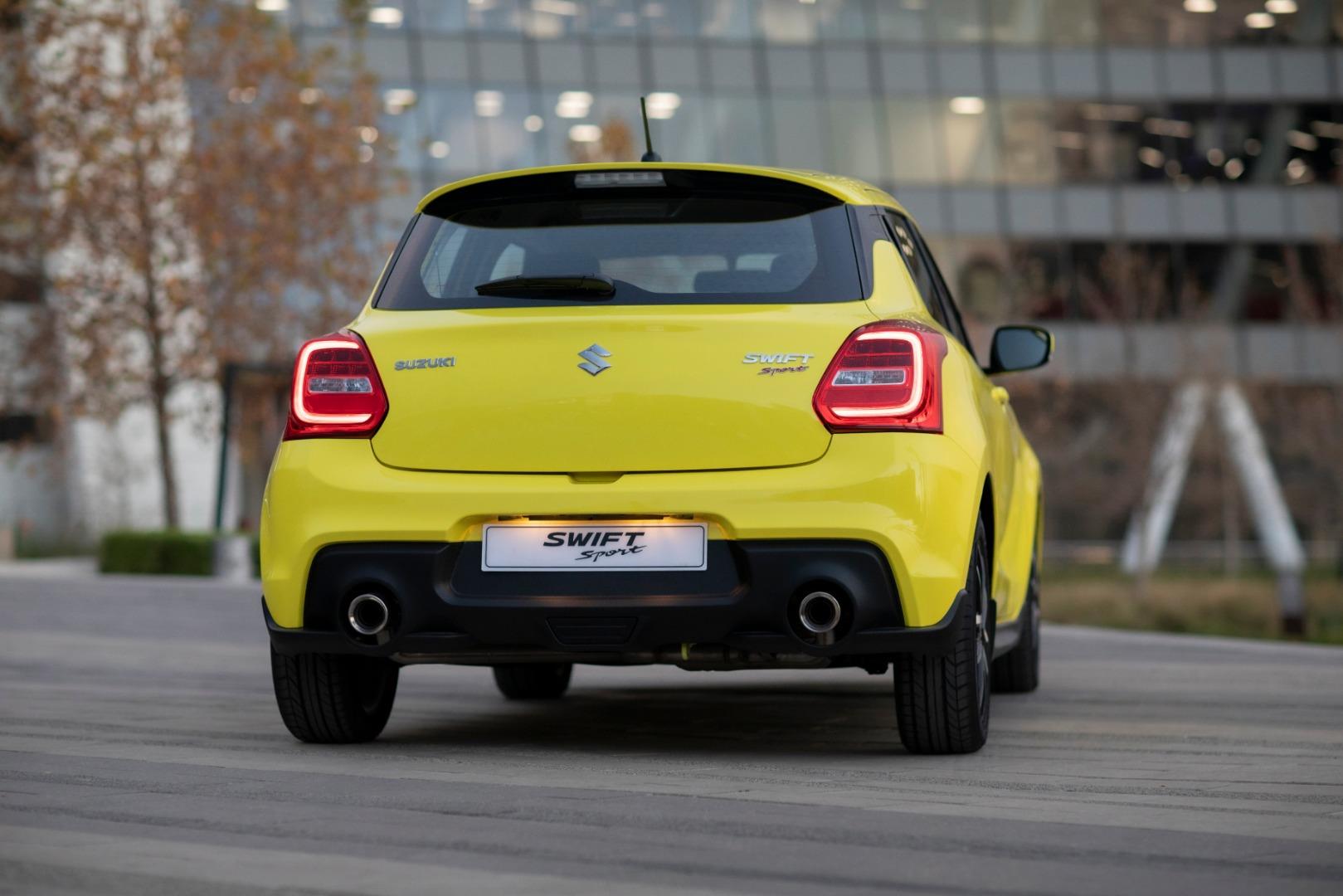
It’s much the same story down the flanks, where diamond-cut 16-inch alloy wheels bracket carbon-look side skirts, while the rear end receives dual exhaust outlets (one on each side), a carbon-look diffuser, and a more prominent spoiler atop the tailgate. The tail light clusters also benefit from an upgrade to full-LED operation. Lastly, in a subtle nostalgic nod, the “Sport” script on the tailgate is almost identical to the old car’s.


Full-house equipment levels
Opening the door and settling into the driver’s seat reveals a very spruced-up Swift cabin. In contrast to the normal cars’ flattish seats, there are two “tombstone” style bucket seats in front, with firm bolsters to support torsos and buttocks during hard cornering. Red detailing abounds, and includes red stitching on the gear lever boot, flat-bottomed leather-trimmed steering wheel, and seat upholstery. Aluminium pedals add an extra racy touch.
The instrument cluster is also much upgraded, with a red rev counter face and a Sport-specific colour information display between the tachometer and speedo. This display can show all manner of sporty-driving-related information, such as boost pressure, oil temperature, and even a G-force meter.
Being the top-line Swift, it also receives the full house of comfort- and convenience items, such as keyless entry with an engine start/stop button, automatic climate control, cruise control, automatic headlights and wipers, and a colour touchscreen infotainment display with Android Auto and Apple CarPlay. This also applies to safety equipment, with 6 airbags, stability- and traction control, and ISOFIX rear child seat anchors.


Swift Sport Pricing
Two variants of Swift Sport are available, with identical trim levels. The only difference lies in the gearbox, with the manual transmission costing R315 900, and the automatic carrying a pricetag of R335 900. Included in these prices are a warranty for 5 years or 200 000 km, and a service plan for 4 years or 60 000 km.
These prices effectively places the new Swift Sport in a class of its own, with more-powerful junior hot hatches such as the Volkswagen Polo GTI nearing the R400 000 mark, and the heavier (and thus slower and thirstier) Opel Corsa GSi carrying a R50 000 price premium. Seen in this light, the value proposition looks pretty solid for the hottest Swift.
Verdict
There’s a lot to love about the new Suzuki Swift Sport. It still handles like a proper little racer, making it huge fun to throw around with enthusiasm, and it certainly looks the part. The new engine (and addition of the optional automatic variant) makes its performance easier to exploit than before, and it’s undoubtedly quicker under all conditions as a result. It’s well-specced for the price level, and buyers can also be sure that it will be a proper fuel-saver, in typical Suzuki fashion. The only possible qualm lies in the engine’s character: while it does the job just fine, it rather lacks the charisma of its predecessor’s powerplant. That’s probably the price of progress, though...
Related reading:
The old Swift Sport was an enjoyable range-topper as well. This video explains why.
In basic 1.2 GL form, the new Swift is a capable all-rounder.
Here's a nice round-up of the Swift's history through the years.
Read more about the 2019 AutoTrader SA Car of the Year.
Here's our review on the much more expensive Polo GTI.
Read more about the Swift Sport's only real opponent, the Opel Corsa GSi, here.