Suzuki Baleno 1.4 GLX (2021) Review – Where virtue and value meet
Practicality, excellent efficiency, and a comprehensive specification sheet find a near-perfect balance in the latest Suzuki Baleno. And, on top of these virtues, you should also add superb value for money – making this model’s comparatively slow local sales even more of a mystery. We spent a month with one, to try and determine why this hugely sensible car flies so far below most buyers’ radar.



Given South African buyers’ preference for inexpensive compact hatchbacks, it’s quite puzzling that the Suzuki Baleno failed to make much of an impression in our market since its local arrival late in 2016. And, with the Baleno’s Toyota-branded but otherwise identical twin (the Starlet) proving to be a major sales success, buyers’ appetite for a spacious, economical and affordable compact hatchback is very apparent. Will the Baleno’s most-recent update, introduced at the end of 2020, change the status quo for this underrated model?
Related: Shop for new and used Suzuki Baleno cars for sale here.
Styling
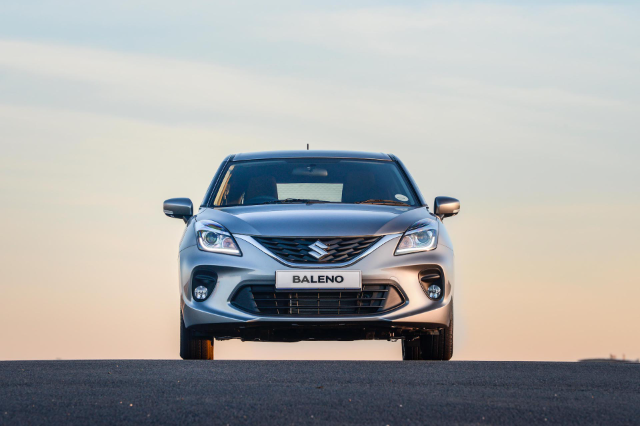
“Form follows function” was clearly the overriding philosophy when the Baleno was styled. This observation isn’t meant to be negative at all, mind you, but merely illustrates the focus on practicality that permeates every aspect of the Baleno’s design. In profile and footprint, it’s a generic 5-door supermini, although its slightly elevated roofline and bulbous trunk area does lend the Baleno some visual distinction.
In front, there’s the revised grille and bumper assembly that was introduced in 2019, giving the latest Baleno a more assertive appearance than its slightly puffy-cheeked predecessor. Apart from a new alloy wheel design and some added chrome trim on the exterior, the visual differences between the current Baleno and the pre-facelift model are very slight indeed.

Performance
Motive power is provided by Suzuki’s proven K14B engine: a 1.4-litre, non-turbo 4-cylinder that delivers 68 kW and 130 Nm to the front wheels through a 5-speed manual gearbox. With a kerb weight of only 915 kg, these modest outputs are however enough for class-competitive performance, if not exactly scorching acceleration.
According to the official figures, a manual-transmission Baleno should reach 100 km/h in 10.9 seconds and run on to a top speed of 175 km/h, and on-road performance subjectively supports that claimed acceleration time. Thanks to the small engine’s wide torque spread and well-chosen gear ratios, it feels pretty nippy in town, and freeway cruising sees enough power in reserve to enable safe overtaking – provided the driver is willing to stir the engine into action with the slick-shifting gear lever.
The Drive
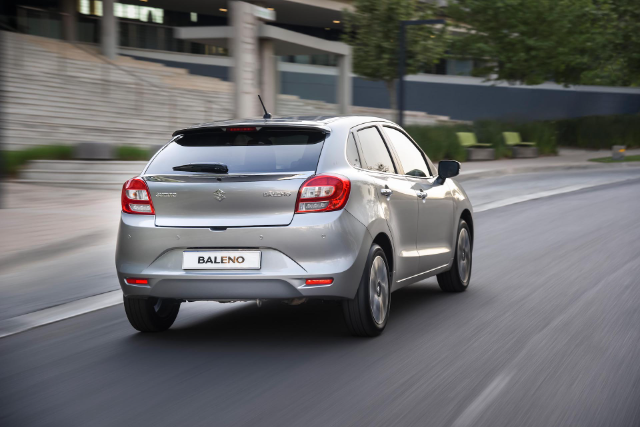
As befits a car in this market segment, the Baleno is very easy to drive. The throttle mapping strikes a nice balance between response and smoothness, the clutch has a light action and smooth drive take-up, and the brakes are reasonably powerful yet progressive. The same applies to the steering, which is low on effort and linear in action, even though it’s not very communicative in enthusiastic driving.

Finally, the 185/55R16 tyres fitted to our test car provided more than enough road grip for the performance on offer, leading to a handling balance that stays neutral up to fairly high limits, before transitioning to gentle understeer on the ragged edge. Most buyers won’t ever explore its dynamic prowess, but it’s good to know that the Baleno has some cornering power in reserve, should road conditions suddenly turn unfavourable.
The sole bugbear is something we’ve noticed in most Indian-market Suzukis, and most likely results from an alignment anomaly created by the Baleno’s slightly elevated, long-travel suspension arrangement. While directional stability on the freeway is good, the steering has a curious dead spot around the straight-ahead position, leading to a “disconnected” feel for the first few degrees of steering wheel rotation.
Space and Comfort
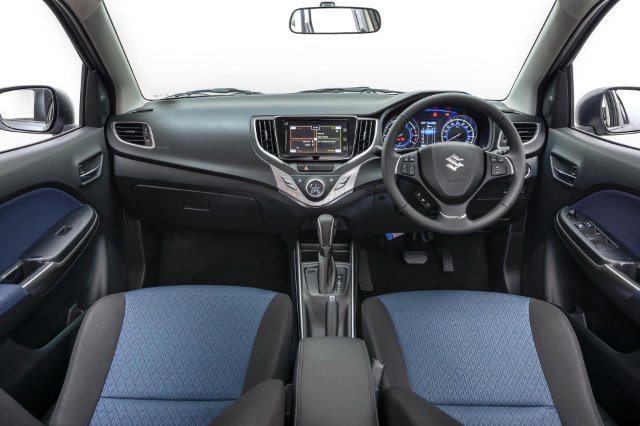
This is a major Baleno selling point, because the cabin- and boot volumes appear disproportionately generous for a car of this size. Front and rear leg- and headroom are both class-leading, and the cabin is wide enough to seat three average-sized adults on the rear bench. Front seat occupants also have no cause for complaint, although long-legged drivers might appreciate an extra few centimeters of rearward seat travel.

The luggage compartment is just as voluminous, and offers a very spacious 355 litres under a removable cover. An easy split-folding action for the rear seatback allows utility space to extend to as much as 1 085 litres, and there’s a neat adjustable floorboard in the boot to further increase cargo space or hide smaller items away from the main luggage area.
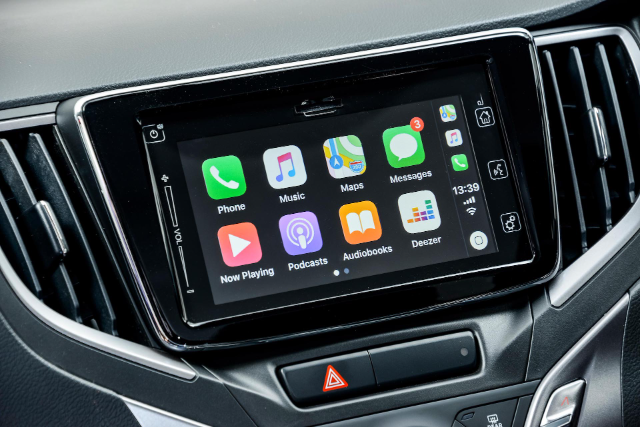
In the GLX trim as applied to our test car, the Baleno’s standard equipment is extremely comprehensive, especially considering its price point. Highlights include LED headlights, keyless entry with pushbutton start, electric windows all round, automatic climate control, cruise control, rear parking sensors, a rear-view camera, leather trim for the steering wheel, and a 7-inch colour touchscreen infotainment system with USB/Bluetooth compatibility and smartphone mirroring.
Safety
To a large degree, the latest Baleno update had safety as its main focal point. While its looks and basic trim hasn’t changed much since the 2019 facelift (when the Baleno GLX’s airbag count improved from 2 to 6), the 2020 update’s main selling point is the addition of stability control across the model range.
Crash safety is another strong suit, with the 6-airbagged Baleno scoring 4 stars in Euro NCAP testing in 2016 (albeit with the optional fitment of an automatic emergency braking system that doesn’t feature on local Balenos). Rear ISOFIX child seat anchors and ABS round out a nicely-judged safety specification for its market segment.

Fuel Consumption
Its extremely trim kerb weight not only boosts performance, but also plays a significant role in the Baleno’s superb fuel efficiency. Suzuki claims an average consumption of 5.1 ℓ/100 km, and there’s little doubt that conservative drivers will achieve that figure in the real world.
Over the review period (which coincided with a severe mid-summer heatwave, plenty of congested traffic and no particular regard for saving fuel), we returned a test average of 5.7 ℓ/100 km – roughly in line with the kind of fuel efficiency we’ve come to expect from Suzuki, and about on par with many smaller Suzuki models.

Price and Warranty
At its current list price of R 259 900, the Suzuki Baleno 1.4 GLX manual is a fair bit less expensive than most of its competitors, and its pricing actually competes with a cluster of budget-oriented smaller cars. When you factor in the very generous standard features list, a warranty for 5 years or 200 000 km, and a standard service plan for 4 years or 60 000 km, the top-spec Baleno becomes an extremely attractive proposition for value-conscious buyers.
* Pricing includes all taxes and was accurate at the time of publication, but is subject to change.

Verdict
Cars in this class aren’t meant to set their owners’ heart aflutter, but should provide comfortable, effortless, and economical motoring for a broad spectrum of customers. The Suzuki Baleno certainly delivers on these attributes, and sweetens the deal with excellent packaging (space utilisation) and very good build quality.
In reality, there’s very little to choose between a Baleno and the Toyota Starlet, apart from the Suzuki’s superior aftersales package (a stronger warranty and service plan), which simply reinforces the brilliant package that the Baleno has always offered. It really deserves more attention in the marketplace, so here’s hoping that some of the Starlet’s popularity will reflect back on its Suzuki-badged sister.