Renault Duster 1.3T Intens Review - a familiar friend, reimagined.
The new Renault Duster has grown up; a new platform, turbo power, and a sharper edge. It’s better in almost every way, but also pricier and facing fiercer competition than ever before. Still likeable, just no longer the obvious choice.



I recall when the first Duster was launched in South Africa. I had mixed feelings about this new model, knowing that it was simply a rebadged Dacia, and my experience with a Dacia Elan was enough to set off several, rather loud, alarm bells. I was more than happy to be proven wrong by this honest, no frills-no fuss SUV that never pretended to be anything that it wasn't. Over the years I would get the opportunity to drive various iterations and
While the interior appeared to rely heavily on plastic trims, the years were kind to it, and the Duster weathered well. The frugal 1.5 dCi engine was a hit, offering amazing fuel consumption and endearing durability. The second-generation Duster looked similar and was based on the same platform as the first, but the latest, third generation elevates the Duster to brand new heights. With a new platform, complete redesign, and a fresh new interior, the Duster means business. But does it still hold the same appeal?

Fast Facts
Category | Specification |
Price (R) | R519 999 |
Engine | 1.3-litre 4-cylinder turbo petrol |
Power | 113 kW |
Torque | 250 Nm |
Top Speed | NA |
Transmission | 7-speed EDC |
Drive | Front-wheel drive |
Fuel Economy | 6.5 L/100 km (claimed) |
Maintenance Plan | 5 years / 150 000 km |
Rivals | Volkswagen T-Cross, Kia Seltos, Jaecoo J7 |

Styling
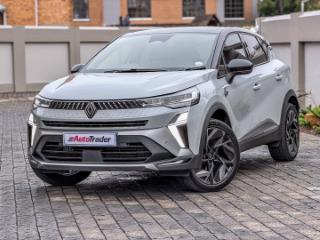
The softer styling of the previous generations has made way for a more muscular, angular appearance that is completely intentional. The design team wanted to start with the right proportions, maintain the Duster's simplicity, and preserve an unmistakable identity. The front gets a large, wide grille, flanked by LED headlights with the familiar Y-shaped LED DRLs. Gone is the diamond-shaped Renault badge, and in its place, the name Renault is spelt out in block letters.
Pronounced, unpainted cladding down the sills and over the wheel arches still implies that the Duster is ready for the bush, while the large, gunmetal grey front bumper mimics that of an off-road-ready bush bar. This is all less noticeable on the darker colours on offer, but provides an attractive contrast when opting for one of the lighter hues. The Intens trim sees the Duster fitted with a set of 18-inch wheels, considerably larger than we were accustomed to seeing on the previous model. The entry-level Zen trim makes do with 17-inch alloys.

Interior and Technology
The Duster was never known for its luxury appointments or its opulent trim. In fact, the first Duster was often criticised for having an interior that relied too heavily on hard plastics, with concerns over how these would age as the mileage piled up. Many were surprised to see how well it fared over the years. The new Duster follows this approach, and I was not expecting leather and Alcantara trims. The hard plastics that one finds in the interior are still pleasant and inoffensive. The fabric seats are relatively comfortable, but some will find them fairly narrow and lacking in leg support.
The Intens trim is fitted with a 7-inch digital driver display with a basic, no-frills display of critical driving information. The infotainment is a 10.1-inch touchscreen unit with Android Auto and Apple CarPlay for smartphone mirroring, and the lower section of this screen offers your HVAC display. Physical controls for the climate control remain a tactile experience with a row of toggles nestled neatly below the screen. Wireless charging and USB-C ports ensure that your devices stay charged.

Performance
The big talk about the new Duster was the absence of a diesel engine from the lineup. Renault elected to forgo the diesel option in favour of a hybrid drive system for the range-topping variant. Our test unit was not one of these, but I still found the new 1.3-litre turbocharged engine to be sprightly and well-suited to residential and highway applications. This unit produces 113 kW of power and 250 Nm of torque, sending power to the front wheels through a 7-speed dual-clutch (EDC) gearbox.
Vehicle | Power (kW) | Torque (Nm) | Price (R) |
Volkswagen T-Cross 1.0TSI | 85 | 200 | R511,300 |
Kia Seltos 1.5 EX | 84 | 144 | R532,995 |
Jaecoo J7 1.6T Vortex | 145 | 290 | R519,900 |

Driving Impression
The Duster was more than agreeable through the tight city streets of Cape Town and as comfortable on the highway. The urgency with which the engine delivers power is enjoyable, and the calibration of the gearbox and throttle, a pain point of many of its Asian counterparts, is more than acceptable. Joining and keeping up with highway traffic isn't any trouble, and on the open road, the Duster shows solid, surefooted manners that make long-distance drives a pleasure.
It offers generous space in the cabin, multiple storage compartments, and the 472-litre boot is amongst the largest in its class.

Fuel Consumption
Renault claims a combined cycle fuel consumption figure of 6.5 l/100km in the 1.3T Intens, and in my time with the Duster, I was able to achieve 6.4 l/100km with fairly mixed use. This was achieved without even trying to hypermile. Renault has always been one that reports accurately on their claimed consumption figures - this only cements this.
With the 50-litre fuel tank, one can expect a total range of 769 km from the Duster 1.3T Intens.

Safety
You get no fewer than 6 airbags in the Renault Duster 1.3T Intens. This complements the standard ABS, EBD, and stability control. Intens trims get additional features such as Blind Spot Detection, a multiview/360-degree camera, 360-degree sensors, and Auto headlights and wipers.
Euro NCAP scored the Dacia Duster at 3 stars with scores of 70, 84, 60, and 57% for Adult, Child, Vulnerable Road Users, and Safety Assist Systems, respectively.

Pricing
At R519,999, the Renault Duster no longer presents the same value for money that it once did, especially when once considers what is on offer in this hotly-contested segment of the market. Customers will undoubtedly be lured into the Chinese showrooms by the impressive spec lists, but the Renault does the job it's designed to do rather well.
Verdict
It's an agreeable companion that makes driving rather effortless and enjoyable. There isn't much theatre to proceedings, but nothing that will drive you over the edge either. It feels familiar and welcoming, and for me, that's a good sign. There's nothing that particularly rubs you up the wrong way or anything that you will feel you will need to "learn to live with".
Yes, it would be brilliant with a small diesel engine, especially for those extended adventures, but that could also be nostalgia speaking - I was particularly fond of the 1.5dCi engine in the previous generation. This new Duster keeps the flag held high, but I fear that the competition is just too tough for us to see as many of this new version, as we did the old.