
Mercedes-Benz G400d (2021) Review – Hand-built and extremely cool
Evolving from a military-focussed all-terrain vehicle to a civilian off-roader and eventually into a toy for the rich and famous, the Mercedes-Benz G-Class has dramatically changed its market profile over its 42-year lifespan. But, even though it has become a plush status symbol, the Geländewagen still adheres to its core values.



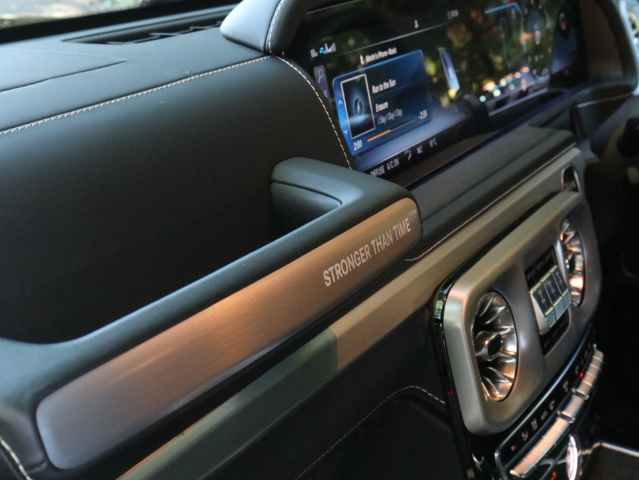
The badges on its fenders and dashboard proclaim that it’s “Stronger Than Time” – a cute piece of marketing-speak that happens to be absolutely truthful. In fact, Mercedes is so proud of their top-tier SUV’s heritage that they styled the latest, all-new G-Class to look almost exactly like its ancestors. And, while its execution is a lot more upmarket than the bare-bones original, it’s still a proper go-anywhere beast, just like the one that first appeared in 1979.
Related: Shop for new and used Mercedes-Benz (and -AMG) G-Class cars for sale here.

Styling
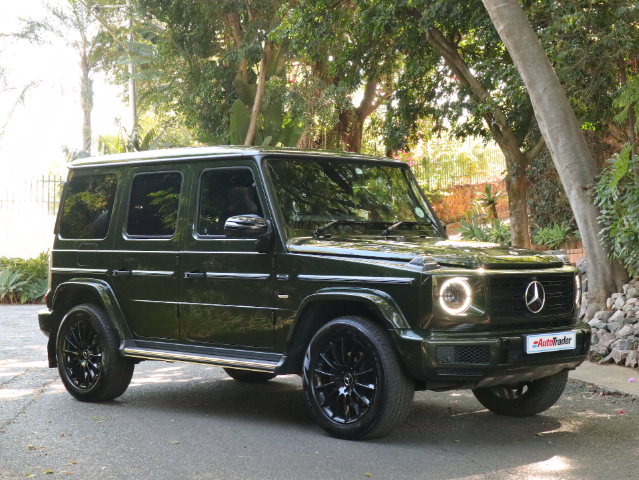
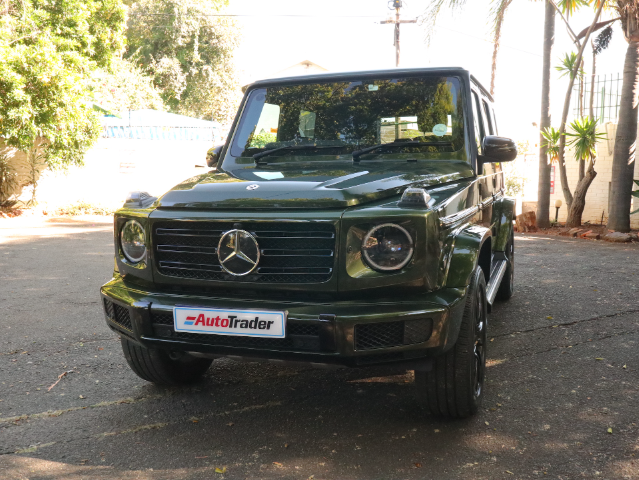
If you know what an early G-Class looked like, you’ll immediately recognise the new one. It’s still squared-off from all angles, with wide wheel arches and those distinctive fender-mounted front indicator units being immediate tell-tales. But, if you look closely, you’ll notice that the bumpers are much better-integrated, the cabin’s corners are slightly more rounded, and LED lighting elements are applied as part of the design rather than as afterthoughts.

Up front, our emerald-green G400d test car was refreshingly devoid of ornamentation, with its blacked-out Mercedes-Benz grille (part of the standard Night Package) and LED DRL-ringed headlights being the main focal points. Scanning down its flanks sees plenty of straight lines and a boxy cabin shape, although the wheel arch flares, linked by burly side steps, add quite a lot of visual drama.
Chunky horisontal bump strips (which incorporate the outer door handles) add a final homage to the original G-Class’s side view. From the rear, LED tail lights in neatly-designed enclosures are the main tell-tale that this is indeed a new G-Wagen, even though the light clusters are still mounted roughly where they’ve always been. The rear view is completed by the traditional side-hinged cargo door, with a hard cover over the tailgate-mounted spare wheel.

Performance
Buyers who simply want a ludicrously-potent G-Class will once again be drawn to the mad AMG G63, now with a twin-turbo, 4.0-litre V8 giving 430 kW and 850 Nm. That would be the one for those who demand the “last number” in the range, then, but for the rest of us, the G400d will be most satisfactory in its own right.

Motive power is supplied by Mercedes’s new, 2.9-litre, inline 6-cylinder twin-turbo diesel, and it’s an absolute peach: very quiet in operation and extremely smooth-running, it offers a torque plateau of 700 Nm from 1 200 – 3 200 r/min. This gives a peak power output of 243 kW, and enables the slick-shifting 9-speed automatic gearbox to keep the engine operating in its most-efficient range.
Bearing in mind that the G400d has a claimed kerb weight of 2 472 kg, lots of heavy off-roading hardware and a very blocky shape, the dash from a standstill to 100 km/h in a claimed 6.4 seconds is impressive, as is its governed top speed of 210 km/h. On-road performance subjectively confirms these figures, while overtaking and hill-climbing abilities are beyond reproach as well. Overall, the lovely new diesel engine is a fantastic companion to the G-Class’s fuss-free and no-nonsense character.

The Drive
We need to remember that the G400d is still an off-road-capable, body-on-frame SUV with a solid-beam rear axle, but, even with these constraints, the driving experience is actually surprisingly contemporary. Hats off to the Mercedes-Benz engineers for making rather archaic underpinnings feel like something from the 21st century!
It's still not a hot hatch, mind you. The high-up seating position amplifies the sensation of body roll in corners (even though there really isn’t all that much, thanks to standard adaptive damping). Meanwhile, the surprisingly heavy steering effort is a constant reminder that this vehicle tends to stretch the laws of physics a tad.

Should you be inclined to find the G400d’s cornering limits, you’ll encounter early-onset understeer, induced by the stability control system to reduce any risk of a roll-over for this tall vehicle. Relax your pace a tad, and it settles down nicely, with a compliant ride and predictable dynamic behaviour.
The presence of no fewer than 3 differential locks, generous ground clearance, and a low-range transfer case indicates that the G-Class will be very capable out in the bundu, but even on poor road surfaces, its composure and stability is superb by almost any measure. We didn’t take it off-road, because those pretty 20-inch alloy wheels and expensive-looking running boards look too vulnerable for this writer’s pauper’s budget. It’s probably safe to assume that most buyers wouldn’t venture too far off the beaten track, either – or, if they would, they should specify off-road tyres with a higher profile.

Space and Comfort
Contrary to what its burly appearance would have you believe, and despite being significantly larger than its predecessor, the latest G-Class casts a surprisingly small shadow: It measures only 4.874-metres in length (including the spare wheel cover), and only 1.984-metres mirror-to-mirror. This isn’t quite enough for a cavernous interior, so some compromises had to be made in its packaging.
The cabin is quite narrow, although this is mitigated by very upright side glass. Not really a problem for front-seat occupants, then, but the rear pews lack shoulder room when packed three abreast. The front seats could however do with some more rearward adjustment, while rear-seat legroom is also limited, especially if the front seats house anyone of above-average height.

Furthermore, the door openings are rather narrow all round, making entry and egress more difficult than you’d think. In compensation, luggage space is pretty generous at 667-litres, thanks in part to the externally-mounted spare wheel. And, with the rear seats folded down, total cargo volume can reach as high as 1 941-litres, so overall versatility is really rather good.
The cabin is also an extremely nice place to spend time, with diamond-quilt leather upholstery and grey contrast stitching mixing with aluminium-look accents and open-pore wood trim to create a classy, upmarket ambience. There’s only one area where the G400d isn’t quite up to the same level as newer Mercedes products, and that’s in the infotainment system, which still features the older COMAND user interface instead of the newer MBUX system.

But, even though its basic infotainment system is slightly dated, it still offers all the functionality you could desire, including standard navigation and voice control (albeit not of the “Hey Mercedes!” variety). There’s also a clear and configurable digital instrument cluster display, which combines with the infotainment display to give the impression of a widescreen cockpit – just as you’d find in any other modern ‘Benz.
The standard equipment sheet is equally impressive, with most of the available options fitted as standard (or at no extra cost) to our “Stronger Than Time” limited-edition G400d test car. Some equipment highlights include a sliding sunroof, ambient lighting with 64 colours, electrically-adjustable dynamic front seats with memory, and three-zone climate control.
Those dynamic front seats are particularly intriguing, because they’re programmed to counteract lateral forces on the front occupants while cornering. It does this by inflating the seatback side bolsters on the opposite side to which the vehicle is turning: turn right, and the bolsters add support on the left of your torso; turn left, and the right-side bolsters inflate to keep your upper body in place. This way, the occupants are always held securely in position, without constrictive side bolsters pressing into their rib cages when it’s not really necessary. Clever.

Safety
Given its position as a halo model for the Mercedes-Benz brand, the G400d has excellent safety credentials as a matter of course. It scored 5 stars in Euro NCAP crash testing in 2019, with adult occupant protection rated at 90% and a child occupant protection score of 83%. It obviously also helps that the G-Class is built like a tank...
Standard safety equipment include a full house of driver aids, ranging from stability control and ABS to blind-spot monitoring and lane-keeping assistance, along with 9 airbags and rear ISOFIX child seat mountings. Other noteworthy standard features include superb Multibeam LED headlights, the full parking assistance package (with self-parking, 360-degree camera, and proximity sensors all round), traffic sign assist, trailer stability control, adaptive cruise control, and automatic emergency braking.
Fuel Consumption
Mercedes-Benz claims an average consumption of 9.6 ℓ/100 km, and our test average of 10.8 ℓ/100 km in mixed-cycle driving suggests that conservative drivers may even approach that consumption claim in the real world. This is a very impressive result for a car of this size and weight, with proper off-road running gear, and with a high-drag body shape.
Refuelling will be a painful experience, however, because taking on 100 litres of diesel will make a serious dent in most people’s bank balances. Fortunately, owners should be able to achieve around 1000 km between refills, so that pain won’t be felt too often – not that anyone who can afford to sign for a car like this is likely to care too much about fuel economy, mind you!

Price and Warranty
At first glance, the Mercedes-Benz G400d “Stronger Than Time” (yes, that’s its full name) base pricetag of R 2 892 840 appears to be very expensive – even with a warranty for 2 years with no mileage limit as well as a maintenance plan for 5 years or 100 000 km. Potential customers in this segment are unlikely to complain, however, because the G-Class’s traditionally high asking price simply makes it even more desirable.
That stratospheric pricetag is quite understandable, because the G-Class is (and has always been) hand-built in Graz, Austria, to the highest possible standards and in small volumes. It’s also immensely capable off the beaten track, sophisticated enough to stand out in any setting, and has street cred by the buckets full. For its target market, these attributes will make the G400d impossible to resist (provided the AMG G63 doesn’t bowl them over first).
* Pricing includes all taxes and was accurate at the time of publication, but is subject to change.
Verdict
In a sensible world, it would be very difficult to make a case for an off-road SUV with a pricetag approaching R3-million. Viewed through coldly objective eyes, you could get similar off-road prowess for a third of the money (but without the G400d’s image or luxurious cabin), or a faster and more-spacious luxury SUV for two-thirds as much (albeit without the G400d’s mountain-conquering abilities).
But the civilian G-Class has never been about sensibility, and never will be. Instead, it has to be seen for what it really is: A rolling style statement to proclaim its owner’s success to the whole world, that just happens to be capable of traversing almost any terrain with aplomb while pampering its occupants in leather-lined luxury.
Fortunately, there’s enough excess capability engineered into the Geländewagen to play all those roles simultaneously, and opting for the lovely diesel instead of the ludicrous V8 at least signals some semblance of pragmatism. Even with the diesel and without an AMG badge, its coolness factor is off the charts, and for some buyers, that will be enough.


