
Ford Mustang Bullitt (2020) Review: Echoes of a bygone era
Few automotive nameplates are as iconic as the Ford Mustang. It set sales records right out of the starting box, and has since earned its place in popular culture. Compounding the evocative nature of these beasts, the limited-edition Mustang Bullitt adds an extra layer of pop-culture credibility and other upgrades to the Mustang, by channelling the spirit of Steve McQueen and his timeless 1968 movie of the same name.


When the first Ford Mustang was released early in 1964, the American public really took it to heart. It started out as a good-looking sporty “personal car”, with just enough practicality to make it reasonably usable, fair performance (for the time) and a very affordable base pricetag. No wonder that it soon became a must-have accessory in the US, and scored supporting roles in numerous movies and title credits in a host of pop songs.
So, for the 1968 movie “Bullitt”, director Peter Yates selected a Mustang fastback as the “hero car”, to be driven by the protagonist – a cop named Frank Bullitt, played by noted actor and successful race car driver, the late Steve McQueen. Eventually, the movie became legendary for its epic car-chase scene through the streets of San Francisco, and its starring car almost ended up upstaging the lead actor as time went by. With such brand equity, it’s no wonder that Ford has appended the “Bullitt” nameplate to a series of limited-edition Mustangs, built since 2001...
Related: Pony up and read our launch impressions of the facelifted Ford Mustang.
Styling

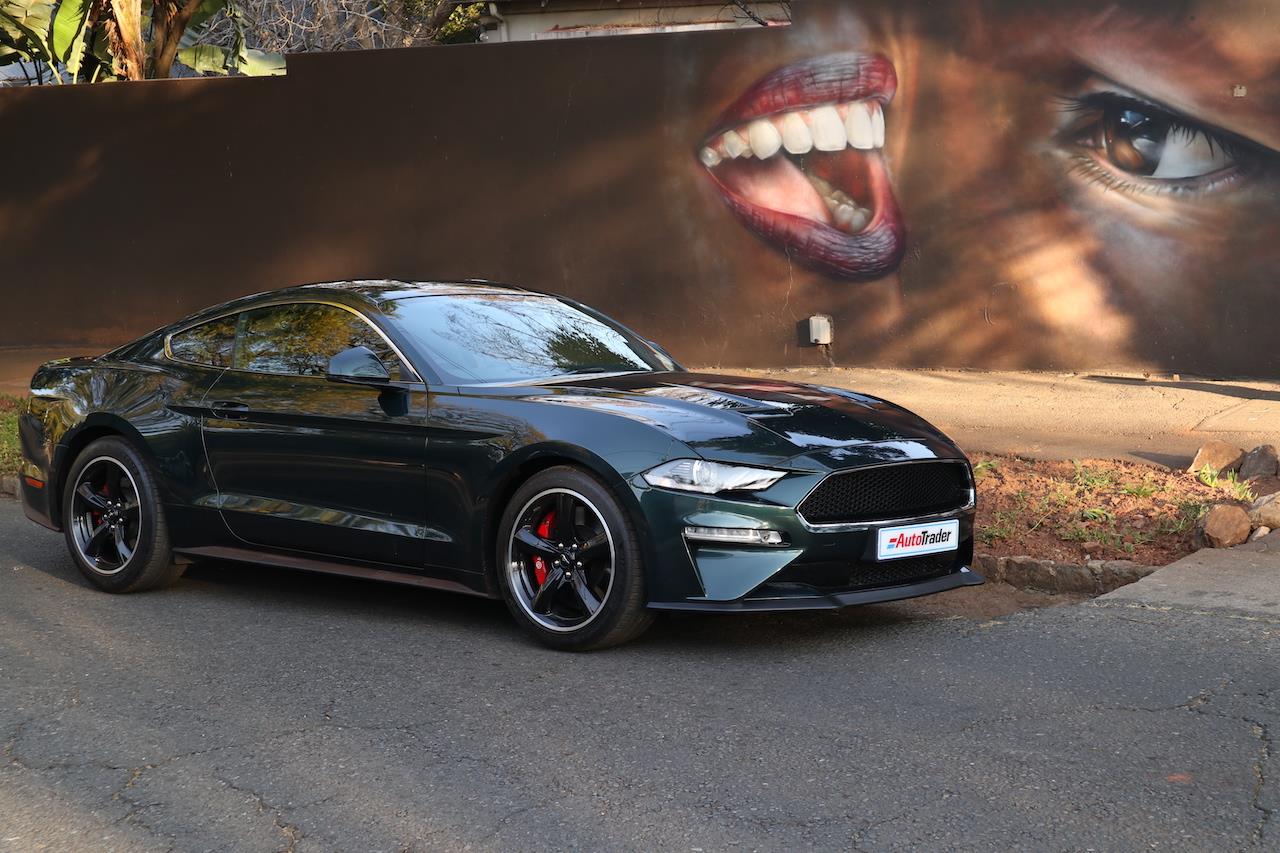
The basic body retains the cosmetic changes applied to the Mustang during its last update (midway through 2019) but there are some Bullitt-specific enhancements. For one thing, it can only be had in two colours: Dark Highland Green or Shadow Black, the former of which was applied very glossily to our test car. The only downside is that this colour looks dusty within minutes of driving it out of a car wash.
The facelift introduced a new visage, with a lower bonnet line, re-styled headlights, a re-shaped grille and front bumper, and a re-profiled bumper at the rear. These all remain in the Bullitt, but with one important distinction: it’s stripped of all the normal Mustang badging, and features only a single blacked-out “Bullitt” decal on the tailgate.

From some angles, the current Mustang body almost takes on an Aston Martin-ish appearance, with that lo-o-ong bonnet, swollen haunches, and swooping C-pillar bringing to mind both old Mustangs and modern Astons. It’s certainly an imposing car, and that scowling visage manages to clear out the right-hand lane on the freeway very effectively.
Down the sides, the gloss-black five-spoke alloy wheels have a polished lip and partially conceal red Brembo brake calipers, accentuating the sinister nature of the car and tying in nicely with the shining window trim. It’s no less arresting from the back, thanks to a wide track and hunkered-down stance, bracketed by distinctive LED tail lights. All in all, a mesmerising sight in the metal.

Related: Watch our video review of the 2019 Mustang GT Fastback
Engine and drivetrain
Motive power is provided by a lightly-massaged version of the Mustang GT’s 5.0-litre V8 engine. There’s no form of forced induction, so its outputs of 338 kW and 529 Nm are staunch, but not stunning. Well, that’s the case on paper, at least. There’s only 7 kW more to play with than you’d get in a normal GT (although the peak torque remains the same), courtesy of a larger throttle body and a modified manifold.
The main difference involves the substitution of the standard (since the facelift) 10-speed automatic gearbox with a 6-speed manual unit. Driving it is highly unusual (when compared to most 6-speed manuals) but not at all difficult. Why is it unusual? Because Ford decided to endow the transmission with extremely tall gear ratios: first gear runs up to almost 90 km/h, and third gear extends way past the point where those friendly folks with the radar guns would insist you stay at their place for a few nights.

As a result, the sensation is rather akin to pulling away in second gear with a normal car – a surprisingly gentle take-off from standstill, followed by a sustained rush as the engine reaches its power band and just keeps on going and going and going. Peak torque only arrives at 4 000 r/min, but the engine’s torque delivery is deep-chested and relentless across the rev range.
Get it on song just above idle speed, stand on the accelerator, and let it rev its rings off. Hit the power peak at 7 250 r/min, followed soon by the rev limiter at about 7 500 r/min (that’s high for such a big V8!) , snatch the next gear, feel the rear end squirm when you re-engage the hefty-ish clutch, and repeat until your bravery flees for safety and you back off the loud pedal.

Oh yes, let’s talk about that “loud” quickly: the Mustang Bullitt announces its presence with a deep rumble that sounds like Judgment Day has started. Fitted to our test car was a two-stage sports exhaust culminating in four tailpieces, but changing between modes merely altered the exhaust sound from “loud” to “booming”. This is an essential factor in defining the Mustang Bullitt’s personality, a sound that gives instant goose-bumps and intimidates everything in its immediate vicinity.
Related: Read the story behind "Bullitt", the movie that inspired the Ford Mustang Bullitt.
Performance
Ford quotes a 0 – 100 km/h sprint in 4.5 seconds and a top speed of 262 km/h, and the latter seems believable. As for the claimed sprint time, we didn’t test the numbers, largely on account of mechanical sympathy: that very tall first gear and fat rear tyres will make for extreme punishment on the driveline in drag-start pullaways.

For what it’s worth, two of the numerous drive modes on tap via a console-mounted toggle switch are called “Drag Strip” and “Race Track”. But, seeing as we didn’t have a dragstrip or racetrack handy, we didn’t try out these functions. Besides, the Bullitt is a very rare car (only 50 in South Africa), and nobody should want to abuse a collector’s piece like that.
Related: When we reviewed the pre-facelift Ford Mustang 2.3T EcoBoost in 2016, it had the cameras clicking.
The Drive
If you were paying attention a bit earlier, you would have noticed the phrase “rear end squirm” after sharp-shifting into the next gear (helped along by a very intuitive rev-match function). This phenomenon is pretty much always a given, when you decide to give the Mustang Bullitt some stick.
The first few times, it could be a bit unsettling to feel the car wriggle under you like that, and not only when changing gears, either – in many conditions where the car is under power (accelerating hard-ish), a road surface irregularity or ill-considered steering action could give rise to The Wiggle.

But, provided the stability control isn’t de-activated, The Wiggle isn’t likely to make the driver lose control of the car. If the stability control is turned off, though, may the odds be ever in your favour – it’s easy to make the Bullitt go sideways, but getting it back from that stage needs a skilled driver and some spare road space.
Of more concern was the rather under-damped ride quality of our test vehicle. As the speed mounted, the proceedings underneath turned a bit wobbly, almost as though the tyres were under-inflated (they weren’t), leading to a vagueness in the steering response and slightly floaty body motions. It’s clear that the suspension is set up to the comfortable side of firm, which pays dividends in comfort but doesn’t inspire a lot of confidence for fast driving.
Of course, that soft-ish suspension will also be helpful when chasing a good quarter-mile timeslip, but it does little to mask the Bullitt’s heft. This is a big car (almost 4.8-metres long and with a kerb weight of 1 851 kg), and it feels like it. It doesn’t really help that the glass area is rather small, either, because the resultant poor-ish sightlines reinforce the impression of piloting a rather quick battle tank.
Related: The Ford Mustang’s past, present, and future.
Space and Comfort

The Mustang was clearly designed for two people, and the rear bench should be seen as only for occasional use. Head-, leg-, and shoulder room in the rear are all seriously compromised, and much of the rear seating area is exposed under the rear windscreen. Front occupants have plenty of space, although the bulky dashboard does rob some knee-room for taller occupants. The luggage compartment is surprisingly useful, with 382 litres available without folding the split rear seatback.
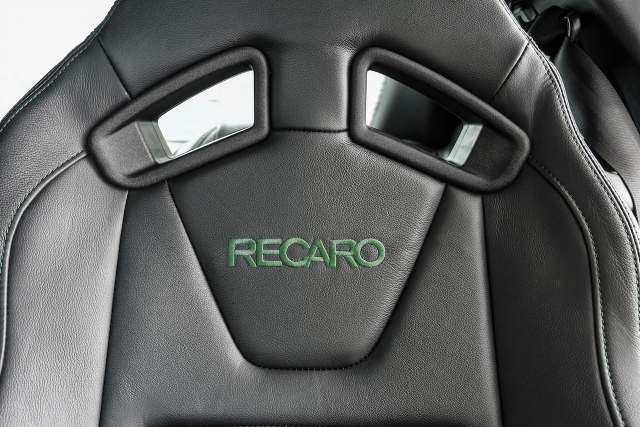
The Bullitt is quite well-equipped, though, with front- and rear parking sensors; a rear-view camera with reversing guidelines; driver-configurable digital instrument cluster; leather upholstery for the seats, door cards and steering wheel; adaptive cruise control and lane-departure warning; Ford’s SYNC3 infotainment touchscreen system with navigation and smartphone mirroring; configurable ambient lighting; and electric seat adjustment for the driver and front passenger all being standard features. Bullitt-specific items include tombstone-style front Recaro sports seats and a numbered plaque on the dashboard.

And, as a result of the mid-life facelift, the cabin is now a pretty decent place to be. Sure, some of the switchgear feel indistinguishable from that in a Figo, but it’s screwed together nicely, and there are at least some soft-touch surfaces in evidence. Of greater importance is the build quality, which also appears to be much improved – the body’s shutlines were even, all the trim pieces fit together properly, and the doors closed with a solid “thunk”.
Related: Not confirmed for local availability (yet), the new Ford Mustang Mach 1 revival promises to be even more exciting than the Bullitt.
Safety
This is where a bone of contention rears its head. A quick look at the Mustang’s Euro NCAP test results shows that it’s rated as only a 3-star car, losing a lot of points for its poor child protection. Does that criterium actually mean something in the context of a 2+2-seater sports car, though? It’s not like the Mustang pretends to be a family car, is it? If this point of criticism were to be ignored, the Mustang should be at least a 4-star car (weighted appropriately), which sounds a lot more reasonable for the car’s intended purpose.

Either way, it’s equipped with ISOFIX rear child seat mounts, and good luck getting those seats in there. More relevant is the fact that it has 7 airbags, a host of driver-assistance systems including that very capable traction control system, automatic emergency braking, an active bonnet, and a decent crash test score in the adult occupant protection department. Minor collisions are also easier to avoid, thanks to the hi-res rear-view camera and parking sensors on both ends.
Fuel Consumption
About that... Suffice it to say that lowest fuel consumption recorded over the test period was 9.2 ℓ/100 km, achieved over a decent stretch of freeway cruising around the speed limit with the engine ticking over at 2 000 r/min. Bury the right pedal in the carpet or chase the revs, though, and watch the trip computer readout jump into the high-teen range (and beyond, in the lower gears).
Make no mistake, this is a thirsty machine, and will drain its tank as eagerly as it stretches its legs toward the horison. Even Ford themselves aren’t too optimistic about the Bullitt’s fuel consumption, and quotes 12.4 ℓ/100 km – still a hearty appetite for 95 unleaded in anyone’s language. Achieving that claimed number would take some seriously considerate driving, and sticking to the higher gears at all times.
Sure, the Bullitt is quite happy to putter around like that, but it enjoys recreational hooliganism a lot more. Then again, it’s not like it pretends to be anything but an old-school muscle car, and a prodigious thirst is part and parcel of that concept. Yet more evidence that, in general, the Bullitt is an uncompromising, obstinately American middle finger to The Establishment.
Price
The price difference between the Mustang GT and the Bullitt is a lot smaller than you’d imagine: a premium of R 86 000 over a GT buys a future collectible, along with the more-visceral experience of taming such a beast by way of a manual gearbox and some decisive steering inputs. Included in the list price of R 1 079 700 is a warranty for 4 years or 120 000 km, along with a service plan for 6 years or 90 000 km.
Related: What is covered by the Ford Mustang’s manufacturer warranty?
Unfortunately, these prices place the V8 Mustang (of all descriptions) in some difficult price territory, with a nice variety of exotic alternatives around for similar money. The first alternative is a new Toyota Supra – it’s quantifiably better in just about every way except utility space, but comes only with an automatic gearbox. You could also get a BMW M240i and load it with R 140 000 in kit, and still end up with enough change for a KFC bucket and a six-pack of Coke.

Again, the BMW is objectively better at almost everything, except for those unique sensations only found with manual gearboxes and high-revving, un-boosted engines. Excellent though the turbo sixes with their automatics are, they just can’t sound and interact with the driver like an old-school V8 with a manual. If you get it, you get it: it's one of the last holdouts from a dying genre.
The Verdict
It took me a few days and a couple hundreds of kilometres to finally mesh with the Bullitt. It doesn’t have the kind of handling precision I desire in a sports car, it’s not particularly quick for the money, and its thundering presence was borderline embarrassing for the first while. It was quite hard work to drive, too, and worlds removed from the easy speed on offer elsewhere for the same money.

And that, for most people, will be that. Case closed. But a small fragment of the well-heeled will find the Mustang Bullitt to be the answer to their automotive prayers. Those customers will likely either fall in love with the Bullitt’s stunning looks, become smitten with the mean machine’s sheer presence, or find their thrills in wrestling down the beast. It’s one of silliest, but at the same time most inter-active, driving experiences I’ve had in a while. And that’s exactly what a Mustang should be.
Related: And now for something completely different – an electric Mustang dragster!
Pricing is accurate at the time of writing, but may change without prior notice.
Included in the list price is a warranty for 4 years or 120 000 km, and a service plan for 6 years or 90 000 km.
Expert rating:
4/5
Recommended Next:
Shop for new and used Ford Mustang cars for sale here.