Audi RS 7 Sportback (2021) Review – Everything a fast Audi should be, and more!
Well-heeled families in a tearing hurry have a new hero car in the latest Audi RS 7: A practical, comfortable 4-door “coupé” that just happens to be grotesquely powerful as well. It takes the Audi philosophy of effortless performance, and then cranks the speed up to 11 by re-arranging the laws of physics.


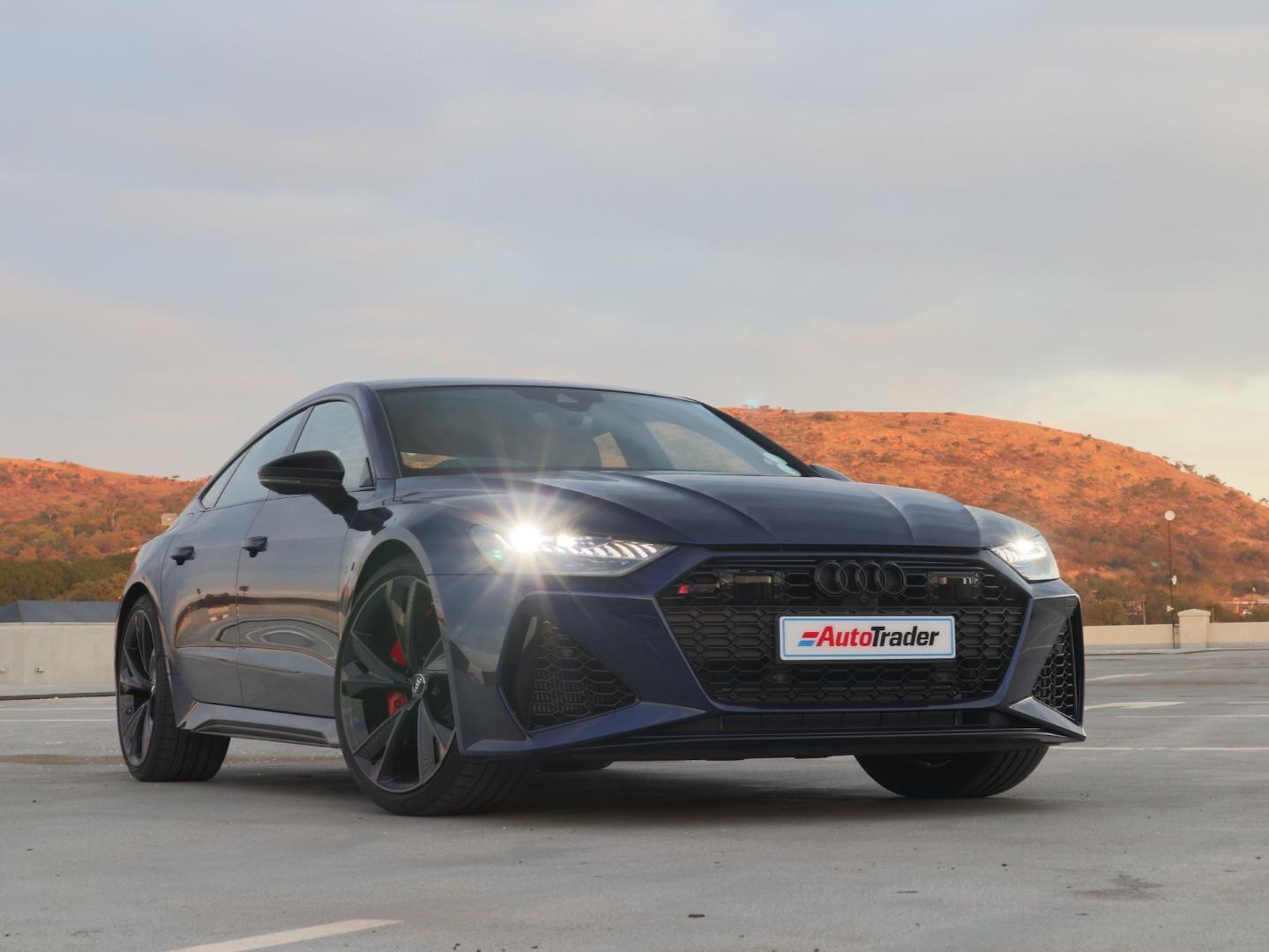
The most impressive thing about the new Audi RS 7 Sportback isn’t necessarily the warp-speed propulsion that hurtles you towards the horison, but the way in which it makes it seem so easy to go extremely fast – and look so good doing it. It’s a tech fest on the surface as well as underneath, and it’s all cloaked in a body that emits drama and sensuality even at standstill.
Related: Shop for new and used Audi RS 7 Sportback cars for sale here

Styling
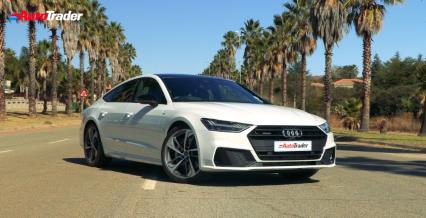
The new Audi RS 7 Sportback sticks to the same general styling recipe as its predecessor, with a long bonnet, low and arched roofline, sloping fastback, and kick-up in the rear side window line. But, while the format stays the same, every body panel is new, and it looks even more aggressive than before.
Our Daytona Gray Pearlescent test car struck a particularly menacing tone, especially with all of its exterior trim bits and wheels getting the black-out treatment to go with the almost-black paintwork. This combination drew unanimous praise from onlookers, and must rank as one of the meanest-looking cars to ever grace this writer’s carport.

The real beauty is in the details – if you’re into air vents, swollen fenders and gigantic (but functional) exhaust outlet tips. In front, the bumper is almost completely taken up by air inlets and glossy black inserts, while the rear bumper proudly shows off a shiny black trim piece that’s styled like a diffuser. In between, the RS 7’s haunches bulge over their wheel arches, and the tapering glasshouse gives a suitably slippery shape to the plan view.
And that’s only in full daylight – it gets even more dramatic at night, because then you can better appreciate the light show from those intricately-detailed light clusters. Animated LEDs trace an complicated pattern in the rear clusters, and the LED front DRL elements light up in sequence to welcome its driver. Imagine “Tron” in the real world, and you’ll be pretty close to accurate.

Performance
A single word would suffice to describe the Audi RS 7 Sportback’s performance: “Brutal”. Counter-intuitively, another suitable word would be “Easy”. How could these two seeming opposites co-exist with any harmony? Through the simple act of throwing lots of technology at it, that’s how.
It starts with a twin-turbo, 4.0-litre V8 engine with 48V mild-hybrid assistance, tuned to produce a handy 441 kW and 800 Nm. Audi reckons that the 0 – 100 km/h dash should take 3.6 seconds, and on-road impressions suggest that this claim may well be conservative. What’s even more impressive than the bland numbers is the wide spread of torque, which runs in a plateau from 2 050 r/min to 4 500 r/min. Throttle response is immediate, and the resulting rush of power is sustained and breathtaking.

Next up is the 8-speed torque converter automatic gearbox, which sends the power to Audi’s quattro AWD system, set up to send 60% of the torque to the active rear differential by default. This torque split can then vary continuously, depending on the available road grip.
And boy, does the RS 7 ever need this clever AWD system! Activating launch mode (on a closed track, not on a public road!) allows full boost to build before pullaway, which then hurtles the RS 7 out of the blocks after a brief scrabble for traction. Yes folks, there’s enough power on tap to make an AWD car chirp its gigantic 285/30R22 tyres from a standstill.

The Drive
You’d think a car that packs so much brute force would be a handful to control, but no. Thanks to the traction management system, it gets every horse to the tarmac without waste, while a myriad of support systems work in the background to keep the proceedings under control. They all tame the beast within, and makes the driver look like a master.
But that’s only one side of the RS 7’s story, and there are many more aspects at which to marvel. There are multiple personalities hidden within the RS 7, accessed either by prodding some switches, or simply by modulating the throttle input according to your desires.

If you’re feeling laid-back, the RS 7’s Comfort mode knows just what to do: It will close off part of the exhaust to quiet it down, relax its grip on the suspension for a surprisingly compliant ride, and shuffle through the gears with barely a murmur from the V8 up front. But, at a moment’s notice, a prod of the accelerator will send the revs soaring, followed by a surge of power that arrives with all the subtlety of a kick in the teeth.
If you really want to drive all-out, the RS 7 has you covered there too. The rear-wheel steering improves high-speed stability, yet allows for a sharp turn-in. The AWD system likewise includes some more-playful drive modes, with which it is possible to engage in some mild power-oversteering antics (again, on a closed track!)

And, for these extremes and every driving style in between, the driver can pre-configure two custom settings, to quickly access them through the “RS mode” button mounted on the steering wheel. Available adjustments include the steering weight, drivetrain programming, suspension stiffness and response, instrument cluster configuration, and various levels of ESP intervention. Oh, and the all-important exhaust note, although it always goes loud when you stand on the go-fast pedal.

Space and Comfort
The Audi RS 7 Sportback is a large car, measuring a little over 5-metres in length and more than 2.1-metres mirror-to-mirror, so cabin space is really rather generous. Yes, that tapering cabin does restrict rear-seat shoulder room and the low-set roofline does enforce some headroom compromises, but clever packaging nonetheless enabled the engineers to carve out enough interior room for four large adults. (The rear bench is shaped to allow for an occasional 5th occupant, but the centre perch isn’t ideal for long-distance comfort).
It's just as impressive underneath that huge rear hatch, where the electric tailgate rises to expose a 535-litre luggage space under a neat cover. Fold down the split rear seats, and total utility volume rises to 1 390 litres – nowhere near as spacious as the likes of the RS 6 Avant, but useful enough for occasional load-carrying duties.

Deeply-scalloped “tombstone-style” sports seats in front provide plenty of lateral support in fast cornering, yet avoid being overbearingly firm. They also look the part, with elegant honeycomb-shaped quilting and plush leather upholstery.
Occupants are pampered with 4-zone climate control and a banging B&O Premium Audio system, linked to the largest colour touchscreen infotainment screen in Audi’s arsenal. Other standard comfort- and convenience highlights include wireless phone charging, gloss-back touch-sensitive switches with haptic feedback, and wireless smartphone mirroring.

On the subject of switches: the old RS 7 (and A/S 7 variants) had an extremely busy centre console, with a multitude of switches to control all the gadgets. The new touchscreen- and touch-switch layout has now simplified the interface to a great degree, and represents a very worthwhile improvement on the first-generation model.
Safety
Solid safety credentials are a given, with the Audi A7 (upon which the RS 7 is based) scoring 5 stars in Euro NCAP crash testing in 2018. Rear ISOFIX child seat anchors, 6 airbags (with 8 as an option), full automatic emergency braking, adaptive Matrix Laser headlights, and advanced stability- and brake control systems all play their parts in keeping occupants safe.

But, in the traditional German way, the choice add-ons are optional. You’ll need to pay extra for our test car’s blind-spot monitor, active lane-keeping assistance, surround-view camera system, and adaptive cruise control, so bargain on an additional R 50 000 or so to get the full suite of driver aids and perhaps a few nice-to-have items.
Fuel Consumption
It’s doubtful that fuel efficiency factors highly in an RS 7 buyer’s calculations, because if it did, that buyer would settle for a more-frugal A7 55TFSI instead. For what it’s worth, an extended freeway trip dropped the indicated average consumption into the low-8 ℓ/100 km range, but conservative driving in a mixed cycle returned 13.9 ℓ/100 km. Audi claims an average consumption of 12.2 ℓ/100 km, so even they’re not terribly optimistic about stellar fuel efficiency...

The problem here arises from the superhuman amount of restraint it would take to drive the RS 7 Sportback conservatively, and to resist burying the accelerator pedal in the carpet once in a while. Indulging in such activities on a semi-frequent basis will soon show higher than 18 ℓ/100 km, draining that 73-litre fuel tank in an alarmingly short time. This applies equally to the RS 7’s opponents, however, so we won’t penalise it for its drinking habits.
Price and Warranty
This is a double-edged sword, because the maintenance plan is as generous as the warranty is stingy. The Audi warranty only provides cover for 1 year (with no mileage restriction), but the maintenance plan runs for 5 years or 100 000 km. Given the Audi RS 7 Sportback’s pricetag, we’d expect a better warranty, but the maintenance plan does largely compensate for this shortcoming.

When we get to the price, the RS 7 makes perhaps its strongest statement. With a pricetag of R 2 173 500 (excluding options), the Audi RS 7 Sportback is at least R 150 000 less-expensive than its (slightly quicker) opponents from BMW (M5 Competition) and Mercedes-AMG (E63 S).
Is the BMW and AMG’s added performance over the RS 7 really worth the extra money? Realistically, no – not when there’s already so much more power on tap than you could reasonably unleash on the road.
* Pricing includes all taxes and was accurate at the time of publication, but may change without prior notification.

Verdict
Blisteringly potent, seductively styled, charismatic, practical and adaptable to a wide range of operating requirements, the Audi RS 7 Sportback does a brilliant job of being most things to most people. It’s perhaps not as engaging in normal use as a driving purist could desire, but it is a devastatingly quick point-to-point machine in its own right.
Crucially, it also embodies the classic fast-Audi trait of being very quick without being threatening – it may need a lot of electronic assistance to be so well-behaved, but the end result speaks for itself. A triumph of technology over physics, the Audi RS 7 Sportback is a technical tour de force, and everything a star-performer Audi should be.