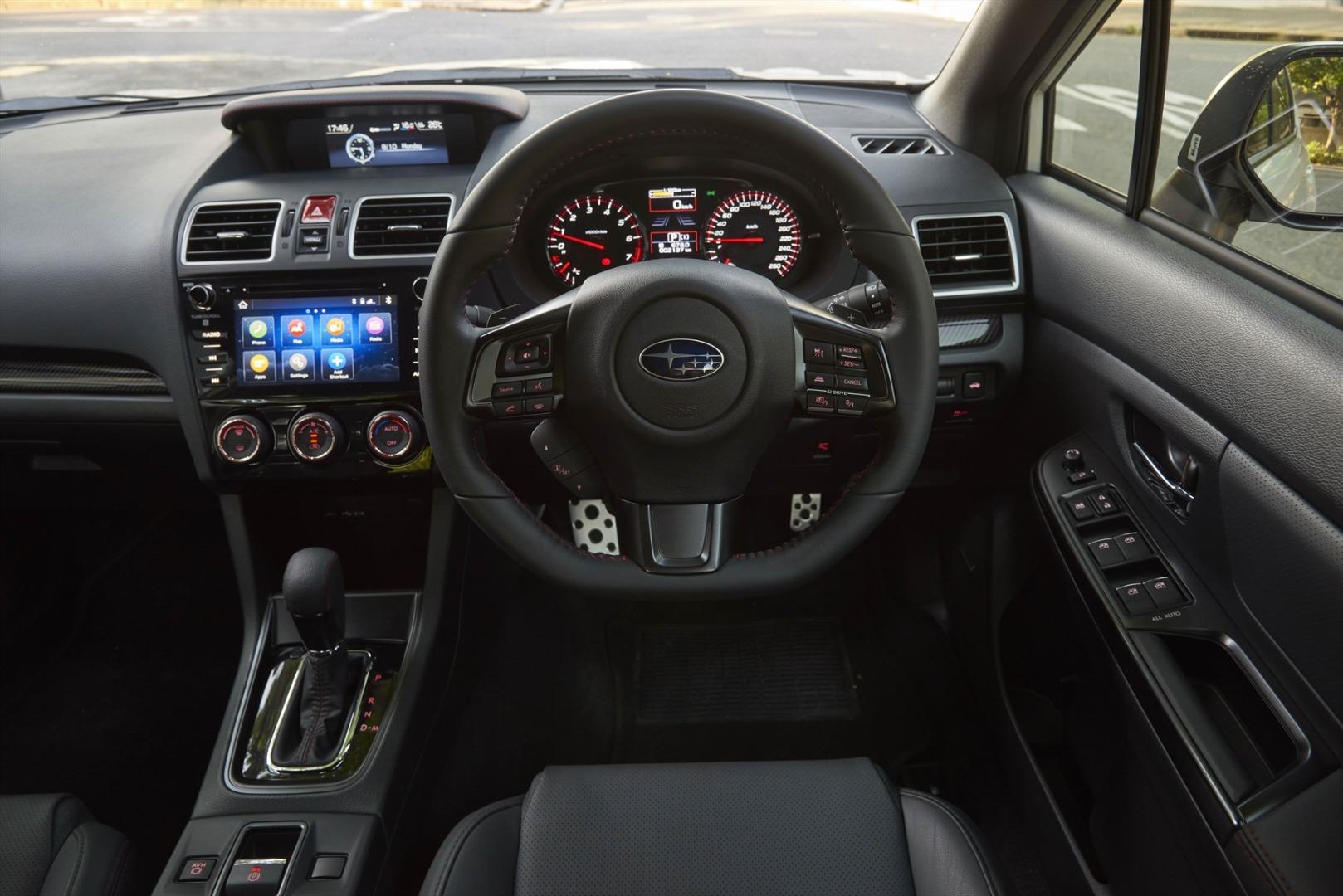
The WRX name struck peak popularity during its reign in the World Rally Championship during the late '90s and early 2000s. However, the new models employ a similar boxer engine configuration as the ones used in the earlier vehicles but with more efficiency and better performance outputs.
Related: Subaru WRX ES Premium review: Split personality in a sedan body
Currently, the Subaru WRX is offered in three derivatives namely Premium, ES Premium and STi Premium. The latter is the flagship model offering owners 221 kW and 407 Nm of torque from its 2.5-litre, turbocharged, 4-cylinder boxer engine. The ES Premium and Premium derivatives come fitted with a smaller 2.0-litre, turbocharged, 4-cylinder boxer motor producing 197 kW and 350 Nm of torque.

Warranty and maintenance agreements
All three WRX derivatives come standard with a 3-year / 75 000 km maintenance plan with service intervals set at every 15 000 km. Included in the maintenance plan is Subaru assist which incorporates emergency, legal and navigation assistance. In addition to this, owners benefit from a 5-year / 150 000 km manufacturer warranty.
Inclusions
The included warranty protects owners from any defect in the material or workmanship of their Subaru WRX. While there are exclusions to the warranty, owners will be happy to note that the factory fitted battery, shock absorbers, clutches and exhaust systems is also covered under warranty, however, only for 1-year / 30 000 km, whichever comes first.
Furthermore, genuine Subaru parts and accessories, exhausts, filters and parts not of the original specifications of the vehicle, that were fitted by an accredited dealership or service centre is also covered under the warranty terms. Any replacement parts fitted during the servicing or warranty claim of the vehicle is are warranted for a period of 12 months.

Exclusions
As with most warranty agreements, there are components that are not covered due to those components experiencing differential wear and tear depending on the owner's driving style. Other components or items might be manufactured by third-party companies and Subaru cannot take responsibility for those items, however, the owner can inquire if those companies carry any warranties on those specific parts.
Not covered under the warranty are items such as the fuel and oil top-ups between services. Tyres and the vehicle's wheel alignment is also the responsibility of the owner as well as non-mechanical interior trim and paintwork, repairs to on-board entertainment such as audio systems and repairs to non-factory components and any non-genuine accessories.
If the vehicle has sustained accident damage, broken windows or has components that have been repaired through an insurance claim, the affected components will be not be covered under the warranty. It should also be noted that should the owner not adhere to the maintenance schedule, the full warranty or cover on specific components could be voided doing so.
Recommended next:
What makes a driver’s car, and does the new more refined Subaru WRX still make a good one?