
What makes a driver’s car, and does the new more refined Subaru WRX still make a good one?
We review the Subaru WRX Premium


What makes a driver’s car?
What makes a driver’s car, and more especially, what makes a good one? A good driver’s car needs to engage the driver by not making it too easy to drive, to make the driver feel he/she is in control of the machine, rather than the machine doing all the work, and has to give the driver feedback through acceleration, steering, stopping… and listening.
Whereas so many cars nowadays are so refined and smooth and even soft to drive, the driver’s car seems to be a dying breed. Electronics have taken over, taking care of so many of the car’s (driver’s) functions, and quietness and refinement have both moved up the priority list in so many cars.
Good enough to be Car of the Year finalist
The Subaru WRX Premium was selected from an extremely long list of eligible cars as a finalist for the South African Guild of Motoring Journalists Car of the Year for this year.
As criteria to make this exclusive list include excellence in its segment, the WRX had to beat other similar cars, but the winner is the one who really moves the game along to the next level.
Still as hardcore as the old WRXs?
When the first road-going Subaru Impreza WRX made it off the rally dirt roads onto normal tar roads, it became a worldwide phenomenon – its success in winning rally world championships translated well into the production car: you could walk into a Subaru dealer and buy a car that looked very similar to the one you saw winning the rally on telly… complete with bright blue paint and gold wheels.
It has undergone a name change, with Subaru deciding to drop the world-famous Impreza name to keep only WRX. Perhaps just as well, as some Impreza were under-performing toned-down bland cars, which only damaged the company’s reputation, and did the Impreza name no favours. So WRX it is.
The first Impreza WRXs were hardcore driver’s cars – if you’ve been winning rallies with a car and then make a production car that isn’t a driver’s car, it would be just wrong.
The Impreza WRX, especially in its 1st and 2nd generations, were proper driver’s cars, ticking all the boxes – it was involving to drive thanks to its great steering-pedal-gear-engine interaction, making the driver feel good about achieving good speed, and enjoying the motions and emotions of getting there. While it was quite easy to drive, it was not too sophisticated and isolated.
The 3rd generation WRX, prior to the current car, went a bit too far with hugely flared bodywork, which made the car look over-styled, and the wheels look too small. Having tested it, the suspension was found to be too soft, which made it lean in corners.
So have they returned to form in the new 4th generation WRX? Some of the hardcore is gone, as market demand is to make cars more gentle – blame its more modern sports executive sedans which drew inevitable comparisons between WRX and the likes of Audi S4 and BMW 3 Series.
The Subaru WRX looks have swopped rounded for chiseled. It is as aggressive as ever, with an imposing bonnet air intake to feed air to the turbo. The LED headlamps look mean yet smart and high-tech. On the side, the front fender bulge with WRX emblem and aft-wheel air outlet add tension, as do dark grey alloy wheels. At the rear, the taillights created are small simple square yet detailed in LED to make a distinctive look, and the over-size boot spoiler has been toned down to a neat integrated item… but powerful aggression is re-instated thanks to quad exhaust outlets in a deep rear valance.
Sticking with the boxer four, turbocharging and symmetrical all-wheel drive?
A big big part of the Subaru appeal is the boxer four turbo engine. The horizontally-opposed cylinder layout has so many advantages that one wonders why only Subaru and Porsche use this engine type – it is compact, which saves space and means it can be installed lower down in the engine bay to lower the car’s centre of gravity, it is punchy thanks to low-mid rev torque, it revs freely and eagerly, and its sound is unmistakably boxer engine.
The turbocharging is also a Subaru skill, and on previous cars the unmistakable boxer-engine growl, the shoosh-pssst of the turbo and the superb handling (all in a usable sedan package) made it a much-loved car.
The new Subaru WRX has fortunately kept the drivetrain layout of boxer + four + turbo + all-wheel drive, but has unfortunately lost some of the distinctive WRX engine and exhaust sound. The WRX is quicker and more powerful and bigger than ever before, but a crucial grin-ingredient in a driver’s car is the sound – this WRX can still be heard, giving off its flat-four burble, but it is all very muted.
The numbers? Where the previous WRX used a 2.5-litre, the new WRX goes back to the size 2.0 engine, though power and torque are actually higher – the new WRX quotes 197kW at 5600, and a strong-pulling 350Nm across a wide 2400 to 5200 rpm.
Subaru says 9.2 l/100km in the combined cycle, but come on… this is a WRX, so you’ll want to enjoy the boxer four turbo. The on-board readouts said 10.3 l/100 km for odo average (assuming this is the overall figure since the car was new) and 13.4 for the trip (since trip meter reset) but 15.3 since last re-fuel.
The all-wheel drive helps it leap off a white road marking, achieving a claimed 6.0 seconds from stop to 100 km/h, which, although not tested with equipment, is fully believable. Overtaking and in-gear acceleration is a WRX strong suit.
Had added refinement kept it a driver’s car?
Despite the better sound insulation and reduced sound effects, the WRX still holds on to some factors which helped create its cult following: the clutch (yes, this is one of the very few remaining manual cars in its segment) is easy to operate but requires concentration to modulate smoothly; the gear lever is a nice short-throw tool, which slots into gears neatly and precisely, giving the driver’s attention enjoyment to engage a gear; the steering is light enough to park and drive around town easily, yet still feels weighted enough to feel sporty, and in bends there is resistance directed up from the wheels… all good.
The Subaru WRX makes its driver concentrate – to drive smoothly, s/he has to pay more attention (than in other small sedans) to synchronise the clutch-gear-accelerator pedal, making it not-so-easy to drive around town, smoothly. However, drive it hard, and the car comes alive, and those car controls which were so almost clumsy in town suddenly make sense.
On the road, some situations entice the WRX driver – a quick sprint, a simple overtake dismissal of the slower vehicle in front, a sweeping bend on a tar or dirt road (evoking that rally feeling). Thank the WRX’s great gearing, steering, torque, turbo pull, all-wheel drive.
But what about the interior – is it better now?
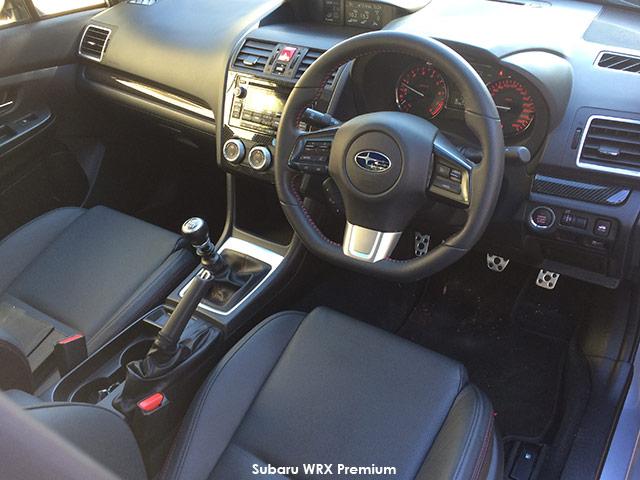
Quick answer, yes. A criticism against previous Impreza and WRX was its plain and plasticky interior. Although this could be explained away by saying the focus is on the drive rather than the interior looks, the new WRX has really stepped up with much more of a quality feel, and a real effort to use quality pleasant-finish materials.
The interior feels much more worthy of its price point, and much more modern, yet there is no tablet-style touch-screen or over-specced buttons to aid/distract the driver.
However, being a Japanese design, they could not stay away from including some gimmicky digital displays: the instrument cluster has a horizontal bar with a + and - sign to show l/100km, which dodges across constantly, which is less informative than it is distracting. In the dash centre display (for all to see) is the text Accel % with a graphic of the driver’s shoe on the pedal – not sure how this contributes in any way to inform the driver or passengers.
The climate control rings have received some brightwork, but why are the readouts of temperature in old LCD graphics… in a tiny box to the left of the dashboard centre display?
How much is it, and does it have rivals?
The Subaru WRX manual price is R 478 400, the auto (with CVT, which is apparently quite good, but no CVT is suitable for a driver’s car) costs R 495 000. You could also go for the WRX STI Premium, using a bigger 2.5T engine for more performance and power and more esteem (that STI badge) at R 629 000, which sets us up for a look at rivals: the only other sedan all-wheel drives are from Audi, with its recently-added first-ever Audi S3 sedan quattro (also with 2.0 turbo but 206kW and 380Nm, priced at R 558 500) and the bigger Audi S4 sedan quattro (with 3.0 supercharged V6 of 245kW and 440Nm, at R 744 500). Both Audis are only S-tronic automatics, while the only other potential WRX / WRX STI rival is the BMW 340i (due soon, at R 660k) though also sports-Steptronic only – this means the WRX and WRX STI manual could be the last manual sedans of their kind.
Does the new more refined Subaru WRX still make a good driver’s car?
The market demanded more refinement and a better interior and, it would seem, less audio effects. In those respects, Subaru delivered… yet it thankfully keeps the characteristic of “you have to drive it”, and therefore stays true to being a good driver’s car.