
We compared Volkswagen T-Roc engines, and the efficiency crown goes to…
Volkswagen finds themselves well-positioned to take advantage of growing demand for compact crossovers, with a wide line-up of SUV-like cars to cover a large section of this market segment. The recently-released T-Roc slots into the micro-niche between the T-Cross and Tiguan, with a variety of trim levels and with two powertrain choices.



In accordance with its market positioning, the T-Roc could be considered a slightly smaller, sportier-looking Tiguan, and it’s priced and powered accordingly. The Tiguan’s drivetrains also feature in the T-Roc, except for the absence of a diesel variant and a de-tuned range-topping engine.
Related: Get the launch details of the initial Volkswagen T-Roc model range.
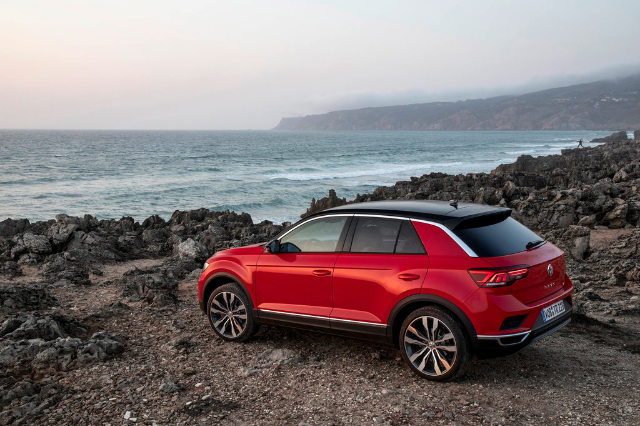
1. Volkswagen T-Roc 1.4TSI 110 kW (R 489 400)
Covering the entry-level of the T-Roc series is a 1.4-litre, turbocharged, 4-cylinder engine, only available with an 8-speed automatic gearbox. This isn’t a dual-clutch automatic, though, but a conventional (if many-cogged) torque-converter type.
It channels the engine’s 110 kW and 250 Nm to the front wheels to record a 0 – 100 km/h sprint in 8.4 seconds and a top speed of 205 km/h. The claimed fuel consumption amounts to 6.2 ℓ/100 km, while high-6 ℓ/100 km averages could be expected in mixed-cycle use.

2. Volkswagen T-Roc 2.0TSI 140kW 4Motion (from R 548 300)
Available in two trim levels, the 2.0-litre T-Roc employs a version of the Golf GTI’s engine, but in a lower state of tune and only with (4Motion) all-wheel drive. In this application, it’s set up to produce 140 kW and 320 Nm, routed to the AWD system via a 7-speed dual-clutch transmission (DSG).
This is enough to send the T-Roc scooting from rest to 100 km/h in a claimed 7.2 seconds and on to a top speed of 217 km/h. The official average fuel consumption of up to 7.2 ℓ/100 km is the penalty paid for the improved performance and all-wheel drive drivetrain losses.
Related: For an detailed report of Volkswagen T-Roc equipment levels and initial local engine specifications, head this way.

Let’s compare the numbers
|
|
VW T-Roc 1.4TSI 110 kW |
VW T-Roc 2.0TSI 140 kW |
|
Engine Type |
1.4-litre, 4-cyl turbopetrol |
2.0-litre, 4-cylinder turbopetrol |
|
Power/Torque |
110 kW/250 Nm |
140 kW/320 Nm |
|
Performance Data* |
0-100 km/h in 8.4s; max 205 km/h |
0-100 km/h in 7.2s; max 216 km/h |
|
Fuel Consumption* |
6.2 ℓ/100 km |
7.2 ℓ/100 km |
* According to manufacturer’s official figures.

The Efficiency Champ
It’s plainly obvious that the 1.4TSI would be the sensible option if efficiency is paramount. It has enough power, torque and gears to get by quite nicely and carry a load with reasonable ease. However, the 2.0TSI’s all-wheel drive will add confidence in slippery conditions, and it is clearly the quicker one here, but its driver will pay for those advantages at the fuel station.
Don’t believe that these will be the only two T-Roc engines we’ll get in South Africa, mind you. International markets also receive a choice of two diesels with up to 110 kW, the 1.5TSI Evo (with cylinder de-activation) already found in the T-Cross and also expected for the Golf 8, and even a rather mad T-Roc R with the Golf R’s 221 kW/400 Nm powerplant. This could get interesting...
* Prices were accurate at the time of writing, but may change without prior notice.
Recommended next:
Shop for new and used Volkswagen T-Cross cars for sale here.