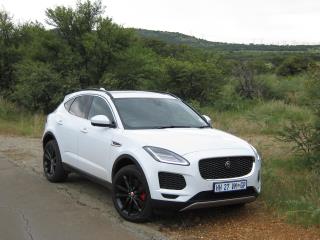
We compared Jaguar E-Pace engines, and the efficiency crown goes to…
A significant part of the Jaguar E-Pace’s recent mid-life facelift involved uprated drivetrains, now including a hybrid option in addition to the established petrol- and diesel engines. Which one deserves the efficiency crown?



As one of the first models from Jaguar Land Rover to launch exclusively with the Ingenium corporate engine range, it’s always offered a choice between petrol- and diesel power, and the current range is no different in this regard. The 2.0-litre turbopetrol can still be had with two output levels, but the diesel range shrinks to a single output level, while the hybrid option arrived with the facelift.
For this article, we evaluated efficiency based on two parameters: their claimed (official) average fuel consumption, and their power-to-weight ratios. The former is self-explanatory; while the latter indicates the power output in relation to the car’s kerb weight – expressed in kW/ton, and used as an indication of the car’s potential performance.
Related: Shop for new and used Jaguar E-Pace cars for sale here.

Jaguar E-Pace D200 (From R 874 210)
Outputs: 147 kW and 430 Nm
Claimed Average Consumption: 5.3 ℓ/100 km
Power-to-weight Ratio: 76.5 kW/ton (EU)
In the pre-facelift E-Pace range, the entry-level diesel would have been the default efficiency champion, but things aren’t as clear-cut as they used to be. The diesel E-Pace has some very competitive numbers, including peak outputs of 147 kW and 430 Nm, and a claimed average consumption figure of 5.3 ℓ/100 km, but its weight works against it.
A kerb weight of 1 920 kg (according to EU standards) is a lot of metal to move around, and this affects overall efficiency to some degree. In the case of the E-Pace, the toll for that portly build is exacted on performance: its power-to-weight ratio of 76.5 kW/ton isn’t quite enough to deliver lively performance. That pile of torque still helps it from a standstill to 100 km/h in a claimed 8.4 seconds, though, so acceleration is nonetheless quite adequate for a car of this type.

Jaguar E-Pace P250 (From R 938 540)
Outputs: 184 kW and 365 Nm
Claimed Average Consumption: 7.7 ℓ/100 km
Power-to-weight Ratio: 97.4 kW/ton (EU)
The E-Pace’s petrol engines carried over unchanged with the facelift, with the P250 representing the lower output of the two available petrol units. It’s a 2.0-litre turbocharged 4-cylinder, and its jump in power output (compared to the D200) gives it a rather more satisfactory power-to-weight ratio and consequently, stronger performance.
Sprinting from 0 – 100 km/h is claimed to drop to 7.5 seconds, but the official average fuel consumption jumps to 7.7 ℓ/100 km as the main trade-off. Also note that the P250 has much less torque than the D200 offers, which may swing things in favour of the diesel when frequent heavy loads or towing is on the cards.

Jaguar E-Pace 300 Sport (R 1 057 940)
Outputs: 221 kW and 400 Nm
Claimed Average Consumption: 7.7 ℓ/100 km
Power-to-weight Ratio: 113.2 kW/ton (EU)
The high-power petrol engine is only available in one E-Pace variant, labelled the “300 Sport”. It uses a more potent, twin-turbo version of the Ingenium 2.0-litre, to bump outputs to 221 kW and 400 Nm. As in all local-market E-Pace derivatives, power is sent to the standard AWD system through a 9-speed torque converter automatic gearbox.
In spite of its much higher output, the E-Pace 300 Sport posts an identical 7.7 ℓ/100 km average consumption claim as the P250, but, because its power-to-weight ratio climbs to 113.2 kW/ton, the 0 – 100 km/h dash drops to a claimed 6.9 seconds. This is the one to get if you want the quickest petrol-only E-Pace, especially as the added performance doesn’t have to mean heftier fuel bills than the P250 would return.

Jaguar E-Pace P300e (From R 1 165 500)
Outputs: 227 kW and 530 Nm (combined)
Claimed Average Consumption: 2.0 ℓ/100 km
Power-to-weight Ratio: 104.5 kW/ton (EU)
The heaviest E-Pace manages to be the quickest out of the starting blocks as well, thanks to a generous helping of battery-assisted torque. The petrol power unit is a 1.5-litre 3-cylinder (essentially a 2.0-litre 4-cylinder minus one cylinder), with 147 kW and 280 Nm. The electric system then does its thing, to take the peak power beyond what’s on offer from the 300 Sport, and to generate more peak torque than the diesel can supply.
There is a slight snag with that 2.0 ℓ/100 km average consumption claim, however. While the P300e could conceivably achieve that figure in certain usage cases (or even better, if restricted to short commutes), you won’t see 2.0 ℓ/100 km on a long road trip.
This is shortly explained as a result of an EV’s ideal habitat not being a freeway. (For a detailed explanation, there’s an entire article on that subject here). Expect (at best) diesel-level consumption in that scenario, because the petrol engine will be doing most of the work on longer trips.

Verdict
Choosing the most efficient E-Pace engine will depend on your specific requirements and usage case. In any event, it won’t be either of the two pure-petrol options. They are efficient enough for vehicles of this type, but that hefty body shell needs as much torque as it can get.
That leaves the diesel and the P300e hybrid. The latter will be perfect for buyers who can recharge their vehicle at home every night, and will be doing the majority of their driving on congested roads. As a bonus, it also has the best performance, and won’t be too badly underpowered even if the batteries run dry on a long journey.
But, if frequent long-distance trips form part of the car’s intended purpose, the D200 has to take the efficiency crown. Not only is it much less expensive than the hybrid to buy, but it has the lowest real-world fuel consumption (in the context of a general-use family vehicle).
* Prices include all taxes and were accurate at the time of writing, but may change without prior notice.