Toyota Land Cruiser FJ 2026 First Drive: The Antidote to 'Software on Wheels'?
Those who revered the original FJ Cruiser have been waiting for a successor for years. But the 2026 Toyota Land Cruiser FJ isn’t playing that game. It’s not trying to relive the past; it’s staging a rebellion against the tech-laden, software-driven SUVs currently dominating the market. We spent a day in the new model to find out where it fits in, how it handles a damp off-road trail, and why it’s one of the most honest cars we've driven in a long time.


The new Toyota Land Cruiser FJ: A retro-styled off-road weapon for the modern era
Every modern SUV you step into today feels less like a real car and more like a rolling smartphone. Physical buttons are almost non-existent, with essential functions buried deep within minimalist digital menus that demand your attention and pull your eyes off the road just to adjust the cabin temperature. But in the 2026 Toyota Land Cruiser FJ, there is a refreshing defiance and a realness that refreshes the soul. Will local buyers take the bait, though? The buying public's comments on social media have been interesting.

Is the Land Cruiser FJ a proper successor to the original FJ Cruiser?
The short answer is no, and it's not meant to be, either. It's more like a spiritual successor, and it's a vast improvement over its 'predecessor'. If you were betting on a gas-guzzling 4.0L V6 petrol with suicide doors and a five-speed automatic transmission that uses 16-18 L/100 km of petrol on average, with the aerodynamics and grace of a sledgehammer, we have to disappoint you. Have a look at this old FJ Cruiser vs new Land Cruiser FJ comparison, just to see the figures for yourself:
| Spec: | FJ Cruiser (2011 onwards in SA) | Land Cruiser FJ (2026) |
| Length | 4,670 mm | 4,610 mm |
| Width | 1,905 mm | 1,855 mm |
| Height | 1,830 mm | 1,890 mm |
| Wheelbase | 2,690 mm | 2,580 mm |
| Ground Clearance | 245 mm | 245 mm |
| Kerb Weight | 1,948 kg | 1,970 kg |
| Fuel Type | Petrol (Unleaded) | Petrol (Unleaded) |
| Avg. Fuel Consumption | 11.5–12.5 L/100 km (claimed) | 10.7 L/100 km (claimed) |
| Fuel Tank Capacity | 72 L (+ 87 L sub-tank) | 63 L |
| Engine | 4.0L V6 (1GR-FE) | 2.7L 4-cyl (2TR-FE) |
| Power / Torque | 200 kW / 380 Nm | 122 kW / 245 Nm |
| Transmission | 5-speed Automatic | 6-speed Automatic |
| Braked Towing | 1,500 – 2,250 kg | 2,500 kg |
| Rear Diff Lock | No (A-TRAC only) | Yes (Standard) |
| Price (SA) | Last model before being discontinued: R813 000 | R714,000 (GX) / R761,400 (VX) |

What does the Land Cruiser FJ look like?
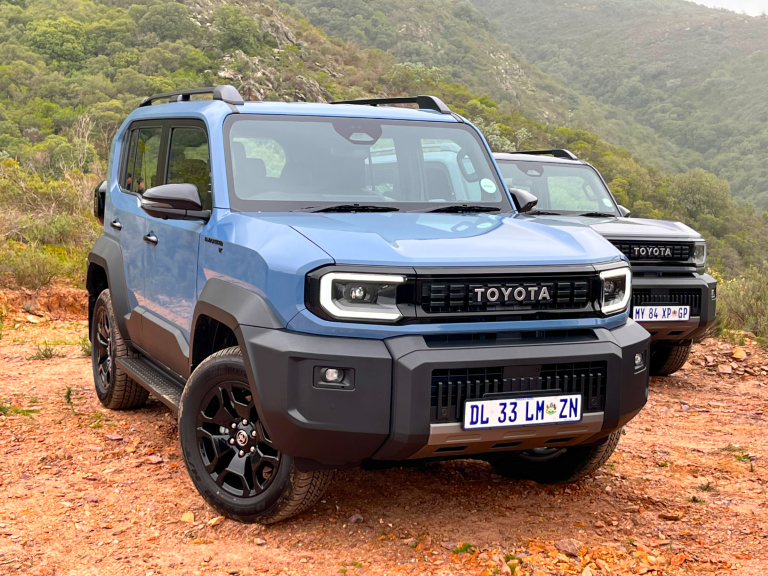
While many SUV manufacturers have been embracing the boxy look of late and copying the older, yet timeless designs of cars like the FJ40, Land Cruiser 76 Station Wagon, Prado, and the Suzuki Jimny, Toyota's designers still lead the way with functional, cool-looking off-roaders.
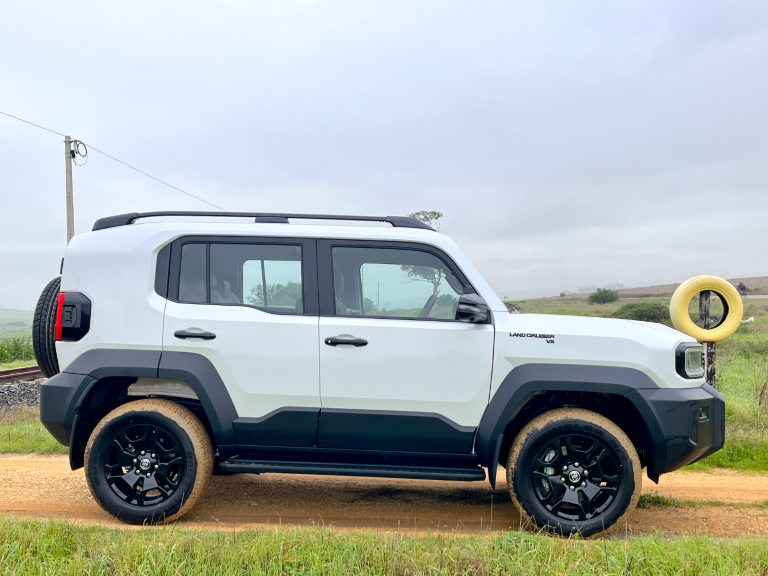
Its 'dice-inspired' silhouette makes the new FJ seem almost too compact, but it's bigger than it looks in the photos. By pushing the wheels to the corners and keeping the body square, Toyota maximised the footprint, keeping the wheelbase short enough for off-road fun but carving out just enough space inside.
Sadly, the influx of 'imitation Land Cruisers' from China has also influenced how the FJ is being perceived. Many will argue that the new FJ no longer looks unique enough, but those born with a taste for true quality won't care. Also, it is now a proper Land Cruiser. So, you'll have the status that comes with that moniker, but you won't have to spend over a million Rand for this 'baby Prado'. To put things in perspective, the cheapest Land Cruiser 76 station wagon (read my review) will set you back R1 065 300 - and it's pretty basic, while this 'Cruiser, especially in VX trim, comes pretty well-specified. (This is how you can present it to your significant other!)
Read our Toyota Hilux road-trip review from January 2026

Is it big enough for families?
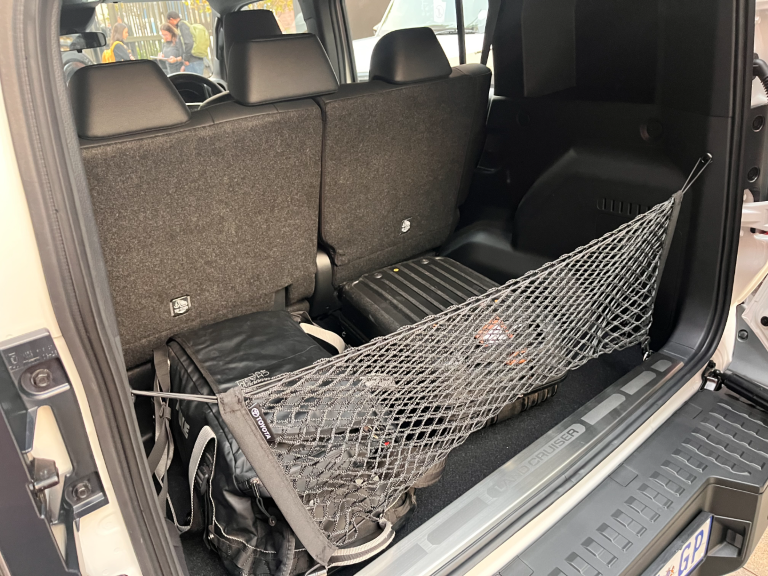
It certainly is, but it largely depends on the size of your family. The LC FJ is built on a shortened version of the IMV platform (the same architecture as the Hilux and Fortuner, but with a much shorter 2,580 mm wheelbase). While it is designed for agility and technical trail work, you could fit in two to three kids and their sports gear in the boot, but I'd say two school-age kids or mid-size adults in the back seat would be a safer bet.

The LC FJ has theatre-style seats, which means the bench is slightly higher to create a sense of spaciousness and a better view to the front, but there isn't infinite room to stretch out. At 1.73 metres, I tested the legroom behind the driver's seat, which was set to my preferred position, and even though I felt relatively comfortable, it's not a solution for a taller person on a 1200 km road trip. As I said before, kiddos won't have issues, though.
The boot space is ample with 795 litres, seats up, but it expands to a generous 1,607 litres when they're folded. This compares very favourably against other lifestyle 4x4s in the segment.
(Writer's note: I realised afterwards that the second row reclines and slides, and on launch I didn't check whether the seats were in their rearmost position, but I assume they were. We'll do a thorough check when we get the FJ on test!)
Interior and ergonomics
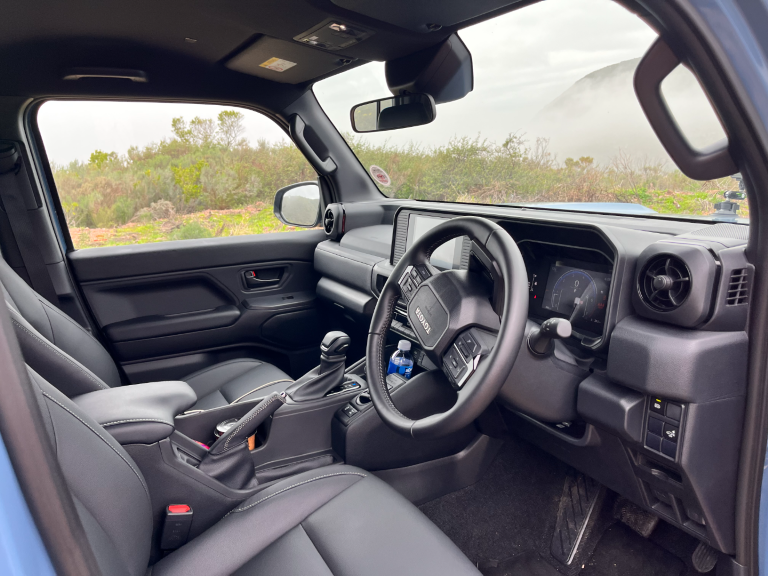
The cockpit and dashboard design are largely horizontal, serving dual purposes: aligning with the exterior aesthetic and providing the driver with minimal distraction and excellent forward visibility. If you're traversing a steep incline and having trouble seeing over the bonnet, the VX model has a Panoramic View Monitor that allows you a variety of 'eyes' where you need them most, for instance, when you need to know where to place your wheels without a spotter present.

While the general cockpit layout is durable, practical and ergonomic, the area below the air-con controls feels ever-so-slightly cramped; I would have liked enough space for at least two large phones. If there's one thing I don't like, it is having to put my phone in a cup holder or in the door binnacle. You can store your phone in the central armrest cubby, but then it's out of sight, and if you're the passenger, it doesn't need to be.
Shootout: New FJ vs. rivals in SA
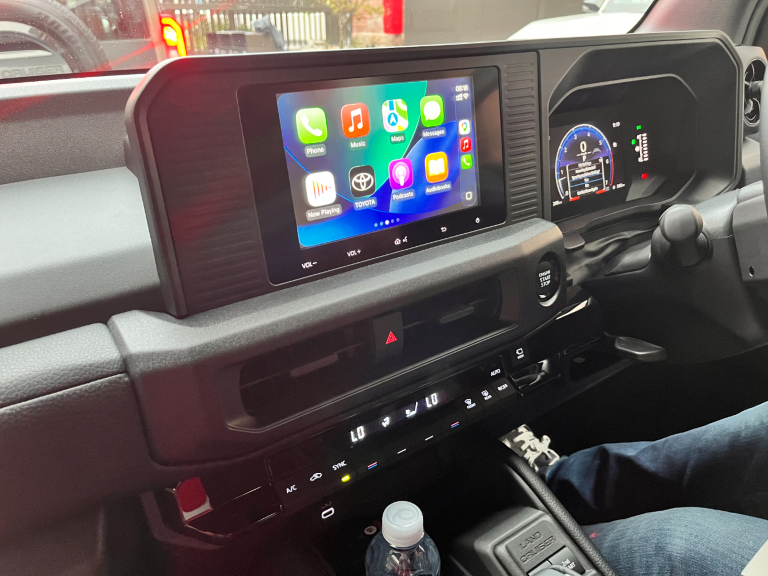
As for the touchscreen, Toyota says a larger screen for the VX is in the pipeline. While the system officially supports wireless Apple CarPlay and Android Auto, our experience is that the wired route remains the gold standard for stability. If you’re heading out on a long trail or a road trip where you need your navigation to be 100% reliable, stick to an original USB cable.
Land Cruiser FJ breaks cover at SOMI

What's it like driving the Land Cruiser FJ on tar and trail?
Whether you’re crawling up the side of a hill or cruising the smooth Western Cape tarmac, the FJ feels right at home; it’s not a million miles removed from the driving experience of a Fortuner or a Hilux. It’s smooth, easy, and reassuringly solid. The 6-speed Super ECT automatic gearbox shifts with a predictable, quiet cadence that prioritises long-term mechanical reliability over lightning-fast gear changes. It’s a deliberate, steady-state transmission that complements the engine’s character, ensuring you’re always in the right ratio whether you’re crawling through technical terrain or maintaining momentum on the highway.
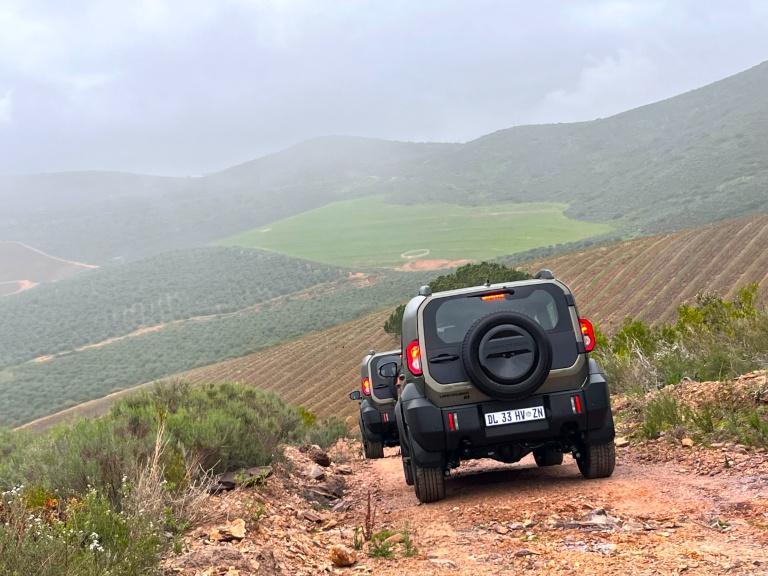
You get that familiar body-on-frame sensation over the lumps and bumps, with a soft suspension setup clearly tuned for tackling erosion gullies and pothole-strewn backroads. In fact, that shorter wheelbase, combined with superior approach and departure angles, actually makes navigating the mountainside a whole lot easier than in its larger stablemates!
I heard someone say that, at first, they thought the new LC FJ was 'just a Sandton accessory,' but that statement couldn't be further from the truth. You can also remove the front and rear bumper corners and add accessories to turn it into an epic overlanding vehicle if the stock-standard factory model doesn't blow your hair back far enough.
Why did Toyota opt for the 2.7L petrol instead of the 2.4L or 2.8L turbodiesel?
There are a few reasons for this: As a bushwhacking vehicle, the LC FJ needs one of the most reliable engines on the planet, like this 2.7 2TR-FE. With roots dating back to the mid-90s and its current iteration serving since 2004, it’s arguably one of the most proven engines in the modern Toyota stable. It doesn't rely on the latest software updates to stay relevant; it relies on three decades of being impossible to kill.
Codenamed the 2TR-FE engine, it may not be the T-Rex of dinosaur engines, but if I had to pick a dinosaur that best represents it, it would be the Ankylosaurus, called a 'living tank' by palaeontologists. It didn't rely on speed or sharp teeth to stay alive; it relied on a low-slung, massive skeleton armoured with bony plates, and a heavy, club-like tail for defence.

Much like the 2TR-FE, which prioritises a robust, simple cast-iron architecture over complex, failure-prone electronics, the Ankylosaurus wasn't built to win a sprint. It was built to endure. It didn't need to outrun the competition to win; it just needed to be the only one still standing when the others had long since fallen.

There is a more cynical business reality here, too. If Toyota had dropped the 150 kW / 500 Nm 2.8L GD-6 turbodiesel into the FJ, they would have essentially created a Fortuner-killer. You’d have a shorter, more rugged, and arguably cooler-looking off-roader with the same heart as the family SUV. It would certainly siphon sales away from the Fortuner, which is a bread-and-butter model for the brand.
By sticking to the 2.7L petrol, Toyota has cleverly 'firewalled' the FJ. It doesn’t compete with the Fortuner’s long-distance, high-torque skillset; instead, it sits in its own niche as a dedicated trail weapon that looks cool enough to be a suburban brawler, if you can afford the petrol. It’s a smart move to keep the product hierarchy stable, even if it leaves the enthusiast crowd wanting a bit more grunt on the open road. That said, during the press briefing, the team hinted that they are considering a diesel powerplant for future LC FJ models.
How thirsty is it?
Neither my co-driver nor I have a lead foot, and we weren't out to test the FJ’s performance limits, save for the odd overtake. We stuck to a steady 110–120 km/h cruising pace. Should you need to put some distance between yourself and a truck on the N1 in a hurry, the power is there, though if your primary mission is towing a heavy trailer or caravan, a turbodiesel’s low-end grunt will always be the superior choice for the job. The new FJ's braked towing capacity is 2500 kg.
After our romp on the mountain trails near Kloovenburg and a stretch of tarmac on the N7, our trip computer settled at a relatively decent 12 L/100 km. Earlier, when we were tracking along the N7, we saw figures closer to 11.5 L/100 km. Keep in mind these are brand-new, unrun-in units; fuel consumption will likely improve once the mechanicals have bedded in and the highway miles start racking up. The expected range for one tank, based on 12 L/100 km, is around 500 km.
The verdict
The 2026 Toyota Land Cruiser FJ is a refreshing dose of reality in a segment obsessed with screen real estate and digital gimmicks. It isn’t the fastest, it isn’t the most spacious, and it won’t win any drag races. But it’s honest, looks fantastic, and it’s built to survive. It reminds you why you started driving off-road in the first place. It’s not for everyone, and that’s exactly why it’s brilliant.
Want to dive deeper into the full spec list or compare the GX and VX models? You can find the official 2026 Toyota Land Cruiser FJ brochure here.
Throwback: How good is the original Toyota FJ Cruiser for families?