First introduced in 2011, the Toyota FJ Cruiser sparked a fit of nostalgia in the motoring market with its traditional styling. The Japanese SUV was inspired by the original FJ40 produced in the ’60s and retained the round headlamps and grille styling on the earlier models, however, with a modern take. The model grew in popularity and 2013, around 70 FJ Cruisers found a new home every month.
Related: Is the Toyota FJ Cruiser good for families?
In 2013, Toyota gave the FJ Cruiser an update which not only saw some stylistic changes made on the exterior but an additional 87-litre fuel tank added as well as a clever and convenient Crawl Control driver-assist function. The FJ Cruiser is offered in two trim levels encompassing Standard and Sports Cruiser. The latter see even more chrome detailing and a Raven Black paint finish added.

Off-road
The Toyota Cruiser model has gained popularity over the years for its off-road capabilities and the FJ Cruiser is no different in this regard. Offering 245 mm ground clearance, an impressive 29-degree break-over angle with a 34-degree approach angle and 31-degree departure angle, the Cruiser can crest some of the toughest terrains. Add to this the Crawl Control function and it even becomes easy to do so.
The Crawl Control driver-assist system controls the vehicle speed whether navigating up or down an incline. This is done by limiting the engine output and regulating the brake hydraulic pressure. This allows the driver to take their feet off the pedals and on focus on steering the vehicle where it needs to go.
Specifications
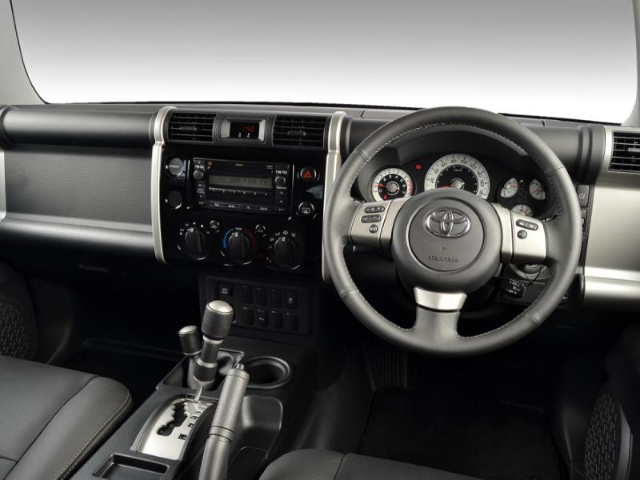
Although the interior trim conveys a premium feel, the infotainment specifications are limited. The FJ does, however, feature Bluetooth, USB and AUX connectivity as standard as well as a six-speaker audio system. The driver further benefits from a multifunction steering wheel. Also, occupants can expect air-conditioning, electric windows, ABS, EBD, Brake assist, vehicle stability control, and 6 airbags as part of the package.
The FJ Cruiser continues its rugged theme with hard plastic surfaces in the luggage compartment which can be hosed down should it soil during adventures. The rear bench, while not offering much room, will prove ample for children and is capable of folding flat in a 60:40 configuration should you require the extra loading space.

Engine
Under the bonnet features a 4.0-litre, V6 petrol motor coupled to a 5-speed automatic transmission. The combination results in 200 kW and 380 Nm of torque but it does come at a price. Toyota claims a combined fuel consumption return of 11.4 L / 100 km, however, in urban traffic conditions you can expect closer to 14-18 L / 100 km.
Recommended next: