
Top 3 things you need to know about the Porsche Panamera
Now well into its second generation, the Porsche Panamera has always been the opposite of a “traditional” Porsche. Four doors, a big V8, and a liftback body style made for a very different kind of car to its lightweight sports car siblings. But it’s since become one of Porsche’s best-selling models, and the current model is very good-looking too. Let’s look at the top 3 things you need to know about the Porsche Panamera.



From portly to sporty
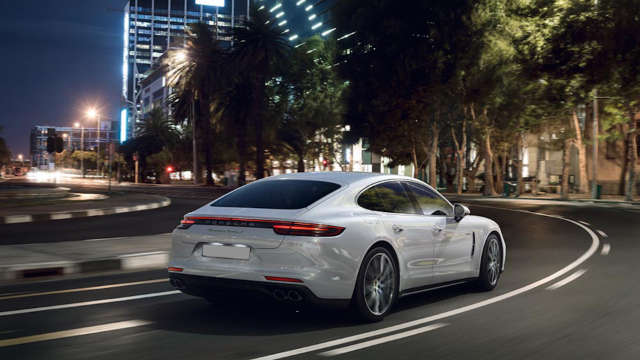
Let’s be perfectly honest here: the original Panamera was not exactly pleasant to behold – and that’s putting it mildly. The reality is that sports car proportions (especially ones as unique as those of a 911) simply didn’t translate at all well to a 4-door form factor.
The stylists’ insistence that the first-generation Panamera had to look like an elongated 911 simply resulted in a shapeless blob of a car, and, while it sold in very respectable numbers and performed the way you’d expect from a real Porsche, it always remained the ugly stepchild in the family. Fortunately, the designers eventually realised this, and decided to give the second-generation Panamera an crisply defined and well-proportioned identity of its own – and it’s all the better for it.
Related: Porsche Panamera vs Mercedes-AMG GT63 S vs Aston Martin Rapide – which one is the best value for money?
1. Forget about diesel power, it’s all about hybrids now
One of the reasons for the original Panamera’s success originated in the availability of diesel power: at various stages in its life, the Panamera could be ordered with the VW Group’s corporate V6- or V8 turbodiesel engines, to give a very satisfying blend of torquey performance and frugal drinking habits.
But then came the nasty “Dieselgate” scandal, the fallout of which eventually led to Porsche dropping diesel engines altogether. Instead, the German engineers decided that their future really lies with electrification, giving rise to a slew of hybrid Panameras.
In fact, out of the currently-listed nine new Panamera derivatives available in South Africa, four have plug-in electric assistance. All Panamera hybrids feature a 100 kW/400 Nm electric motor, making for a hybrid model range with system outputs of 340 kW/700 Nm or 412 kW/750 Nm (when mated to the 2.9-litre turbo V6 petrol), or 514 kW/870 Nm (when applied the 4.0-litre turbo V8 petrol).
Petrol-only power units vary between 243 kW and 450 Nm in the entry-level (V6) Panamera, 353 kW and 620 Nm in the mid-range (V8) Panamera GTS, and 463 kW and 820 Nm in the (high-power V8) Panamera turbo S. With such a spread of outputs and drivetrain types, there’s sure to be a Porsche Panamera to suit the need of any executive in a hurry.
Related: Which Porsche Panamera is better – petrol or hybrid?

2. It comes in two sizes
As with the first-generation Porsche Panamera (since its 2013 facelift), the latest generation can also be had in two sizes. While the gorgeous Sport Turismo (shooting brake) body style doesn’t appear on local price lists, the normal 4-door fastback is available with two wheelbase sizes (with a commensurate increase in their overall lengths).
Unlike the stretched first-generation models, local LWB second-generation models come only with lower- to mid-level trim, and carry an “Executive” label. High-performance Panameras (turbo S and turbo S e-Hybrid) are only available with the standard (shorter) wheelbase, in keeping with their sportier intent.
Related: Get all the info about the Porsche Panamera Executive LWB variants here.
3. A supercomputer on wheels
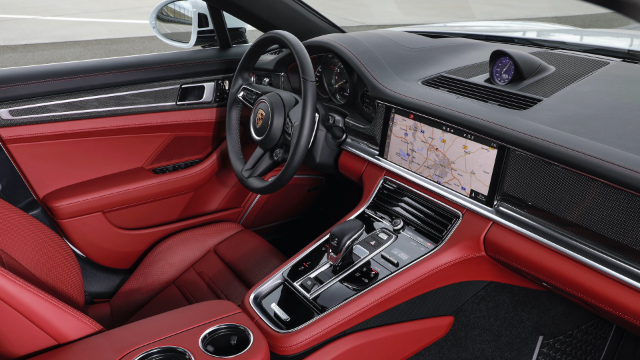
In keeping with its range-topping status, the Porsche Panamera has always been a high-tech car, but the second-generation steps the computing power up another few notches. This is only logical, really, especially seeing as it now features the latest in connectivity, a multitude of digital display screens, and highly sophisticated chassis- and traction management systems.
To get an indication of the massive complexity inherent in the current Panamera, consider some statistics. The first-generation car already had a not-inconsiderable 70 electronic control units, but the latest one takes that up to 112 – thanks in part to a new rear-wheel steering system, independently adaptive (four wheel) air suspension, and the switch to touch-sensitive panels instead of the old car’s physical switches.
Now remember that all these control units need to be programmed, and also need to communicate with each other, and it becomes only logical that the software at play is equally advanced. From only (!) 2-million lines of code in the old car, the new one has at least 100-million lines of code. To get an idea of scale, consider that a modern jet airliner typically has up to 15-million lines of code, and it soon becomes clear that the new Panamera is among the most-advanced cars on the market at the moment.
Related: Porsche Panamera 4 Review - Zuffenhausen builds a great limo!
