
Top 3 things you need to know about the Mercedes-Benz CLS-Class
Now into its third generation, the Mercedes-Benz CLS has always been a polarising design. The latest one is arguably the best-looking yet, but its market positioning has changed slightly over the years: it’s evolved into more of a grand tourer, rather than the all-out speed freak of yore. Let's investigate the top 3 things you need to know about the Mercedes-Benz CLS-Class.



An acquired taste
The motoring world mostly stared in bewilderment when the first-generation Mercedes-Benz CLS-Class arrived in 2004. Not only were its elongated lines, tapered ends and slit-like glass area unusual, but Mercedes had the audacity to call it a “four-door coupé” as well. It probably didn’t help that the first CLS also bore more than a passing resemblance to the then-freshly-departed (and largely unlamented) Ford Falcon AU, either.
But here we are, 16 years later, and the marketplace is filled to the brim with so-called four-door coupés (and SUV-coupé mashups) of various sizes. The lines have now blurred to the extent where Mercedes-Benz offers two closely-related large four-door coupés (the AMG GT 4-door and the CLS-Class), with the main differentiator being that the one has a liftback tailgate and the other one doesn’t.

But, if you look below the surface and beyond their door counts, some other differences begin to emerge. In line with its current market positioning, the CLS-Class is the more-civilised, slightly understated variant in a model family with a multitude of extroverted offshoots.
Related: Want an AMG 4-door coupé with everything dialed up to 11? Then step this way for our review of the GT63 S 4Matic+.
1. Goodbye, V8...
For its first two generations, buyers could order a variety of V8 engines for the CLS, with both normal- and AMG-fettled derivatives being on offer. Power outputs peaked with the 2013 CLS63 AMG S, giving a very healthy 430 kW and 800 Nm from its 5.5-litre, twin-turbo V8. Earlier hot AMG variants featured the immortal naturally-aspirated 6.2-litre M156 V8 and the old supercharged 5.4-litre beast, both finding a home in the first-generation model.

But that’s all changed now. The third-generation CLS-Class can only be had with 6-cylinder engines in petrol or diesel flavour, with some hybrid tech thrown in for boosted efficiency. With a Mercedes-Benz badge, the CLS can only be had in South Africa with the wonderful new 2.9-litre inline-6 turbodiesel (CLS400d), good for 250 kW and 700 Nm. That’s considerably more than the non-AMG first-generation’s petrol V8 delivered, for some perspective.
If you prefer petrol power, you’ll have to look towards the only AMG-badged third-generation CLS, the Mercedes-AMG CLS53 4Matic+, with its sonorous 3.0-litre turbopetrol engine and mild hybrid boosts to offer 336 kW and 520 Nm. Both CLS-Class derivatives drive through all four wheels, and employ the same excellent 9-speed automatic gearbox.

And that’s it: the CLS63 S is no more, giving up its slot in the range to the fastback AMG GT63 S. Confusingly, the AMG GT 4-door is also available with the CLS53’s drivetrain (albeit with a much higher pricetag), as are the E-Class coupé (two-door) and cabriolet twins. Spread between these four body styles, there is a Mercedes-AMG “53” coupé with just about every possible door/practicality permutation.
Related: Reviewing the Mercedes AMG GT53, we were quite taken with its virtues, but taken aback at its pricetag...
2. The rear bucket seats are gone, too
One of the key differences between an earlier CLS and its contemporary E-Class sedan was the split rear seat – two deeply sculpted bucket seats separated by a console. As with the highest-performance engine, these seats also moved over to the AMG GT 4-door coupé, leaving the CLS with a conventional rear bench.

This again indicates that this generation of CLS is aimed at a different buyer profile, with a greater emphasis on being an effortless and comfortable all-rounder and toning down on the sporting pretenses. But don’t let the rear bench seat fool you, because headroom is still severely limited by that sloping roofline. And, even with its frameless side glass, entry and egress to the rear is less than graceful. A normal E-Class will be the better bet if practicality is a strong consideration.
Related: In this review of the Mercedes-AMG CLS53, we were hugely impressed by the cutting-edge engine – among other things!
3. It’s still plenty quick
All this talk about a more-relaxed kind of CLS-Class may make this model sound less than exciting, but that’s not an accurate assessment at all. Yes, a 4.0-litre twin-turbo V8 with, say, 430 kW would have been nice, but in reality, even the “entry-level” Mercedes-Benz CLS400d has quite enthusiastic get-up-and-go. Its claimed 0 – 100 km/h sprint in 5.0 seconds is quite far to the fast side of respectable, and places it quite close to the previous-generation’s non-AMG V8 petrol variant on acceleration.
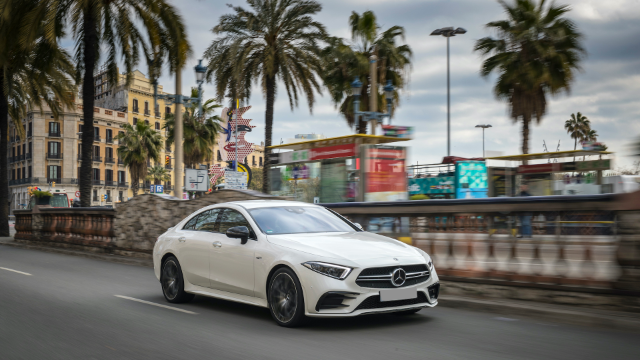
In its turn, the CLS53 dispatches with the same run in 4.5 seconds – almost as quick as the previous base-trim CLS63, but rather far off from today’s V8-engined E63 S and GT63 S. The upshot is in the performance-per-Rand area, where the CLS53 costs about as much as an E53 coupé, almost R 800 000 less than an E63 S, and less than half as much as a GT63 S.
Related: This review will tell you everything about the stellar Mercedes-AMG E53 Coupé.
Mercedes-Benz/Mercedes-AMG CLS-Class range pricing (before options)
CLS400d 4Matic: R 1 342 260
CLS400d 4Matic AMG Line: R 1 390 360
CLS53 4Matic+: 1 683 320
* Pricing was accurate at the time of writing, but may change without prior notice.

Recommended Next:
Shop for new and used Mercedes-Benz CLS-Class cars for sale here.
Shop for new and used Mercedes-AMG CLS-Class cars for sale here.