1. It’s not as small and impractical as it looks
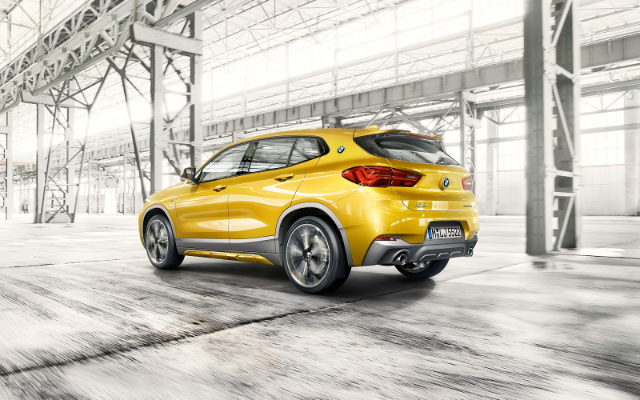
The X2 is a mean and sporty-looking crossover that has eyes following it whenever it goes. The sloping roofline, high beltline and wide C-pillar would lead you to believe the interior is cramped and the boot too small. This isn’t really the case, as even average-sized adults are quite content on the rear seat, as long as they’re not six feet tall or sitting three in a row. At least the backrests recline should the rear passengers feel the need to sit lower. These same occupants will be pleased to know that they’ll have their own designated air vents too.
As for the boot, yet again there’s a reasonable amount of space of 470 litres vs. the X1’s 505, even if the X2 boot opening is a little narrow. The X2 isn’t the crossover with the most ground clearance so lifting heavier items into the boot doesn’t feel like a Crossfit exercise.
Related: BMW X2 launch report (2018)

2. South African X2 models have M Sport suspension as standard
Instead of forking out extra cash to make your X2 more agile, South African
models have this extra bit of kit added. I suppose BMW is being this generous in order to give the X2 an additional edge over the more family-orientated X1, which can be had with M Sport suspension as well, but as an added extra. M Sport lowers the suspension and makes it tauter for improved corner-carving abilities. It will never quite feel like a low-slung sports hatch, but you’ll feel more in touch with the road below you. Not ideal for dilapidated roads, but if you’re a city-dweller who will mostly encounter smooth tar, it’s rather nice. You can always spend a bit more on adaptive air suspension if the ride quality is a bit too hard for your liking.
The X2 rides on 19-inch wheels, but 20-inchers can be specced for maximum effect.
Related: The BMW X2 - An acquired taste
3. The diesel model is going to give you mileage ad infinitum
The current engine line-up has a 1.5-litre turbo-petrol and 2.0-litre turbo-petrol- as well as turbo-diesel models, mostly sDrive or front-wheel driven. The all-wheel drive X2 xDrive model is only available in diesel.
The BMW X2 sDrive 20d M Sport, R752 430, is highly efficient and it doesn’t skimp on power either. This 2.0-litre turbo-diesel engine offers 140kiloWatts’ worth of grunt and 400 Nm of torque. The 0-100 km/h run is over and done with in 7.9 seconds, only 0.2 seconds slower than the X2 sDrive 20i M Sport (R720 834).
The manufacturer’s usage for the diesel X2 is rated at 4.9 litres per 100 km, but real-life consumption figures are likely to be closer to 5-7 on average. That’s still very economical if you consider how much power you have on tap. Based on the figure by BMW, a thousand-plus kilometres from one 51-litre tank is quite possible, and should you wish to travel further on a regular basis, you can spec your fuel tank to hold 61 litres’ worth of diesel.
The entry-level BMW X2 sDrive 18i M Sport, at R677 924, has 103kW and 220Nm available and makes the 0-100 km sprint in just under 10 seconds. The flagship model of the range, the X2 M35i, has a whopping 225kW and 450Nm of raw power. The 0-100 km/h sprint is done just under 5 seconds.
Pricing for the X2 M35i (with 225kW) is R899 374, while the X2 xDrive20d M Sport (also 140kW) is going for R785 268.

Recommended next:
Which BMW X2 is better, diesel or petrol?