I've been waiting to compare the 5-door version of its 3-door sibling since the new derivative launched locally in 2023. I recently had my first experience in the 5-door, and I brought my 3-door model into the equation to see how it measures up!
Related: Suzuki Jimny Gathering 2025 is coming!
Styling
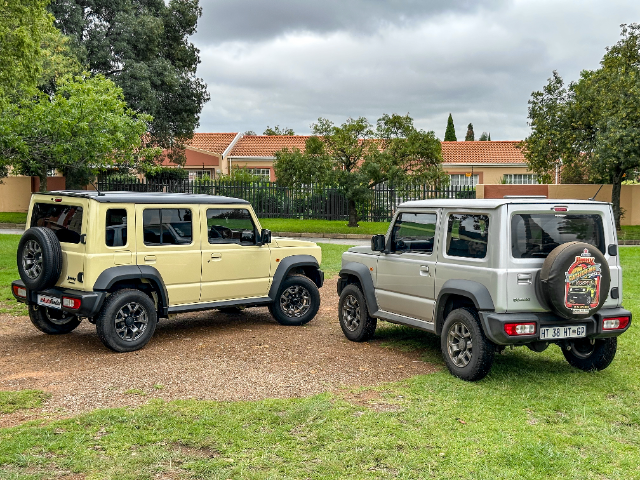
When it comes to picking a winner between the 5-door and 3-door Jimny from an aesthetics perspective, subjectivity plays a big part! I feel that the 3-door is the better-looking product. It looks compact and purposeful, and its matte black grille is more understated than the grey and chrome-accented version on the 5-door. I also find the side profile of the 5-door to look ungainly compared to the 3-door.

Interior
The interior of the 5-door and 3-door Jimny models are broadly similar; however, there are some key differences, with the 5-door featuring a larger 9.0-inch infotainment system versus the 7.0-inch system in the 3-door. The newer 9.0-inch unit responds faster, has better resolution and features wireless Apple CarPlay and Android Auto. The information display in the instrument cluster is also updated in the 5-door model, with white backlighting, which does not look as integrated as in the 3-door model. Both models exhibit the same poor-quality audio system, which becomes increasingly ridiculous with each price increase on the models. Overall, the quality of the interior seems similar, which is good considering that my 3-door was built in Japan. In contrast, the 5-door was built in India, showcasing a similar level of quality control between the two production facilities.

Fuel consumption
Practicality
Regarding practicality, the 5-door Jimny presents a more usable package, with a 211-litre boot with the rear seats in place, versus just 85-litres in the 3-door. The rear occupant space in the 5-door and the added benefit of rear doors make this a more rear passenger-friendly machine. An area where the 5-door struggles is in low-speed manovreability, with the 3-door being noticeably easier to park and move around tight spaces thanks a 9.8 metre turning circle, versus an 11.4 metre turning circle in the 5-door.

Driving comparison
Having access to both cars, I drove them along the same route to get a feel for things. The 5-door shines versus the 3-door when heading out onto the open road, with its longer wheelbase endowing it with better stability at speed. On the highway, where the 3-door can feel battered by crosswinds and lack stability, the 5-door feels more substantial and generally handles speeds between 80-120km/h far better. Around town, the 3-door's 105kg weight saving and smaller footprint make it easier to use. However, I noted that the 3-door exhibited slightly more transmission and engine noise than the 5-door, so perhaps the newer car has slightly more soundproofing.
It is also interesting to note that the standard tyres fitted to the two models differ, with the 3-door having Dunlop Grandtreks and the 5-door Bridgestone Duelers. Overall, in my opinion, the 5-door wins in the road comparison, managing to feel more substantial at higher speeds while not losing too much manoeuvrability at low speeds.
Off-road ability
While both of these products are superb when heading off-road, the 3-door model wins in the off-road department, with a better approach, breakover and departure angle versus the 5-door model. Both products come with road-bias tyres, with the 3-door shipping with Dunlops and the 5-door with Bridegstones. Both models have the same 210mm of ground clearance, but it's an easy win for the 3-door here, which feels lighter, turns through tighter obstacles better, and can traverse steeper and more intense off-road conditions.
| Angle (degrees) | 3-door | 5-door |
| Approach angle | 37.0 | 36.0 |
| Break-over/ramp angle | 28.0 | 24.0 |
| Departure angle | 49.0 | 47.0 |

Pricing*
There's a R30 000 price difference between the two models, but many may find the 5-door worth the extra amount for its added practicality.
| Model | Price |
| Suzuki Jimny 1.5 GLX AllGrip 3-door manual | R 427 900 |
| Suzuki Jimny 1.5 GLX AllGrip 5-door manual | R 457 900 |

Verdict
Having had a 3-door Jimny for nearly seven years, the 5-door was an eye-opening experience. If I had the choice between the two models, I would choose the 5-door model as it offers more practicality and the ability to tackle road trips more easily while coming with a relatively modest price increase. For those who want to modify the car for off-road use or do not need the added practicality or high-speed stability of the 5-door, the 3-door remains a great option! One thing is for sure, though: the Jimny is not nearly as affordable as it once was!