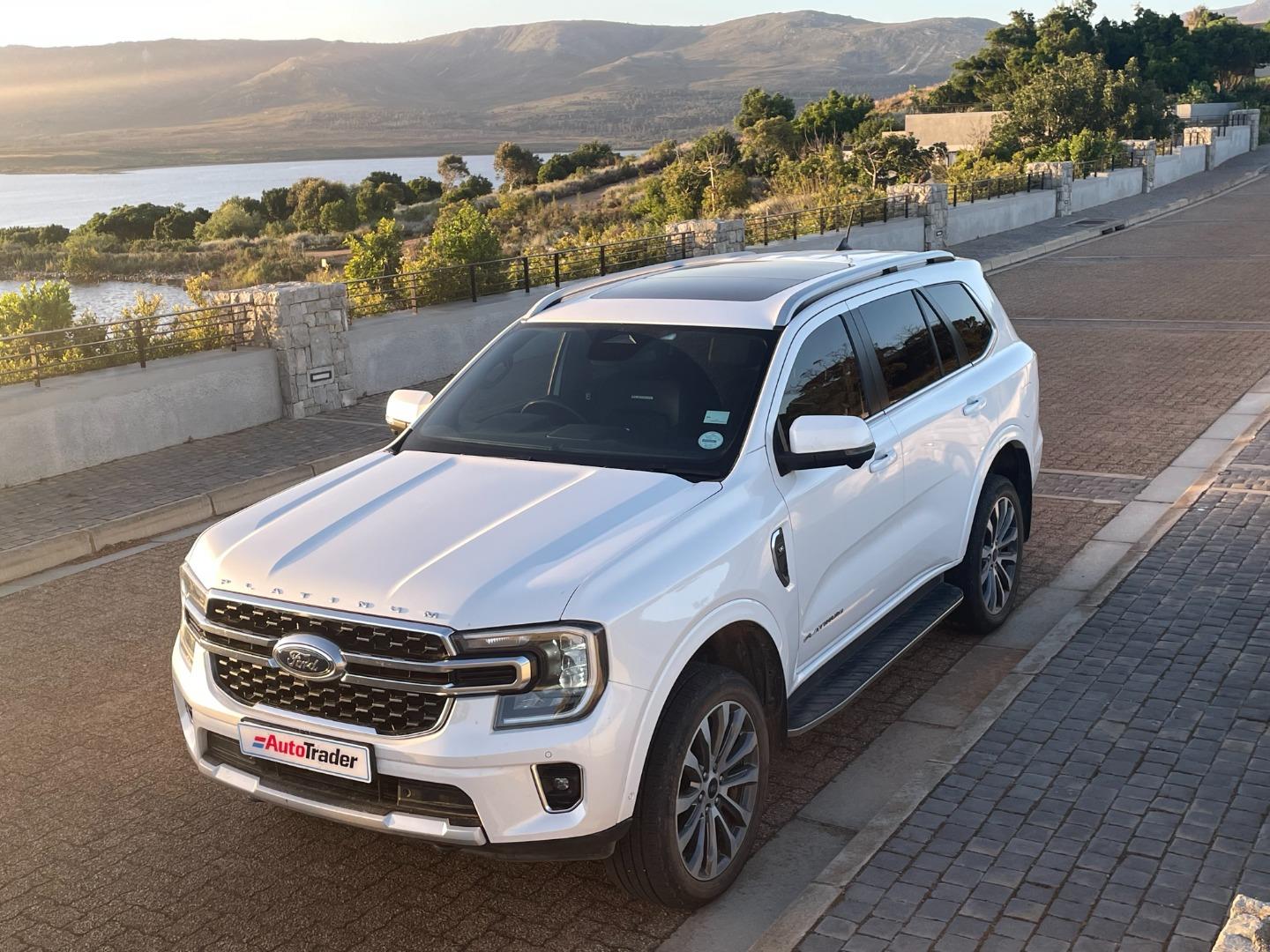
So you've bought a new Ford Everest 2.0 BiTurbo. Good choice: This isn't some mall-crawler SUV pretending to be capable; it's a proper seven-seater that'll haul your family to the Drakensberg, tow the caravan to Plett, and tackle the school run without breaking a sweat.
But here's what nobody tells you at the dealership: Ford's claimed 7.5L/100km is about as realistic as load-shedding ending permanently. Real owners on forums like 4x4Community report around 10-13L/100km in mixed driving. That's still reasonable for a 2 200kg seven-seater SUV. (Read Chad's review on the '24 model here.)
It cranks out 154kW and a hefty 500Nm of torque at just 2,000 r/min for lovely pulling power, and delivers the goods right where you need it. At a more honest 12L/100km, you're looking at about 638km range. Still, Johannesburg to Durban on one tank, just with a fuel stop thrown in for good measure.
Read our Ford Everest XLT Review from '23 here.

Diesel vs petrol: It's not just about fuel
Most people think efficient driving is the same whether you're burning petrol or diesel, but there are a few differences.
Petrol SUVs respond well to quick throttle inputs and work best when you keep them spinning. They're happier in city traffic, where you can use their responsive nature.
Diesel engines are more like patient Ridgebacks. They are powerful, steady, and built for the long haul. They don't like being rushed; they prefer consistent work, and they'll punish you if you treat them like sports cars.
Your Everest's bi-turbo diesel wants to cruise, pull loads, and have long, steady drives where it can settle into its rhythm and deliver that 500 Nm without effort. Feed it this kind of driving, and you will likely see 10L/100km on highway runs. Abuse it in city traffic, and you'll be pushing 13-14L/100km.

The numbers from real Everest owners
Forget Ford's lab-tested figures. Here's what actual forum users are experiencing after thousands of kilometres:
Mixed suburban and highway driving: 11-13L/100km (this is your reality)
Best case highway cruising: 9-10L/100km (one forum user reported 10.6L/100km as their best)
City stop-start traffic: 12-14L/100km (where diesels suffer)
Towing your caravan or boat: 13.5-15.5L/100km (forum reports confirm this range)
Family road trips with full load: 13-15L/100km (seven people plus luggage add up)
One long-term owner on 4x4Community reported an average of 13L/100km after 12,000km of real-world driving, including some towing. Another managed 10.6L/100km as their best figure with careful driving. That's the honest spread you're looking at.

Why the massive gap between claimed economy and real life?
At a constant 90km/h, no air conditioning, perfect roads, minimal load, and a following wind, it's easy to get good consumption. But things change if you're driving in Johannesburg traffic with the aircon on full blast, seven seats occupied, school bags, sports gear, and weekend camping equipment stuffed in every available space.
Ford Everest Wildtrak 2023 Review
But here's the thing - even at 12L/100km, your Everest is still drinking sensibly for what it is. Compare that to:
- Equivalent petrol V6 SUVs: 15-18L/100km
- Toyota Prado V6 petrol: 16-19L/100km
- Land Rover Discovery petrol: 17-20L/100km

Fuel-saving secrets
So what should you do differently to conserve that liquid gold?
Stop babying cold starts. Your Everest doesn't need five minutes of warm-up like old-school diesels. Thirty seconds and you're good to go. But those first few kilometres matter; keep it gentle until the engine temperature settles.
Use the bi-turbo magic wisely. That 500 Nm of torque kicks in at just 2,000 rpm, but turbos need time to spool up. Gradual acceleration works better than sudden throttle stabs that just make the turbos work harder.
Highway efficiency exists, but it's limited. Find your sweet spot around 100-110 km/h. Push it to 120-140 km/h and rapidly watch consumption climb. (I have a family member who insists on driving no more than 100 km/h from Gauteng to Cape Town. It's tedious, but his Ford Ranger's fuel consumption is excellent.)
Weight management is crucial. You may have bought a seven-seater to carry people and stuff, but every extra kilogram hurts. At 2,200kg unladen, your Everest is already carrying solemn mass. Those golf clubs that live permanently in the back, the camping chairs from last summer, and the "emergency" tool kit are all drinking your diesel.
Terrain modes matter for efficiency. Don't forget to engage Eco mode for highway cruising.
Ford Everest 3.0 V6 Review (2023)
The petrol SUV comparison
Your mate with an ageing petrol Prado V6 would easily burn 16-18L/100km in similar driving. That's a massive difference. Over 20,000km annually, you're saving thousands in fuel costs despite the higher diesel servicing requirements.
Petrol's advantages? Cheaper initial servicing, quieter at idle, and sometimes marginally better in pure stop-start traffic. But diesel still makes financial sense in an SUV world where you're expected to tow, haul families, and cover serious distances.

Keeping your Everest in good shape
Between services, maintenance directly affects fuel consumption.
- Check your air filter every 10,000km, especially if you drive dusty roads. A clogged filter can push consumption from 12L/100km to over 13L/100km.
- Keep those tyres properly inflated. Seven seats and 4x4 capability mean substantial tyres that create serious rolling resistance when under-inflated.
- Use the specified engine oil grade. Bi-turbo diesels are particularly fussy about lubrication - wrong viscosity increases internal friction and kills efficiency.
- Give it regular highway runs to keep the DPF (diesel particulate filter) happy. City driving doesn't get it hot enough to self-clean, leading to reduced efficiency over time.

Money talks
At current diesel 50ppm prices around R20.20 per litre, realistic fuel consumption makes a real difference when covering family-SUV distances. Based on 20,000km annual driving:
Careful driving (11L/100km): R44 440/year
Typical driving (12L/100km): R48 480/year
Heavy-footed driving (14L/100km): R56 560/year
That R12,120 difference between efficient and wasteful driving pays for a family holiday at the coast.
Compare this to an equivalent petrol V6 SUV burning 17L/100km at R22.15/litre: R75 310/year. Your diesel saves nearly R27 000 annually in fuel costs - enough to justify the higher purchase price and service costs within 18 months.
Even compared to more efficient petrol SUVs, which do 14L/100km, you're still saving over R14,000 per year in fuel alone.

The honest truth
Your Ford Everest 2.0 BiTurbo will realistically give you around 10.6 -13L/100km in mixed family driving. That's not Ford's marketing figure, but it's what forum users with real-world experience are getting after thousands of kilometres.
The bi-turbo setup delivers solid performance, but it's still a substantial SUV carrying substantial weight.
Drive smoothly, think ahead, maintain it properly, and you might creep closer to 11L/100km average.
Budget for 12L/100km in real-world mixed driving, and you'll never be disappointed. At current diesel prices of R20.20/litre, that works out to about R4 848 per month for typical family driving covering 2,000km monthly.
Your Everest is efficient for what it is: a proper seven-seater that can tow 3,500kg and wade through 800mm of water. That capability comes with fuel consumption reality, but at least diesel prices make it affordable.