
Renault Sandero vs Suzuki Swift vs Polo Vivo: here's our winner.
Renault’s Sandero is aging gracefully, it has to be said. It’s been around for almost 8 years, but judicious updates through the years have kept it fairly competitive against fresher opponents. But is this enough when its pricing overlaps with some very appealing alternatives? We compare it to the Polo Vivo and Suzuki Swift to decide which one wins our approval.



Cheap shots
The budget supermini segment is one of the busiest on our new-car market. And, thanks to growing buyer’s interest in this segment, the number of participating manufacturers has grown in leaps and bounds. But some long-standing names remain firm favourites, at least for the moment: both the Renault Sandero and Volkswagen Polo Vivo have built up loyal fan bases over the years. Neither are thrilling to drive, but they both offer plenty of space and reasonable performance at a fairly affordable price.

But their continued market leadership is by no means guaranteed, because some newer contenders offer similar attributes in a more-modern wrapping. One of these new-generation challengers is the Suzuki Swift. Still fresh after being all-new for 2018, the higher end of the Swift’s line-up overlaps on price with the low-to-mid-range Sanderos. But can the smaller Swift pose a serious challenge to the Sandero, let alone the all-conquering Vivo? Let’s meet the contenders!

Renault Sandero 66 kW turbo Stepway Expression
The middle child of the three-tier Sandero range, our Stepway Expression benchmark car is mechanically identical to the other two Sandero derivatives. It is however the least-expensive way to get the Stepway dress-up kit, which is essential to make a Sandero look its best, while its last model update left it with a rather attractive face as well.

Engine, performance and consumption
Under the bonnet, you’ll find Renault’s corporate 0.9-litre turbocharged 3-cylinder. It’s not really the most powerful (or smoothest) thing out there, but it can deliver reasonable acceleration if the driver keeps the accelerator pedal nailed to the floor.
66 kW and 135 Nm is fair for a 1055 kg car, but it will never be a winner out of the blocks – especially not with notable turbo lag working against it. Renault claims a 0 – 100 km/h sprint in 11.1 seconds, but on-road performance makes that seem a bit optimistic. The top speed of 168 km/h should be easily attainable, though.
Claimed average fuel consumption of 5.4 ℓ/100 km is a pretty decent figure, but also somewhat optimistic. If the driver shows regular tendencies towards urgent acceleration, that figure will easily climb to the mid-7 ℓ/100 km range, with mid 6 ℓ/100 km being an expected average figure for real-life use.
Standard equipment
Expression trim means entry-level in Sandero-speak, but fortunately they all come with plenty of standard features, even at this base specification level. Standard toys include air-con and power steering, 16-inch alloy wheels, cruise control with a speed limiter, remote controls for the audio system, remote central locking, electric front windows, along with the Stepway's must-have crossover-like body cladding and roof rails. That’s pretty good for its price!

Related: 5 Extras you should retrofit on a used Renault Sandero.
Safety
At this price point, the presence of stability control deserves applause. Very few of the Sandero’s opponents offer this safety system, so the fact that Renault made it standard equipment is worthy of honourable mention. It didn’t fare too badly in crash testing, either, earning a 3-star Global NCAP rating. Not great, but not terrible, either. The Sandero also comes with ABS and two airbags, so the basis for decent safety is present and accounted for.
Practicality
The Sandero’s slightly larger size counts in its favour here. It has the largest boot of this trio, and offers the most rear cabin space. Boot volume is 292 litres, and the split rear seats folds down for extra cargo space. Its tall build also endows the Sandero with a headroom advantage, even if it makes for slightly gawky proportions.

Price and value proposition
We’re talking about budget-minded cars here, so the Sandero’s price of R 203 900 is pretty decent for the space and standard equipment on offer. Half-a-class above the cheapest of the cheap, the Sandero Stepway manages to look a whole lot more sophisticated than it really is, and hides its bargain pricetag pretty well. Included in the price is a warranty for 5 years or 150 000 km, as well as a service plan for 2 years or 30 000 km. That complete package represents very good value for honest, no-frills motoring.
The competition
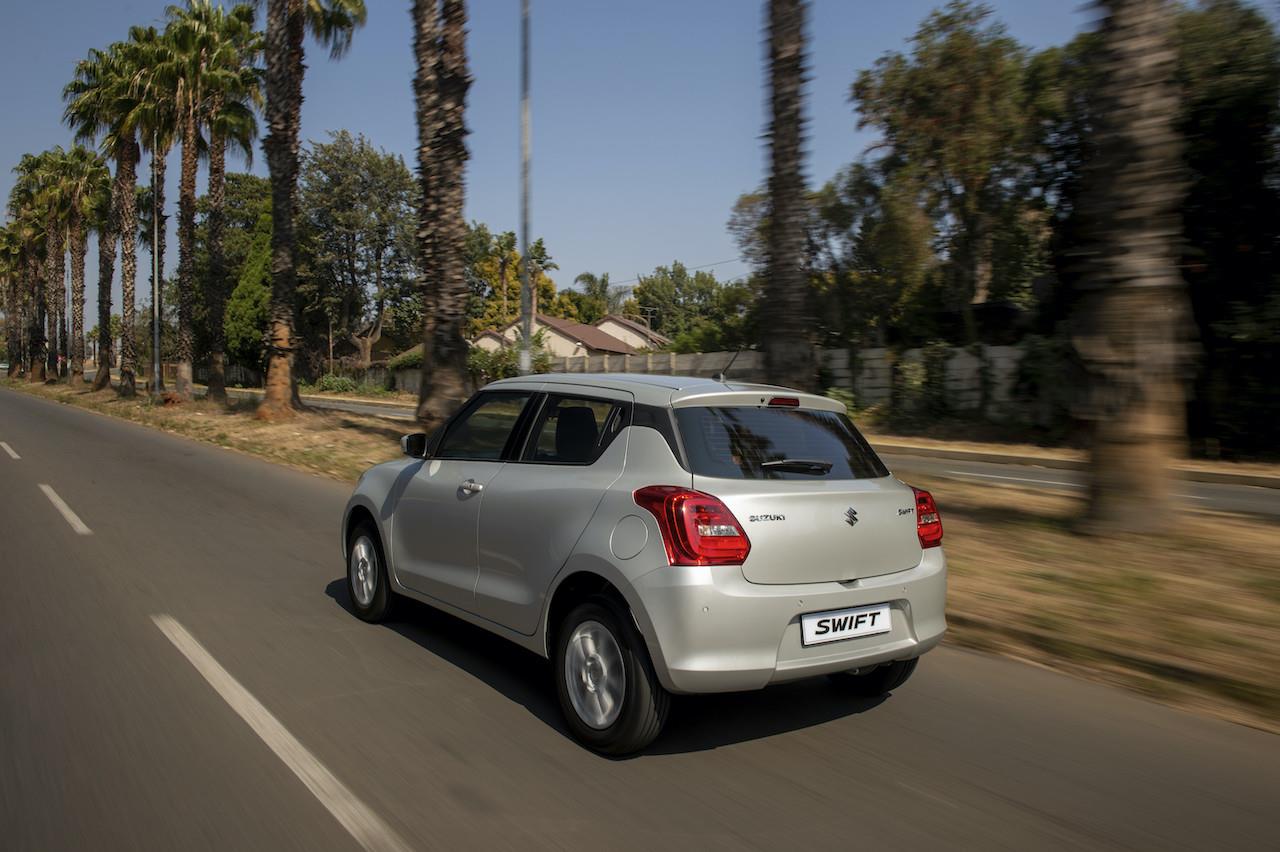
Suzuki Swift 1.2 GLX

The Swift 1.2 GLX has already proven its mettle by walking away with a value comparison win against the Vivo Comfortline and Ford Figo. But there’s more at play than just value this time around, because it has to face down yet another larger opponent. How does the small Suzuki compare?
Forward motion comes from a naturally-aspirated 1.2-litre 4-cylinder engine, powering the front wheels through a 5-speed manual gearbox. Thanks to its lightweight construction (with a kerb weight of only 875 kg), the 61 kW and 113 Nm on offer is deployed effectively enough. Suzuki claims a 0 – 100 km/h sprint in 12.0 seconds, and on-road experience supports that claim.
The top speed of 170 km/h is also spot-on for this class, but the 1.2-litre Swift’s fuel efficiency is other-worldly in any class. The claimed average fuel consumption amounts to 4.9 ℓ/100 km, and real-world driving will see easily attainable mid-5.5 ℓ/100 km average figures. This makes the Swift easily the most economical car in this group.

In this top-level GLX trim, the Suzuki has a lot to offer in terms of creature comforts. Some of the items on the standard spec sheet include power steering and climate control, a leather-wrapped steering wheel, a multi-function steering wheel, a colour touchscreen infotainment system with smartphone mirroring, keyless entry with pushbutton start, electric windows all round, electric adjustment and folding for the side mirrors, rear parking sensors, and a rear-view camera. There’s a lot of things in there for which you have to pay extra in larger and more-prestigious cars (and a lot of things the Sandero Expression could only dream about).
Related: Our top 3 things that make the Suzuki Swift stand out against the competition.
The Swift does lose out somewhat on utility- and cabin space. Front occupants of all sizes will be perfectly comfortable, but rear-seat occupant should be no larger than average-sized. That funky, low roofline exacts its toll on rear headroom, and the Swift's shorter overall length means that there’s less space to work with in the cabin and boot alike. That said, the Swift’s luggage volume of 268 litres is very impressive, given the size constraints imposed by its smaller dimensions.
The Swift's safety credentials are unfortunately not great. There are two airbags, rear ISOFIX child seat anchors and ABS on call, but the disappointing 2-star crash safety rating achieved by Indian-built 1.2-litre Swifts (which includes our non-Sport Swifts) is cause for concern. Stability control is also conspicuous by its absence, so in this regard, the Swift has to take a back seat to the Renault Sandero’s stronger crash protection and more-comprehensive safety features.

The Swift GLX is very good value for money, though. Its list price of R 199 900 makes it the least-expensive car in this group, yet it has the longest standard spec sheet of them all. Add a 3 year/100 000 km warranty and a 2 year/30 000 km service plan into the total package, and the little Suzuki’s value proposition becomes a big deal.
Related: Is the Suzuki Swift good for new drivers?
Volkswagen Polo Vivo 1.4 Comfortline

There isn’t much left to be said about the Vivo that hasn’t been said many times before: it’s a lot of car for not a huge lot of money. We mean that in the literal sense, because the Polo Vivo is very close to the Sandero’s overall dimensions. It’s also comparably equipped, which logically places it quite far behind the Swift as far as the toy count goes.
Motive power is courtesy of a 1.4-litre naturally-aspirated 4-cylinder petrol engine, which sends a class-competitive 63 kW and 132 Nm to the front wheels via a 5-speed manual gearbox. The Vivo is (barely) the heaviest car here, so it matches the Sandero and Swift quite closely on real-world performance. It can’t match either the downsized-engined Renault or frugal Suzuki on economy, though, with a claimed average consumption figure of 5.9 ℓ/100 km. Normal mixed-use consumption should be closer to the high-6 ℓ/100 km range.
Related: Read our review of the Volkswagen Polo Vivo Comfortline here.
Safety equipment is on par with that of the Suzuki and Renault, with ABS, ISOFIX anchors and dual airbags being standard fare. It’s bound to be quite a bit safer in a collision than both of the others, though – even this Vivo’s predecessor model (by then about a decade-and-a-half old) scored 3 stars in Global NCAP testing 3 years ago, and the full-fat Polo upon which the current Vivo is based scored 5 stars in Euro NCAP evaluations back in 2009 already.

The Vivo is about as practical as the Sandero, falling mid-way between the Suzuki and the Renault on luggage space, but matching or bettering the Sandero on cabin space. It’s also assembled a bit better, and feels rather more solid than its opponents.
At face value, the Polo doesn’t represent great value in this company. Its list price R 209 900 is the highest in this group, yet it doesn’t particularly shine in any area except safety credentials and perceived quality. The 3-year/120 000 km warranty betters that of the Suzuki, but falls far behind that of the Renault, while the absence of a standard service plan is a fly in the ointment, especially given its steeper pricetag.
Related: Top 3 Volkswagen Polo Vivo trims head to head: here's our winner.
Facts and figures:
Let’s quickly recap the important numbers:
|
Renault Sandero 66 kW turbo Stepway Expression |
Suzuki Swift 1.2 GLX |
Volkswagen Polo Vivo 1.4 Comfortline |
|
|
Engine size (cyl/size) |
3-cyl, 0.9-litre turbopetrol |
4-cyl, 1.2-litre petrol |
4-cyl, 1.4-litre petrol |
|
Power/Torque |
66 kW/135 Nm |
61 kW/113 Nm |
63 kW/132 Nm |
|
Kerb Weight |
1 055 kg |
875 kg |
1 066 kg |
|
Length (mm) |
4 072 |
3 840 |
3 972 |
|
Airbag count |
2 |
2 |
2 |
|
Luggage capacity * |
292 litres |
268 litres |
280 litres |
|
Top Speed (km/h) * |
168 |
170 |
177 |
|
Ave Consumption * |
5.4 ℓ/100 km |
4.9 ℓ/100 km |
5.9 ℓ/100 km |
|
Warranty |
5 yr/150 000 km |
3 yr/100 000 km |
3 yr/120 000 km |
|
Price |
R 203 900 |
R 199 900 |
R 209 900 |
* Manufacturer's official claimed figures.
Verdict
Taken on a balance of attributes, the Polo Vivo has to be eliminated first. Its higher price might be justified by its superior build quality and safety, but that sparse equipment list and lack of any service plan counts against it. It’s a very good car, but in this competitive arena, greatness still eludes the Polo Vivo.

The Swift is the next contender to be eliminated here, because there’s more at stake than just value for money and a loaded spec sheet. Those unfortunate safety credentials have to count against it in the race for ultimate glory, and its relatively compromised utility space dulls its luster when evaluated next to the spacious Sandero.

This leaves the Renault Sandero as the car we’d recommend from this particular trio. It’s not brilliant in any specific area, but its consistent strong showing makes for a good all-rounder. Add its excellent warranty and funky crossover-like looks to the equation, and the reasons why the Sandero Stepway ends up at the top of this comparison become apparent.

* Pricing was accurate at the time of writing, but may change without prior notice.
Recommended Next:
Shop for new&used Renault Sandero cars for sale here.
Shop for new&used Suzuki Swift cars for sale here.
Shop for new&used Volkswagen Polo Vivo cars for sale here.