
Range Rover Sport vs Audi Q8 vs Porsche Cayenne: here's our winner
Range Rover Sport vs Audi Q8 vs Porsche Cayenne: here's our winner


By Martin Pretorius
Few people would expect sporting aspirations is a large SUV, but that doesn’t keep the manufacturers from churning out a surprising number of appealing choices in this market segment. BMW and Porsche were two of the pioneers of this concept, and tried their best to combine all-road ability with a shot of on-road sportiness.
They were far from the only ones with an eye on a slice of this pie, however, because it didn’t take other premium manufacturers very long to also hop onto this bandwagon. The latest brand to join this bunfight is Audi, with their range-topping Q8, while the Range Rover Sport and Porsche Cayenne have already settled into their second- and third generation offerings in this class (respectively). Alert readers will notice some absentees in this comparison: the Mercedes-Benz GLE is due for replacement soon, while BMW’s X5 is less style-oriented and more slanted towards practicality, with a new BMW X6 also about to be revealed.
For this reason, we selected a mid-level variant of the Range Rover Sport, and compared it to an entry-level Audi Q8 and a mid-range Porsche Cayenne S. We selected model derivatives with base price points around the R1.3-million mark, and our spotlight fell on the 6-cylinder petrol-fuelled variants. But before we get into the nitty-gritty, let’s look at some bare statistics to reveal some interesting similarities (and major differences as well).
Facts and Figures
|
Engine size (cyl/size) |
V6, 3.0-litre supercharged petrol |
V6-cyl, 3.0-litre turbo petrol |
V6, 2.9-litre turbo petrol |
|
Power/Torque |
250 kW/450 Nm |
250 kW/500 Nm |
324 kW/550 Nm |
|
Kerb Weight |
2195 kg |
2095 kg |
2020 kg |
|
Length (mm) |
4 897 |
4 986 |
4 918 |
|
Boot volume (litres) |
780 - 1616 |
605 - 1755 |
770 - 1710 |
|
Airbag count |
6 |
6 (opt 8) |
8 (opt 10) |
|
Top Speed (km/h) * |
209 |
250 |
265 |
|
Ave Consumption * |
10.8 ℓ/100 km |
9.1 ℓ/100 km |
9.4 ℓ/100 km |
|
Warranty |
3 yr/100 000 km |
1 yr/unlimited km |
2 yr/unlimited km |
|
Price |
R 1 273 357 |
R 1 388 000 |
R 1 319 000 |
*Manufacturer's official figures.
Analysis
Power, performance, and drivetrains
These three contenders share some major characteristics in their general drivetrain layouts: they’re all powered by V6 engines with forced induction and displacements of around 3.0-litres. They all send their power to all four wheels through 8-speed automatic transmissions as well, so you could expect similar levels of traction from them all.
The Range Rover Sport starts off with a notable output disadvantage here: although its supercharged V6 produces an Audi-matching 250 kW, it’s down 50 Nm on the turbocharged Q8’s 500 Nm. However, neither of them can match the Porsche’s 2.9-litre turbo V6 in the output stakes, however, because the Cayenne S packs a full 324 kW and 550 Nm.
Combined with the lowest kerb weight in this group, this power advantage gives the Porsche the strongest performance, with a limited top speed of 265 km/h and a 0 – 100 km/h sprint time of only 5.2 seconds. The runner-up Audi isn’t too far behind, with its top speed limited to 250 km/h and a sprint time of 5.9 seconds.
Meanwhile, the Range Rover Sport’s 100 kg weight disadvantage (against the Audi) and lower torque output comes into play, with a governed top speed of 209 km/h and a 0 – 100 km/h sprint in 7.2 seconds. It is far from slow in real-world terms, but it has to concede victory to the Germans on this front, with the Porsche Cayenne S easily walking away with a victory in the performance department.
Economy
It’s unlikely that many buyers in this segment will be too concerned with fuel efficiency, but it’s worth noting nonetheless. This is where the Audi scores some points, and where the Range Rover Sport has to concede defeat once again. The Porsche isn’t far off the Audi’s benchmark average figure of 9.1 ℓ/100 km, only using 0.3 ℓ/100 km more according to the manufacturers’ claims, but the Range Rover Sport clocks a whopping 10.8 ℓ/100 km official average figure.
This is most likely due to two things: the Range Rover’s engine uses a supercharger to boost its power (a setup that’s inherently thirstier than the turbos employed by the other two), and its rather prodigious kerb weight needs extra energy to move around. That said, the Ranger Rover’s engine has immediate throttle response, and feels similar to a larger, naturally-aspirated engine, rather than the obviously-boosted character of the two Germans with their traces of boost lag and softer initial responses.
Practicality
None of these vehicles could ever be deemed small, so it follows that they’re all spacious and practical as a result. Cabin space is generous for all occupants, although the Audi Q8 does hold some advantage in rear-seat legroom. The Q8 pays a penalty in luggage volume as a result, however, with the smallest cargo hold of the lot when all the seats are in use. Its 605 litres of boot space isn’t bad, though, and it holds the trump card in maximum cargo volume, by offering 1755 litres with the rear seats folded down.
The Cayenne has a much more voluminous boot than its Audi cousin, packing a full 770 litres behind the rear seat. It’s not far behind in maximum cargo space, either, with 1710 litres on offer when you drop the rear seats. In contrast, the Range Rover Sport has the largest volume behind the rear seats of this threesome, but gives up almost 100 litres to the Porsche with the seats folded away.
In the end, it all depends on priorities: the Audi has the more-spacious cabin and the highest maximum cargo volume, while the Range Rover Sport has the least space with the rear seats folded down but the most with them in use. But, on balance, the Porsche offers the best compromise between cabin room, luggage space, and overall utility volume.
Equipment and safety
All three contenders are well-covered in the safety stakes. Although it’s difficult to find model-specific data for the Q8 and the Range Rover Sport, the closely related Audi Q7 and Land Rover Discovery (respectively) both scored 5-star NCAP ratings in crash tests. The Cayenne has however been tested by Euro-NCAP, and also scored 5 stars, so it’s safe to say that there’s very little to choose between these three in crash-worthiness.
The Porsche leads the airbag race, by including knee airbags for both front seats, and leaving only rear side airbags on the options list. Next up is the Audi, which does without the knee airbags, but also has the option for rear side airbags to be added. Meanwhile, the Range Rover Sport matches the Audi’s base airbag count, but it doesn’t appear to offer additional airbags as options.
However, they’re all equipped with ISOFIX child seat anchor points, advanced stability and traction control systems, and standard LED headlights. We’ll call this section a win for the Porsche, however, simply based on the inflated number of airbags on offer.
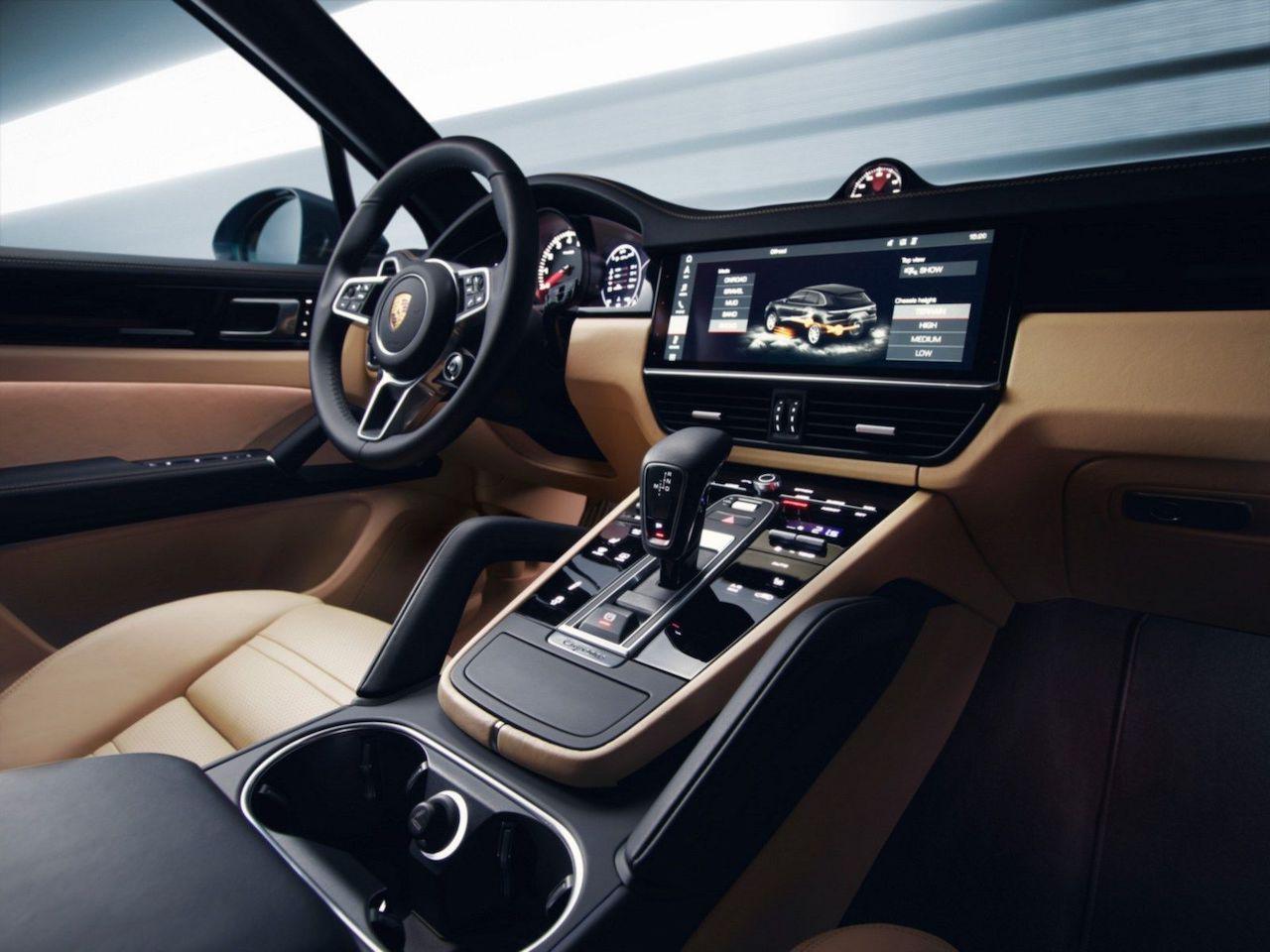
As far as standard equipment goes, it has to be noted that the Audi has the most sophisticated lighting system of this bunch, with its adaptive matrix LED headlights and animated rear light units. Their standard spec sheets are also loaded with multi-zone climate controls, touch-screens and touch-sensitive switches all over, and wheels with diameters of at least 19 inches.
It really depends on personal preference here, although the Audi is the only one with a standard panoramic sunroof. It’s also the newest design, which means that its interior trimmings and convenience features are just that little bit more modern than you’d find in the others. As such, it wins the equipment race, justifying its higher list price.
Verdict
The first car to fall by the wayside in our overall rating has to be the Range Rover Sport. It’s not really deficient in any area, but doesn’t quite have the same broad spread of abilities as the other two, either. It’s also the oldest, slowest, heaviest, and thirstiest in this group, and the German cars have more-advanced mechanical bits in their chassis technologies. Higher-trim variants are also available, but they're even more expensive than the Q8...
The next car to be eliminated is the Audi Q8. It has the most modern interior and more fancy gadgets as standard, but its slightly compromised luggage compartment and relative lack of performance (compared to the Porsche) counts against it. It also carries a serious price premium over both of the others, and while it has some nice toys to compensate, it’s hard to justify its R70 000 price premium over the faster, more-practical Porsche.
This leaves the Porsche Cayenne S as our overall winner. It has the quickest acceleration and the highest top speed, carries more stuff behind the rear seats, comes with almost all of the Audi’s bells and whistles, and its pricing puts it midway between the Range Rover and the Audi. Based on its overall spread of abilities, the Cayenne has to take this crown.
* Pricing was accurate at the time of writing, but may change without prior notice.
Related reading:
The BMW X5 is another highly accomplished sporty SUV, although it's currently only available with diesel power.