
Mercedes-AMG A-Class - everything you need to know
Mercedes-AMG A-Class - everything you need to know



By Martin Pretorius
In the beginning, AMG was only affiliated with Mercedes-Benz in the loosest sense, as independent purveyors of appearance- and performance-enhanced Mercedes-Benz cars. This all started in the late-1960s, when the firm created a racing car using the gigantic 300 SEL-6.3 as the unlikely base vehicle. Unbelievable as it may seem, this racing limousine was surprisingly successful in competition – enough to make potential customers take notice, at least.
From the track to the streets
More importantly, Mercedes-Benz also noticed AMG’s efforts, and gradually started to co-operate more closely with the independent tuning shop, greatly assisting in Mercedes’ track racing efforts through the ensuing decades. This path finally led to Mercedes-Benz acquiring a controlling stake in AMG in 1999, and buying the company outright in 2005.
And through it all, AMG’s basic philosophy remained the same: take a normal Mercedes-Benz as a starting point, and then massage it until it becomes a snorting, storming, tyre-shredding monster.
But what about the little ones?
One Mercedes-Benz passenger car missed out on AMG’s attention for years, however. Introduced in 1997, the first A-Class was a pudgy, odd-looking thing, with an emphasis on practicality above all else. The same applied to 2005’s second-generation A-Class, which shared the same priorities.
It’s quite understandable that AMG ignored this model, given that it was exclusively front-wheel driven, and it used a selection of breathless 4-cylinder engines – both elements anathema to the AMG philosophy of big engines, big power, and lots of tyre smoke.
All of this changed in 2013, however, when the third-generation A-Class arrived on local shores, complete with new-generation engines and a much sleeker (and more conventional) design. Mercedes-Benz probably watched the success of souped-up hatches such as the Golf R and Audi S3/RS3 with considerable envy, which was likely why they instructed their performance branch to remedy the matter.
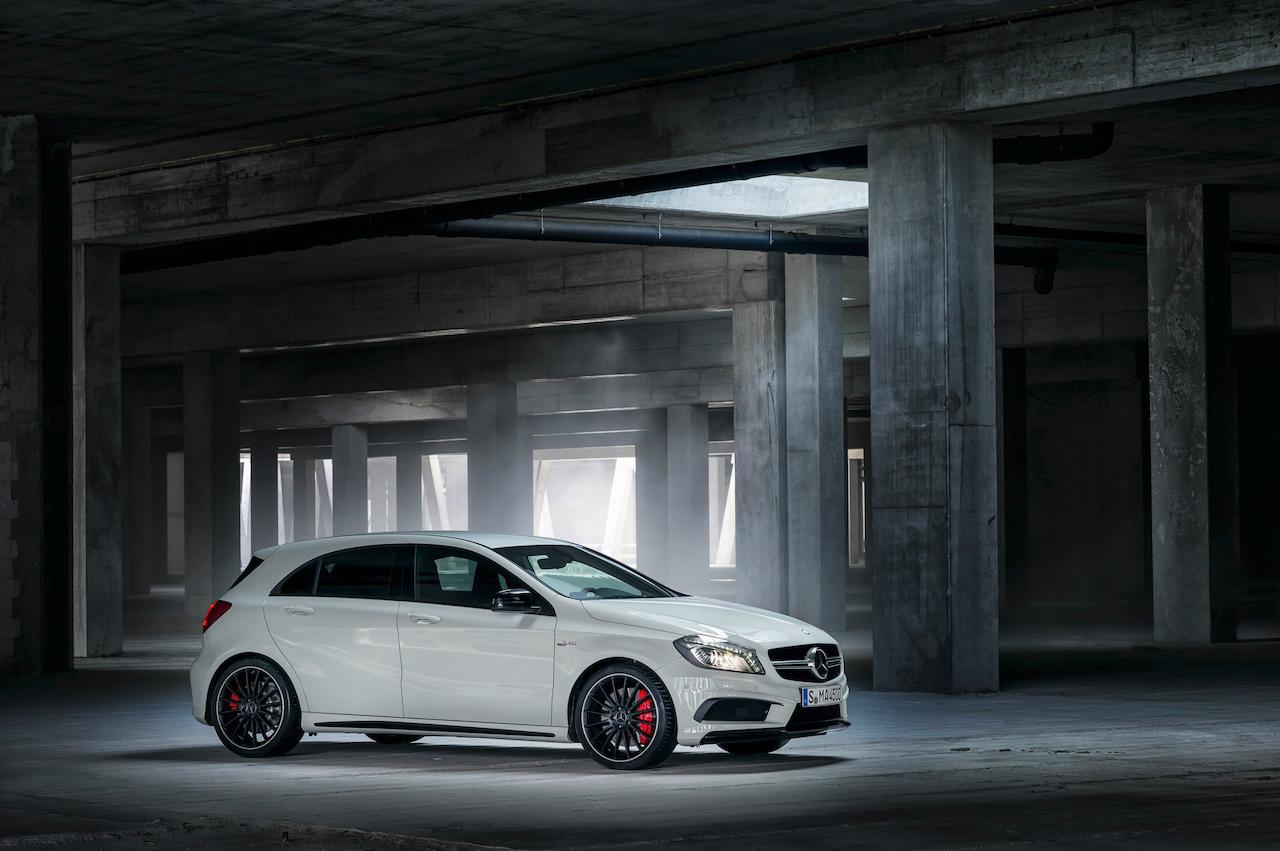
First-generation Mercedes-Benz A45 AMG
AMG finally set to work on the A-Class, and, staying true to their ethos, they pulled out all the stops. Instead of the FWD setup employed in basic A-Class, a full-time all-wheel drive system was fitted to cope with the planned power increase. A completely new 2.0-litre 4-cylinder engine with strengthened internal bits was engineered, with an oversized turbo bolted on. And, to make sure that their new road rocket actually stayed on the tarmac, the suspension, brakes and aerodynamics also received extensive attention.
The end result was explosive, to say the least. At the time of its launch, the A45 AMG boasted the highest power outputs of any production 2.0-litre engine, with power jumping from the A250’s peaks of 155 kW and 350 Nm, to an eye-widening 265 kW and 450 Nm from the AMG engine. With the AWD system getting all that power to the ground after passing through a 7-speed dual-clutch automatic, the A45 AMG’s performance was predictably shattering.
Using the launch control, a sprint from 0 – 100 km/h could be dispatched in less than 5 seconds, with an electronically governed top speed of 250 km/h. Following the 2016 A-Class facelift, power took another step upwards, with new output peaks of 280 kW and 475 Nm. The suspension was re-tuned and the AWD system reworked as well, further improving the facelifted car's cornering abilities. For the next few years, the title of “quickest-accelerating compact hatchback” alternated between the A45 and Audi's RS3 – exactly where Mercedes-Benz aimed at the outset. However, at the end of 2017, the RS3 received a power boost to 294 kW, finally dethroning the A45... for a little while, at least.
Second-generation Mercedes-AMG A-Class
Following the decision to re-brand AMG cars as Mercedes-AMG models, the A45 also received a name change to become the Mercedes-AMG A45 near the end of this generation’s production run. At the same time, Mercedes-AMG also decided to expand the brand’s reach by introducing “second-tier” variants with a little less power than the top-line cars, but with most of their charisma intact. This has given rise to models such as the Mercedes-AMG C43, E43 and E53, both of which greatly impressed us greatly when we reviewed them.
And what about the latest A-Class? Well, in the hatchback’s case, there’s a new “entry-level” AMG derivative called the A35, with outputs of 225 kW and 400 Nm, again sent through a 7-speed dual-clutch gearbox to the AWD system. This should be enough to pre-empt the power gains expected from the next-generation Audi S3 and Golf R variants.
The biggest, baddest A-Class of them all will however still be the upcoming A45, which will be offered in two states of tune. Yet again employing a 2.0-litre turbo 4-cylinder mill, the next-generation A45 will have 285 kW and 480 Nm in base trim, or 310 kW and 500 Nm in the range-topping A45 “S”. Expect the 0 – 100 km/h sprint to dip well below the 4-second mark for the fastest one.
Sadly, the A35 hasn’t been introduced in South Africa yet (though it’s sure to appear very soon, so watch this space). The A45 variants are officially still under wraps, but will see an international reveal very soon. Making an educated guess, we’d wager that the A35 will arrive locally towards the end of 2019, with the A45s to follow early in 2020.
Can't wait until next year?
If you’re looking for a new Mercedes-AMG A45 at the moment, your only hope would be that a dealer somewhere will have a first-generation car in stock, though that is becoming more unlikely with each passing day. Alternatively, you could consider the slightly larger (but mechanically identical to the first A45) CLA45 four-door, which is still available on new-car dealership floors. Don’t fret, however, because we have a number of very late-model, low-mileage examples at bargain prices, listed here on AutoTrader. But, if you’re patient, 2020 may just bring the answer to all your A-Class AMG dreams...