If you're keen on an EV but couldn't be bothered with hunting for functional charging points, Leapmotor's C10 REEV may be just the ticket.
Who is Leapmotor?
Leapmotor launched in 2015 and has quietly built a reputation in China as a tech-focused EV manufacturer. They focus heavily on what they call "full-stack self-development": basically, they design and build most of their components in-house rather than buying them off the shelf.
Leapmotor targets the mid-to-high-end market, the largest and fastest-growing segment in China, and has secured its position among the top-tier pure-play NEV manufacturers in the country.
The brand's philosophy centres around making advanced EV technology accessible and affordable, which explains why its C10, considering its tech specifications, lands in South Africa with competitive pricing.
Related: Leapmotor C10 REEV headed for SA (April 2025)

Where does Stellantis fit in?
In 2023, Stellantis (the automotive giant behind brands like Jeep, Peugeot, Fiat, and, locally, Isuzu) invested €1.5 billion in a 20% stake in Leapmotor (read more about it here). But this isn't just a financial arrangement; Stellantis gets exclusive rights to manufacture, export, and sell Leapmotor vehicles outside Greater China.
Think of it as a marriage of convenience: Leapmotor gets access to Stellantis's global manufacturing and distribution network, while Stellantis gets cutting-edge EV technology without developing it from scratch. For South African consumers, this means Chinese innovation with European backing; potentially the best of both worlds, distributed through Stellantis's existing dealer network.
“This unique partnership in the automotive industry offers European buyers access to advanced, high-value BEV technology, bolstered by the organisational and retail support of Stellantis for a customer-focused ownership experience that sets Leapmotor International apart from other Chinese competitors,” said Stellantis CEO Carlos Tavares. “Thanks to the powerful Stellantis parts distribution system, Leapmotor’s customers will benefit from an unrivalled level of service, which is an important differentiator."

What exactly is a REEV?
REEV stands for Range-Extended Electric Vehicle, and it's essentially the clever compromise between pure electric driving and range anxiety. Picture this: you've got a fully electric car with a 145km range (perfect for most daily driving), but tucked away at the front is a small 1.5-litre petrol engine that acts purely as a generator when your battery runs low.
The key difference from a plug-in hybrid (PHEV) is that the petrol engine never directly drives the wheels – it only charges the battery, which then powers the rear-mounted electric motor. So you always get that smooth, silent electric driving experience, but with the peace of mind that you can drive up to 970 km on a full tank and battery.
It's like having a portable power bank for your electric car, except this power bank happens to run on petrol. The C10 won't be the first REEV in South Africa; BMW previously offered its i3 with this configuration, but it represents a more practical approach to the concept.

What does the C10 look like?
It looks quite sleek and sophisticated, with a quirky element, but in a good way, like an ultramodern beetle visage. Built on Leapmotor's LEAP 3.0 platform, the C10's clean, contemporary exterior wouldn't look out of place in a premium European lineup.
The face features sleek LED headlights with an understated grille (thanks to the Active Grille Shutter for improved aerodynamics). The nose is purposeful rather than aggressive, with clean surfaces that suggest efficiency over ego.
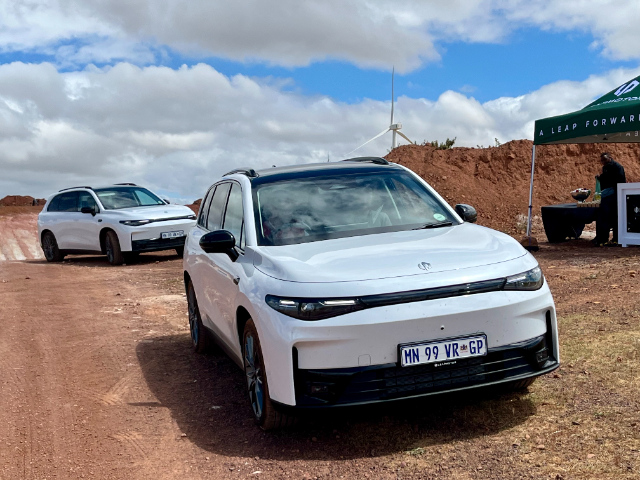
Viewed from the side, the C10 shows its practical side. At 4,739 mm long with a generous 2,825 mm wheelbase, it's designed for space rather than just style. The concealed door handles add a modern touch, while the rising beltline and 18 or 20-inch alloy wheels (depending on spec) give it a planted, substantial stance. The extended wheelbase is made possible by the brand's Cell-to-Chassis technology, which integrates the battery directly into the floor structure.

At the rear, the taillight treatment is well executed, with LED units featuring light animation – a small but effective premium touch. The roof spoiler and shark fin antenna complete a rear view that's clean and neat, and happens to be very similar to that of the Porsche Cayenne.

However, every second new car from China seems to have some premium German design influence these days.
What's it like inside the C10?
Open the door of the C10 REEV model, and you're greeted by what can only be described as a minimalist's dream – or the source of a Boomer/Gen X person's frustration, depending on your perspective.

The good stuff: The seats deserve special mention. Covered in what Leapmotor calls "OEKO-TEX certified Silicone leather" in the Design trim (the only variant on launch), they're highly comfortable for long drives. Both front seats offer heating and ventilation, while the driver gets 6-way power adjustment. The panoramic sunroof is impressively sized – we're talking 2.1 square metres of glass flooding the cabin with light and making the space feel even more airy.

Space is its real strength. The second row comfortably accommodates three adults side by side – no small feat in this class. When you need cargo space, the boot offers a practical 400+ litres with seats up, expanding to a cavernous 1,375 litres with the rear seats folded. That's enough space for a proper family holiday or a furniture shopping spree. The cabin also boasts 26 storage spaces throughout, including a deep centre console and secure spots under the boot floor for charging cables.
Build quality: Decent enough, with soft-touch materials where you'd expect them. The acoustic glass and active noise control contribute to a quiet cabin. It's not Audi-level premium, but it doesn't feel cheap either.

The controversial bit: This is where the C10 divides opinion. The interior is entirely buttonless, with everything controlled through the 14.6-inch central touchscreen powered by a Qualcomm Snapdragon 8295 chip.
Want to adjust the air conditioning? You'll need to drag your finger across the screen to direct airflow where you want it. It's undeniably clever, but not particularly user-friendly when you're driving. Apple CarPlay and Android Auto were unavailable in our model, but over-the-air updates should sort this out. We connected our phones via Bluetooth for music streaming purposes.

The voice assistant, meanwhile, isn't the sharpest at understanding requests. However, the 12-speaker, 840W surround sound system delivers impressive audio quality, making the drive more enjoyable.
What's the C10 REEV like to drive?
Stellantis planned an interesting launch route for us to find out: Hotel Verde near Cape Town International, over the scenic Franschhoek Pass, up to the wind farm near Caledon, back over Sir Lowry's Pass, lunch at Cavalli Estate in Stellenbosch, and back to base, designed to test both performance and efficiency.

Like any EV, the C10 delivers immediate, linear power. The rear-mounted electric motor produces 158 kW and 320 Nm, providing more than adequate performance: 0-100km/h in 8.5 seconds feels brisk rather than blistering. Pull out for an overtake, and the response is immediate and confident.
The C10 also offers four tailored energy modes designed to match different driving needs:
- EV+ Mode: Maximises battery use by allowing the generator to start only below 9%, perfect for extending the last miles in full electric mode.
- EV Mode: Prioritises electric driving for daily commutes, with the generator starting only when the battery drops below 25%.
- Fuel Mode: Maintains battery charge using the generator, ideal for long journeys with limited charging opportunities.
- Power+ Mode: Keeps the generator always running to ensure strong performance in demanding or low-battery conditions.
Mountain pass performance: The C10 felt sure-footed and composed on Sir Lowry's Pass and Houwhoek Pass. The rear-wheel-drive setup and well-tuned suspension (McPherson front, multi-link rear) handled the switchbacks without ease, while the regenerative braking helped keep the battery topped up on descents.

Real-world efficiency: During our mountain driving in Fuel mode (recommended for road trips), we averaged 6-7.5 litres per 100km.
Consumption varies dramatically by mode: EV/EV+ modes achieve around 15-19kWh/100km when running on battery (this is very impressive), while Fuel and Power+ modes see real-world consumption between 6.5-8.5L/100km when the 50-litre petrol tank is doing the work. The official 0.9L/100km figure appears achievable only with near-constant charging and minimal generator use.
The overall driving experience is refined and relaxing, exactly what you want from a family SUV, with the added benefit of electric vehicle smoothness regardless of which mode you're using.

How long does it take to charge?
The C10 REEV's charging capability is impressive for rapid top-ups. With DC fast charging, you can charge from 30% to 80% in around 20 minutes at a compatible fast charger.
Where to charge: The usual suspects apply – GridCars stations, selected, and an increasing number of hotels and shopping centres. The 65kW limit means you won't be able to take full advantage of the newest 150kW+ chargers, but you'll be compatible with most of South Africa's current charging infrastructure.
Home charging: Most owners will charge at home using the onboard 6.6kW AC charger, which takes about 5 hours for a full charge. This makes the most sense for daily use, given that 145km of electric range covers most people's daily driving needs.
The REEV advantage: Here's where the range extender shines – you're not dependent on charging infrastructure for longer trips. Run low on battery power between charging stations? The 50-litre fuel tank and front-mounted generator keep you going, eliminating the range anxiety that still plagues many pure EVs in South Africa.

What is the charging cost: Home vs public?
Home charging: Based on average South African electricity tariffs (around R3.50 per kWh), filling the 28.4kWh battery from empty would cost roughly R99. That's enough for 145 km of pure electric driving, working out to about 68 cents per kilometre.
Public DC Charging: Public charging rates vary significantly, but expect to pay anywhere from R4-7 per kWh at commercial charging stations. At the higher end of R7.00 per kWh (which you might encounter at a 60kW charger), that same 28.4kWh top-up would cost about R199, or roughly R1.37 per kilometre.
REEV mode: When running on petrol, the reality is quite different from official claims. While Stellantis quotes 0.9L/100km, real-world testing shows 7-9L/100km in Fuel and Power+ modes. At current fuel prices of around R23 per litre, you're looking at roughly R1.61-R2.07 per kilometre – still competitive with most SUVs but significantly higher than pure electric operation.
The reality check: Running costs are low for most users who can charge at home and use EV or EV+ modes for daily driving. The petrol engine becomes your insurance policy for more extended trips rather than your primary power source. Still, it's important to understand that fuel consumption climbs rapidly when you rely on the generator.

What does the C10 cost?
Leapmotor has positioned the C10 competitively in the South African market:
Style Trim: R759,900
Design Trim: R799,900
Both prices include a comprehensive 5-year/100,000km warranty and 5-year/100,000km service plan.
The pricing represents solid value considering that both models have the same powertrain, 5-star Euro NCAP safety rating, and comprehensive driver assistance systems; name it, and it's there. Seven airbags are standard.
How does the Style variant differ from the Design model?
Is the R40,000 price difference between the two trim levels worth it?
Both variants share the same powertrain, safety systems, and core technology, but the Design trim adds several comfort and convenience upgrades that justify the premium for many buyers.
Style trim standard features: The base Style trim comes well-equipped with dual-zone automatic climate control, electrically adjustable front seats, wireless phone charging, a 360-degree camera system, and smart access via Bluetooth and NFC key. You also get the same 14.6-inch touchscreen, 12-speaker sound system, and panoramic sunroof.
Design trim upgrades: Step up to the Design trim, and you get noticeably premium touches. The seats are upgraded to OEKO-TEX certified silicone leather (from standard leatherette), with both heating and ventilation for the front seats. There's also a heated steering wheel for those chilly mornings, multi-colour interior ambient lighting that adds a proper premium feel, an air quality monitor for the cabin, and a power-operated tailgate that's genuinely useful when your hands are full of shopping. The panoramic roof is standard on this model only.
If you appreciate the finer things and plan to keep the car for several years, the Design trim's comfort features make daily living more pleasant. However, if you're budget-conscious and don't mind missing out on heated seats and ambient lighting, the Style trim offers the same fundamental C10 experience for R40,000 less. (I would opt for the Style variant.)
Related: Should you buy a Haval H6 GT PHEV? The pros and cons

Should South Africans take the leap?
The C10 REEV is genuinely impressive as a technology and offers a practical solution to EV adoption in South Africa. The combination of daily electric driving with long-range capability perfectly addresses our unique challenges. At the same time, the four energy modes give you control over efficiency and performance to suit different situations.
However, Stellantis doesn't have the strongest reputation for reliability in South Africa, and some say parts can be expensive and sometimes difficult to source. Whether South African consumers will embrace a Chinese brand under European stewardship remains an open question. In the same breath, Stellantis is much more established than a brand like Jetour, for example.
The C10 also faces stiff competition from established Chinese brands like Haval and Chery, which have built trust through years of local presence and competitive pricing.
PHEVs (Plug-in hybrid electric vehicles) like the Haval H6 GT (R799 900) and Chery Tiggo 9 Pro CSH (from R839 900) also offer the best of both worlds: electric-only driving, low consumption figures, quick charging, and faster 0 - 100 km/h sprint times.
The Jaecoo J7 SHS PHEV is priced at R689 900, while the Chery Tiggo 7 CSH PHEV is an affordable (for a plug-in model) R619 900.
Related: Jaecoo J7 vs Haval H6 HEV vs Chery Tiggo 7 CSH running-cost comparison

The verdict
If you're ready to be an early adopter, the C10 REEV offers genuine innovation and practicality, not to mention all that space, making it very family-friendly. When road-tripping, you won't be a slave to finding charging stations, either.
However, the target market for an R800k car is probably not Gen Z, and the more mature drivers who can afford this may not be too keen on having to control every setting via the touchscreen system and/or voice control. I'm not saying that having no buttons is a bad thing; Volvo's button-free, Google-powered system works like a charm, even if you're longer in the tooth.
But, if you're tech-savvy and keen on trying and owning something completely new, the C10 REEV may be the breath of fresh air you've been waiting for, without any of the range anxiety.