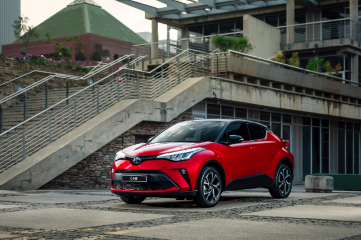
Is a used Toyota C-HR a good car?
Toyota’s C-HR is a niche product that combines an SUV stance with coupé-like styling, leaving the compact family-SUV market open to the Corolla Cross and Urban Cruiser instead. Should you consider a used one if it fits your usage profile? We took a closer look to find out.



To its target audience, it probably doesn’t matter very much that the Toyota C-HR doesn’t have a very useable boot, or that the rear seating area has almost no view to the outside. If those things are important, they’d be better-off with an Urban Cruiser or a Corolla Cross instead.
The C-HR is all about style, with its built-in Toyota reliability being the secondary highlight. With this in mind, we investigated whether a used Toyota C-HR is a good car, or if buyers would be better-off shopping elsewhere.
Related: Shop for new and used Toyota C-HR cars for sale here.

About the Toyota C-HR
First arriving on local shores early in 2017, the Toyota C-HR got off to a slow start in the local sales race, likely due to its specialised nature. Three derivatives were available at launch, in two trim levels: the entry-level variant employed a 6-speed manual, while the up-spec “Plus” could be had with either the manual gearbox or a CVT. All C-HRs are front-wheel-drive, and they all feature the same engine.
Key outputs are 85 kW and 185 Nm, courtesy of a 1.2-litre turbocharged 4-cylinder petrol engine. Its claimed performance won’t set any records, but the manual can get to 100 km/h in 10.9 seconds for the manual variant (11.1 seconds for the CVT), so it’s adequate for its likely usage pattern.
A high-spec “Luxury” trim was added to the range in August 2018, which upped the safety spec to include 7 airbags (instead of 2), a host of automatic driver safety aids, and added some convenience features (such as self-parking ability and leather seat trim).

The mechanical bits continued as-is, and nothing changed in this department with the mild early-2020 facelift, either, which focused mostly on cosmetics and an upgraded infotainment system. It must be noted that the 2020 facelift did standardise 7 airbags across the range, so these later examples are the ones to get.
In this latter, many-airbagged form, the C-HR scored 5 stars in Euro NCAP crash testing in 2017, with the passenger cell proving to be very sturdy.

Buying a used C-HR
Toyota’s warranty runs for 3 years or 100 000 km, and the C-HR’s service plan is capped at 90 000 km (but with no age limit). This means that first-year examples (and most of those dating from 2018) in the used market will not have any OEM warranty cover left, although the majority of these early C-HRs still fall within the service plan’s distance limit.
Being a Toyota product, the C-HR has pre-ordained reputation for build quality and durability, and its track record thus far proves this to be valid. Even the CVT (which is usually an early failure point on many cars equipped with this transmission) appears to be holding up well in overseas surveys. In short, the C-HR should uphold its manufacturer’s reputation, and provide dependable service for a long time.

Is a used C-HR a good car?
A C-HR certainly won’t suit the average owner, being cramped in the luggage compartment and cave-like in the rear seats, but for individualists who don’t want to compromise on longevity and a country-wide service availability, the Toyota C-HR should tick most of the boxes. Alternatives within this class include the Mazda CX-3, Fiat 500X, Volkswagen T-Cross, and Hyundai Venue, and none of them really make a more-compelling argument to win style-conscious buyers’ affections.