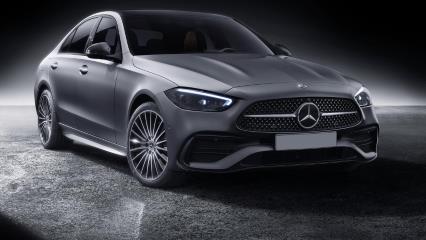
Whether you're hunting for a bargain W205 or considering splashing out on a brand-new W206, here's everything you need to know about C-Class reliability, common problems, and what to watch out for when buying.
Mercedes-Benz C-Class history in SA
The C‑Class story in South Africa begins with the global launch of the W202 in 1993, replacing the beloved 190E. Local production kicked off at Mercedes‑Benz’s East London plant in 1994, starting a three‑decade run of building one of Mzansi’s favourite luxury saloons. By November 1997, East London was already exporting right‑hand‑drive C‑Class models, underscoring its growing global role.
W203 (2000–2007): Growing up and going global
Arriving in 2000, the W203 brought more space and modern styling that’s aged remarkably well. East London was heavily upgraded during this era and became a key global hub for right‑hand‑drive C‑Class production. This is the generation that truly cemented the C‑Class as a credible BMW 3 Series rival for South African buyers.
W204 (2007–2014): Into the modern era
Launched locally in September 2007, the W204 ushered in a big step up in build quality and sophistication. It ran until 2014 and remains a strong option on today’s used market thanks to its blend of comfort, safety and tech.
W205 (2014–2021): Reinvention with S‑Class style
The game‑changing W205 landed in 2014, reinventing the C‑Class with S‑Class‑inspired design and luxury. Local production at East London began in May 2014, making it the second global site to build the model. By 2015, South Africans could choose favourites like the C 200 Avantgarde and C 250 Exclusive, and local assembly helped sharpen pricing versus early imports. Spanning everything from frugal diesels to fire‑breathing AMGs, the W205 made the C‑Class cool again for younger buyers who couldn’t quite stretch to an E‑Class.
2022: The new Mercedes‑Benz C‑Class arrives (W206)
Production of the W206 began at East London in June 2021 after a R13‑billion investment that brought new body and paint shops, upgraded logistics and a modernised assembly line. The new generation hit South African showrooms on 22 February 2022.
Related: Fuel-saving tips for your C-Class

Highlights:
• 48V mild‑hybrid assistance as standard for smoother pull‑away and start/stop
• Optional rear‑axle steering for tighter manoeuvring and added agility
• Simplified trims: Avantgarde and AMG Line (Classic/Elegance/Sport are gone)
• Local line‑up at launch: C200 (petrol) and C220d (diesel), each offered in Avantgarde and AMG Line
Workshop verdict on the W205 (2014–2021)
Independent workshop owners praised the W205’s comfort, spec and overall solidity, but noted a few diesel‑specific issues:
• EGR valve clogging (diesels): Carbon build‑up can trigger warning lights and reduced power. It is usually not catastrophic, but cleaning or replacement isn’t cheap.
• DPF warnings (diesels): don’t rush to blame the filter. Often, a boost leak or faulty sensor is the real culprit; proper diagnosis saves thousands.
• Petrol models: generally less prone to these issues as they don’t rely on the same EGR/DPF hardware. Regular maintenance and quality fuel remain key.
What about the new generation?
It’s early days, but the W206’s fundamentals are promising. The mild‑hybrid system is a straightforward 48V integrated starter‑generator that assists the engine and delivers ultra‑smooth start/stop; simpler than full‑hybrid setups. Rear‑axle steering is available as an option and meaningfully tightens the turning circle for city driving and parking.
How does the C-Class compare to the BMW 3 Series?
Buying advice
• W205 (2014–2021): a well‑maintained example with full service history is a smart buy. Petrol variants offer simpler ownership; diesel buyers should budget for potential EGR/DPF attention and use reputable workshops that diagnose before replacing parts.
• W206 (2022–present): an excellent all‑rounder for new buyers. Opt for a finance package with extended warranty/maintenance cover. Mercedes luxury is brilliant, but parts and labour are premium.


What the mechanic says
The W202 and W203 were proper cars. Simple, solid, you could fix them with basic tools. The W204? Still decent, but that's where they started getting fancy with the electronics.
The W205 generation
The EGR valve drama is real. It's not just the valve itself; the whole intake system is clogged with carbon because people don't drive these cars hard enough. City driving, short trips, never getting the engine properly hot. That EGR valve can be costly, and if you don't sort the carbon buildup simultaneously, you'll be back in six months.
These cars get expensive because of the electronics. The command system freezes, parking sensors go haywire, and so on; however, softeware updates can solve these problems. As for the air suspension on the AMG models: It's lovely when it works, but when that compressor goes, it's big money.
Timing chains on the early petrols are a real problem if the service intervals get stretched. If you're buying a used W205 petrol without documented service history at reasonable intervals, be very cautious about potential timing chain issues. That timing chain replacement is an expensive exercise.
The W206 models? It's too early to tell, but the mild-hybrid system seems simple enough. However, there have been complaints of a whining noise from the ISG (Integrated Starter Generator): It sounds like a turbo spooling, but it's actually just the electric motor working hard.
Related: Differences between the C-Class and E-Class.
Early warning signs in the W206
- Battery drain issues - these 48V systems can be power-hungry, and if there's any parasitic draw, your main 12V battery goes flat quickly
- MBUX infotainment glitches - screens freezing, needing hard resets, Bluetooth dropping out
- Sensor confusion - the mild-hybrid system relies on loads of sensors, and when one starts playing up, you get warning lights everywhere
The good news
The 1.5L in the C200 and the 2.0L diesel in the C220d are solid. The diesel is exceptionally smooth and economical, around 5.5L/100km if you're not hammering it.
What to look out for when buying
Buy from someone with a full service history, stick to the intervals, and find a workshop that knows these cars. Don't take it to your corner mechanic: these cars need proper diagnostics and genuine parts for the important stuff. And be diligent with oil changes.
If you maintain these cars properly, they will run forever. But if you don't, they will bankrupt you.