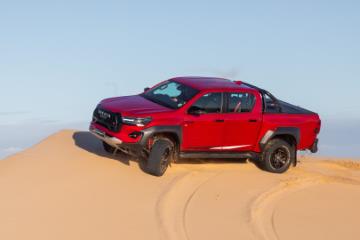
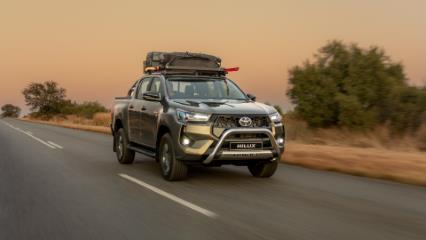
South Africans have long demanded vehicles that combine toughness with versatility. Among the top contenders in the double-cab segment are the Toyota Hilux and the Nissan Navara. Both vehicles boast impressive features and a loyal fan base, but how do they stack up against each other?
We pit Nissan's flagship PRO-4X 4x4 model against the Hilux in 4x4 Raider trim to pick a winner.

Pricing
When considering initial costs, the Nissan Navara 2.5DDTi PRO-4X 4x4 comes in at a slightly more accessible R844,000, while the Toyota Hilux 2.8GD-6 Double Cab 4x4 Raider Auto is priced at R858,600.
Related: Hilux GR-Sport III (2024) Review

Performance and capability
For performance enthusiasts, the Hilux stands out with its established 2.8-litre turbodiesel engine that churns out 150 kW and 500 Nm of torque. This makes it the superior choice for towing and handling heavy-duty tasks. The Navara, with a solid 2.5-litre engine delivering 140 kW and 450 Nm, holds its own comfortably but falls slightly short on raw power compared to the Hilux.
Related: Toyota Hilux GR-Sport (2024) Video Review

Riding comfort and handling
The Navara is often praised for its better on-road handling and comfort, attributed to its multi-link rear suspension, which delivers a smoother ride compared to the Hilux's traditional leaf spring setup. That being said, the Hilux's ride quality, known for its robustness, caters well to those venturing into challenging terrains, where durability takes precedence over comfort. This provides a reassuringly sturdy and resilient feel across uneven landscapes.
Looking for a workhorse? We compare the Isuzu D-Max and Nissan Navara here.

In the same breath, the Toyota Hilux 48V Raider I drove recently (read my review here), was extremely comfortable both on and off the tarmac, and felt great to drive in general.
My colleague, Taye, reviewed the Navara 2.5DDTi PRO-4X 4x4 Double Cab last year, and this is what he said:
The suspension setup uses double wishbones with coil-over struts in the front and multilink rear suspension instead of the general rear leaf-spring setup. The result is a softer rear-end, more compliant on-road performance, and comfortable ride quality. This doesn't dull the Navara's blade, though, on the rough stuff, as while it is comfortable, it can still manage 4x4 settings well enough in factory form. The PRO-4X, in this guise, has 17-inch wheels fitted to All-Terrain tyres. The Navara strikes a good balance between on-road and off-road usage, making it entirely usable for daily duties.
Payload and towing capacity
Payload capacities reflect practical applications—where the Navara shines, boasting an impressive 1,003 kg compared to the Hilux's 790 kg, making it better for hauling loads. Both models can tow up to 3,500 kg, making them equally competent in this regard.
Related: How popular is the Nissan Navara?

Interior features
Inside, both bakkies cater to comfort with leather upholstery and electric seat adjustments. The Hilux focuses on using its established ergonomic layout, while the Navara takes a tech-forward approach, offering features like keyless start, lane departure warning, and blind-spot monitoring, along with a surround view camera.

Essentially, the Navara’s cabin feels slightly more modern, sporty and tech-savvy, while the Hilux cabin is starting to look a little dated - but, ergonomically, it works extremely well.

If you prefer a posh-looking interior, however, the Navara wins this round.
Safety features
When it comes to safety, the Nissan Navara enhances its appeal with posh safety features such as lane departure warning and the aforementioned blind-spot monitoring, surround view camera with moving object detection, forward collision warning and intelligent emergency braking.
Both vehicles offer seven airbags and standard electronic stability controls, but the additional features give the Navara an edge in active safety.
It's also worth noting that Hiluxes are a lot more popular with hijackers while the Navara doesn't make the most-wanted list; the smaller Nissan NP200 is much higher in demand.

Warranty and maintenance
Toyota Hilux 2.8GD-6 Double Cab 4x4 Raider Auto
- Warranty: 3-year/100,000 km
- Service Plan: Standard service plan covering nine services
- Service Plan Distance: 90,000 km
- Service Interval Distance: Every 10,000 km
Nissan Navara 2.5DDTi Double Cab PRO-4X 4x4
- Warranty: 6-year/150,000 km
- Service Plan: Standard service plan coverage
- Service Plan Time: 6 years
- Service Plan Distance: 90,000 km
- Service Interval Distance: Every 15,000 km
The Navara pulls ahead with a generous 6-year/150,000 km warranty (and longer service intervals) compared to the Hilux's 3-year/100,000 km warranty.
Both the Hilux and the Navara are manufactured on local soil.

The verdict
So, which is better? It mostly boils down to what's more important to you:
- For power, guaranteed resale value, and off-road prowess, the Toyota Hilux 2.8GD-6 comfortably ticks those boxes, continuing its legacy as a top choice for those who want power and Toyota reliability.
- If you’re inclined towards advanced tech and new-generation safety features, a striking interior, a superior payload, great ride quality and a more generous warranty, the Nissan Navara PRO-4X may just work better for you.
As for value? The Navara with its generous list of standard features makes it a winner.
Related: South African Bakkie of the Year crowns overall winner (2024)