



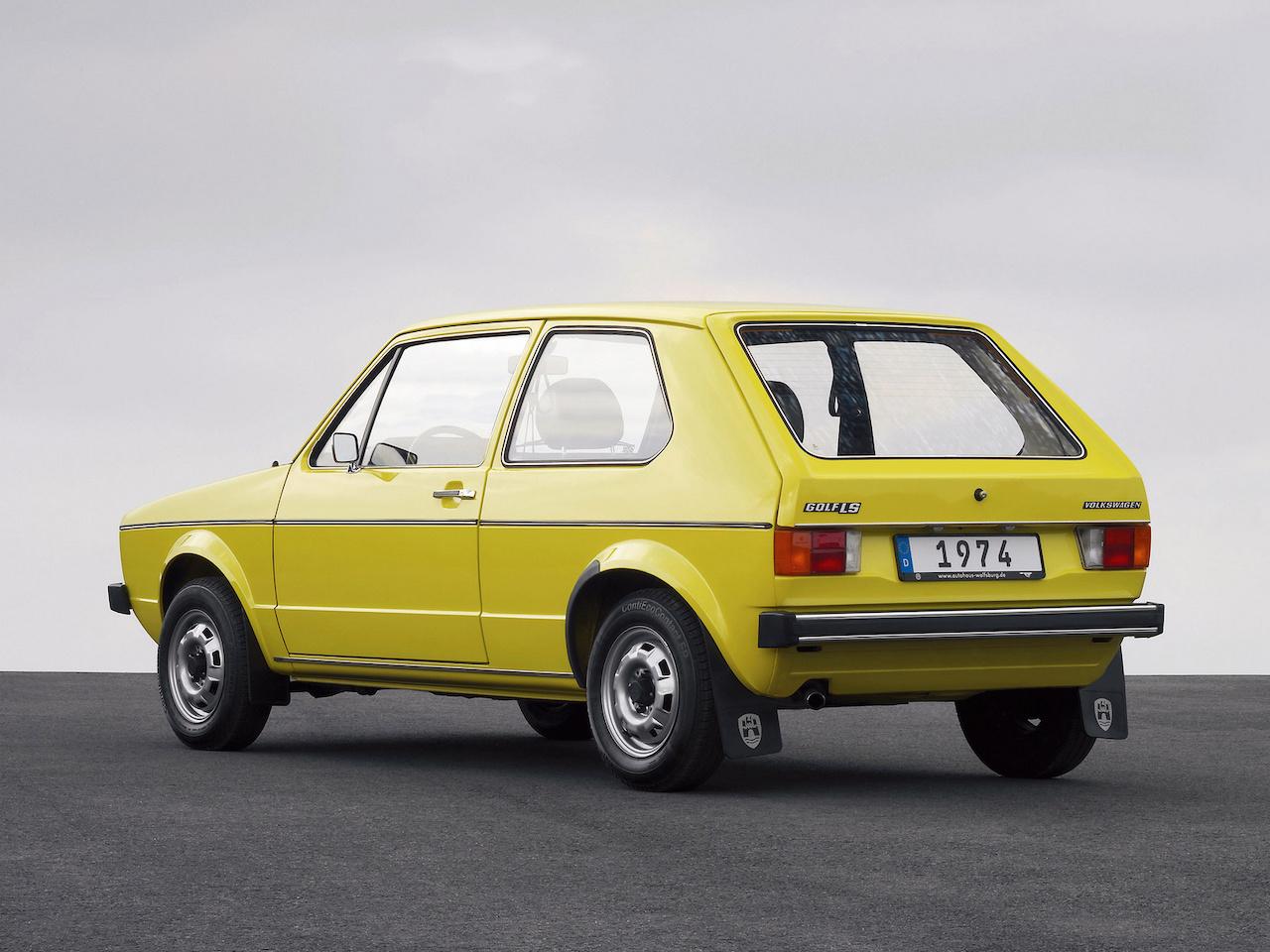
How does one replace a legend? This question was particularly vexing for Volkswagen, back in the early 1970s, when the immortal Beetle finally passed its sell-by date. It’s not like they hadn’t tried, mind you – numerous variations on the established air-cooled, rear-engined formula had reached the market by then, but none of them were really successful. But then, Volkswagen literally and physically turned their product line-up around, and successfully re-invented the whole company in the process. This is the story of the Golf.
By 1974, Volkswagen had altered their product strategy in a most dramatic way, thanks to fresh thinking and new technology flowing in from Audi. We’ve already detailed how the front-wheel drive, water-cooled Audi 80 led this product line revitalisation when it was turned into the Volkswagen Passat. But the biggest challenge still lay ahead, and that was to field a replacement for the wildly successful Beetle.
This was not an exclusively in-house project, though. While the mechanical bits were drawn from the new-generation parts bin, the styling and design were critical for this new model. To this end, the famed Italian designer Giugiaro was roped in to help clothe this crucial new car.
The final product wasn’t really ground-breaking in its appearance, but its crisply folded edges and pert proportions suited its era to perfection. Success was instantaneous and overwhelming, and Volkswagen could finally pull the plug on the Beetle's (which hung around for a few more years, just in case the public rejected the Golf).
GTI creates a new market segment
The Volkswagen Golf didn’t just replace the Beetle, though. While early Golfs used low-powered engines ranging from 1.1-litres to 1.5-litres in capacity, a small engineering team in Wolfsburg had wilder ideas. Working in secret and after hours, they set about creating a “Sport Golf”, by dropping in a larger, fuel-injected engine from the Audi 80 GTE, stiffening up the suspension and uprating the brakes.
The result was stunning, and yet, the deeply conservative management at Volkswagen didn’t initially see the merit in making the Golf go fast. Eventually, after some tweaks to improve the prototype’s ride quality and silence its exhaust somewhat, the “Sport Golf” received the go-ahead for limited production. It also got a new name: the Golf GTI.
It created a sensation upon its launch at the 1975 Frankfurt auto show, and when the media got to drive it, the accolades started rolling in. Here was a small, practical hatchback car with the performance to mix it with the big boys. Thus was an entirely new genre born, that of the hot hatchback. Even in the modern era, hot hatches are highly sought-after and held in high regard – and they all have the original Golf GTI to thank for their existence.
The Freedom of the Citi
The Golf Mk 1 holds a special spot in the hearts of many South Africans as well. When the larger and more refined, but also more expensive, Mk 2 Golf arrived in 1983, Volkswagen South Africa had a surplus of Mk 1 bodyshells and other components still cluttering up the factory floor. To get rid of this stockpile of parts, they came up with the concept of a “Citi Golf”: a stripped-out Golf Mk 1, painted in bright colours, and sold cheaply as a limited-edition special.
And yet again, the Golf Mk 1 surprised everyone. The CitiGolf proved to be so popular that Volkswagen South Africa put it back into production as their entry-level car, expanded the range, and embarked on modernising its mechanical components. Eventually, it received many parts from the Golf Mk 2, including the GTI’s engine and gearbox (in the now highly sought-after CTi), and even got electronic injection, a modern dashboard, and a driver’s airbag towards the end of its second life. Many of these updates applied to the Caddy bakkie as well, which remained in production along with the Citi until 2009, after a lifetime spanning more than 25 years.
Growing bigger with age
As the years went by, the Golf grew bigger with each new generation. The changes were incremental with every step of this evolution, but the Golf had started on a relentless upmarket march from the moment the Mk 2 appeared. And, with the added size came extra refinement, addressing a weakness that was all too apparent for the first two generations. But, with its ever-increasing size, the Golf also became heavier and heavier.
Sadly, the engines didn’t quite keep up the performance end of the bargain. At the end of the second-generation model’s production run, its top-performing 2.0-litre variants were slower than the 1.8-litre units which preceded them. By the time the third generation came around, the GTI was little more than a catchy name, and the top-performing slot was filled by the smooth but heavy 2.8-litre VR6.
The turbo era
This performance deficit was only addressed when the fourth-generation Golf arrived in Europe in 1997. While the Mk 4 GTI's new 1.8-litre 20-valve turbo engine initially only produced 110 kW, this represented a major improvement on the 88 kW with which the Mk 3 GTI 8V ended its run.
Higher-powered variants soon followed, topped off with a 3.2-litre development of the VR6 in the all-wheel drive R32 – the very first Golf R. This was the Golf generation which finally introduced South Africans to Volkswagen’s TDI engines, winning instant acclaim from local buyers with its combination of surreal fuel efficiency and punchy performance. A local delicacy in the Mk 4 range was the GTI-R, which mixed the R32's styling with a 132 kW version of the 1.8T engine and a 6-speed manual gearbox.
Lower-trim Golf still pottered around with 8-valve engines, however – engines which could trace their lineage back to the 1.5-litre units in the Mk 1.
Enter FSI
But the Golf’s real return to form (in spirit, if not in size and weight) occurred with the Mk 5, when the GTI received the first 2.0-litre turbo FSI engine, with 147 kW and an optional DSG twin-clutch gearbox. Meanwhile, a fancy multi-link rear suspension restored the sharp handling which the Golf lost over the years.
Sure, the lower-spec Golfs were still lumbered with anachronistic 8-valve engines, but at least the GTI became a high-speed stormer again. The sixth generation was really more of the same, with mild mechanical updates and next-generation TSI engines in mid-spec variants, but its basic skeleton remained unchanged until the arrival of the seventh (current) generation.
MQB brings big changes
For the Golf Mk 7, Volkswagen threw out almost everything the Golf had become and started afresh. Featuring the first generation of the new MQB component set (since applied to cars as diverse as the Arteon and Tiguan), the Mk 7 was lighter but stronger, yet more refined and more efficient. It also became a near-premium product – a fact reflected in its pricing.
It also benefitted from a selection of new powertrains, with 7-speed DSG gearboxes and downsized 1.0-litre 3-cylinder TSI engines on offer since its mid-life facelift in 2017. And all the while, the GTI grew more powerful, peaking at 228 kW in the limited-production Clubsport S – the same output as the recently refreshed Golf R.
The current range
Mainstream Golfs are currently available with two engines, and in three trim levels. The entry level is represented by the 1.0TSI Trendline (R316 200), with a 1.0-litre turbocharged 3-cylinder engine producing 81 kW and 200 Nm. This engine also powers the higher-trim 1.0TSI Comfortline variant (R337 000), and only comes with a 6-speed manual gearbox.
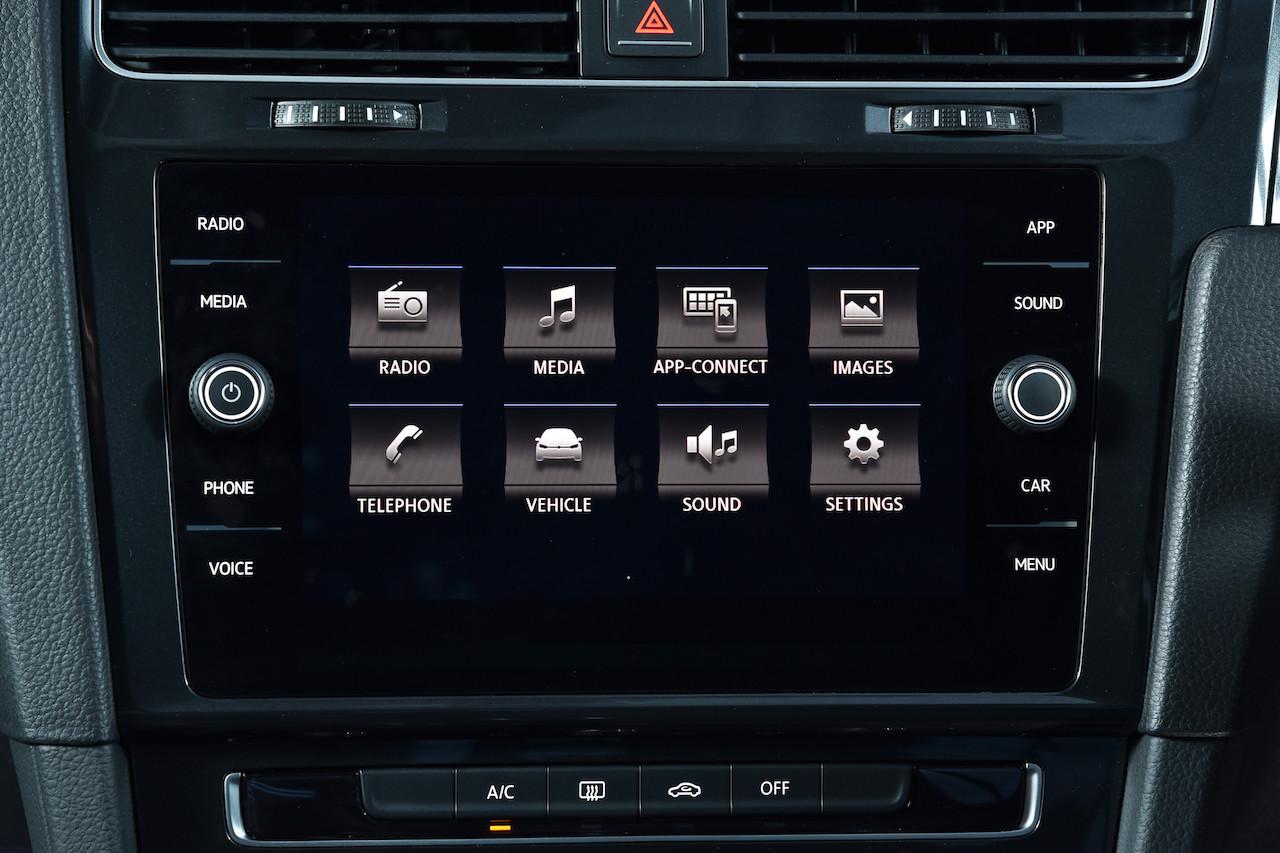
Standard equipment includes stability control, ABS and 7 airbags, along with air-con, power steering, 15-inch alloy wheels, a multi-function steering wheel, and a colour touchscreen infotainment system with Bluetooth/USB functionality and Android Auto/Apple CarPlay.
Comfortline trim adds a front centre armrest, automatic headlight- and wiper control, 16-inch alloy wheels, cruise control, and front foglights. The R-line (cosmetic) package adds a spoiler, sportier bumpers and detailing, and 17-inch alloy wheels for R357 650. Cool options include adaptive cruise control, adaptive LED headlights, a panoramic sunroof, digital dashboard, navigation, rear parking sensors and camera, and blind-spot monitoring.
Comfortline and R-Line trim also extends to the 1.4TSI (R390 200 and R410 850, respectively), which upgrades the engine to a 1.4-litre 4-cylinder turbo mill with 92 kW and 200 Nm. This engine is only available with a 7-speed DSG automatic.
Performance Golfs
Volkswagen currently fields 3 very different high-performance Golfs, all with DSG automatic gearboxes. At the slower end of the scale is the Golf GTD (R528 700), which essentially mixes GTI styling, cabin trim and suspension with a frugal yet torquey 2.0-litre TDI engine. Its 130 kW and 380 Nm are useful numbers, but shine somewhat less brightly when compared to the real GTI’s 169 kW and 350 Nm – yours for R558 000.
At the top of the pile sits the Golf R (R676 000), now with the same 228 kW and 400 Nm as is available in other markets. Up till recently, we only received this variant in lower states of tune, but it’s nice of VWSA to finally give us the full-fat Golf R. Fun fact: In South Africa, the performance Golfs make up more than half of total Golf sales – the only world market where this is the case.
What about the Golf 8?
Originally slated for introduction at the end of 2019, the arrival of the next (Mk 8) Golf has been delayed until 2020. The reasons are unclear, but it doesn’t really matter, because even the 2012-vintage Mk 7 is still a class leader.
Expect yet more high-tech stuff in the Golf 8, as well as a new emphasis on alternative drivetrains (at least for international markets), weight loss, and improved efficiency. However, because the Golf 8 still uses the MQB platform, it’s bound to look very familiar.
Looking into the crystal ball, it would appear that the Golf as we know it may be entering its final stretch. With Volkswagen’s recent commitment to electrification, we could expect them to move their focus away from their traditional cars and concentrate more on their future electric models.
In fact, the MEB electric vehicle platform and component set has already been revealed to the motoring press, and it’s safe to assume that the future Golf 9 will use this platform as well. In many ways, this would indicate as significant a direction change for Volkswagen as the original Golf did, and will completely change the character of the Golf. Will it even still be called Golf by then? Nobody knows just yet, but the coming years sure will be interesting to watch...
Prices are accurate at the time of writing, and may change without prior notice.