
Everything you need to know about the Audi A4
Everything you need to know about the Audi A4



Martin Pretorius
While the A4 isn’t Audi’s sales volume leader anymore, it is nonetheless one of the brand’s most influential and historically significant offerings. Its great-great-great-great-grandfather even helped save Volkswagen! We take a look at this model’s history, its present model range, and where the future might take it.
It all began back in the 1970s, shortly after Volkswagen bought Audi from Daimler-Benz. Yes, you read that correctly: at that stage, the fledgling Audi brand had some DNA from the company which was to eventually become one of its biggest competitors.
That’s not where the brand really started, however, because, prior to the Second World War, Audi used to be a German premium manufacturer, only getting folded into Auto Union at a later stage.
Auto Union rose to some prominence in the intervening years, giving birth to a series of cars which shared one critical flaw: they all used two-stroke engines. This particular engine type fell out of favour soon after the war, which, by the mid-1960s, left Auto Union with a serious of problem regarding their way forward.
However, Audi's previous owners (Daimler-Benz) had already made their then-new M118 four-cylinder, four-stroke engine available for fitment into the existing “F102” bodyshell, even though Volkswagen had by then already acquired Audi. This created the first Audi of the modern era, known as the "F103" or Audi 72 (followed by the 60, 75, 80 and Super 90), which became an unexpected success, spawning the first Audi 100 (C1-generation) as a larger evolution.
The first real “80”
By 1972, Audi was ready for the next step in their brand-building exercise, launching an all-new “80” model, codenamed “B1”. While it was front-wheel driven in the manner of the Auto-Unions, DKWs and the F103 which came before it, its engine was all-new.
This new, in-house-designed four-cylinder engine would eventually give rise to a whole family of VW/Audi engines. Its influence is still felt in Volkswagen group’s engines to this day. In fact, many of today’s Audi- and Volkswagen building blocks first appeared with the Audi 80 – and just that fact makes it an incredibly important car in the company’s history.
How did this come to be, and why did the original Audi 80 save Volkswagen?
Simple: it laid down the template for future Audis. The B1 was the first car from this company to combine a front-mounted, water-cooled four-cylinder engine with front-wheel drive, and it pioneered a platform design which remained in use for more than two decades.
Scaled up, the Audi 80 became the second-generation Audi 100 (which then turned into the A6 and eventually the first modern Audi V8 luxury car).
Scaled down (and with the engine mounted transversely), it gave birth to the Audi 50 (which morphed into the Volkswagen Polo and Golf). All of these models became bread-and-butter machines for Volkswagen, and came around just as the parent company's own archaic air-cooled rear-engined designs finally shuffled off to the great junkyard in the sky.
Cross-pollination ensued
Seeing as they needed a new medium-sized car to replace the flopped 411/412, Volkswagen wasn’t really in a position to refuse help from their new subsidiary. So, just as the Audi 50 was turned into the first VW Polo, the Audi 80 was turned into the first VW Passat.
Both of these new Volkswagens were literally mildly re-skinned Audis, but they both became smash hits, which allowed the German juggernaut to rebuild their image and model offerings in the post-Beetle years.
This status quo remained until the second-generation Passat passed away in the late-1980s, when the Passat moved onto a stretched version of the Golf’s transverse-engined platform. It was to make a brief return to Audi-based underpinnings in the late-1990s, but most Passats since then were basically oversized Golfs.
Gradual Evolution
Not that this bothered Audi too much, because the Audi 80 (and its later, more-upmarket sibling Audi 90) evolved into new generations, and soldiered on until 1994. It grew larger and more complex over time, gaining 5- and 6-cylinder engines and more power with each new iteration, and it also served as the introductory platform for Audi’s pioneering “quattro” all-wheel drive system.
Thus equipped, the Audi 80-based Coupé quattro became a rallying legend, with the technology developed for this car continuing to influence Audi’s drivetrain technology to this day.
Moving the game along
Meanwhile, over in the USA, Audi had taken a serious market share knock, mainly thanks to the “unintended acceleration” disaster – a scandal which has since been proven to be manufactured by the “60 Minutes” TV show back in 1986. We won’t go into the details of this tragedy here, but suffice it to say that Audi desperately needed to re-invent itself to regain customer confidence.
Audi chose the 80/90’s successor to be the flag-bearer for their revival charge, and threw everything they had into its development. Traditional Audi features abounded, of course, including the by-now legendary quattro all-wheel drive system, but the “next 80” also benefited from a selection of high-tech new engines, advanced front suspension design, and a stunning new take on Audi’s smooth styling language.
The first A4
This car (codenamed “B5”) also received a new name: out with the old 80/90 nomenclature, and in with the new A4 badge, fitting neatly below the larger A6 and A8 and creating a new family identity in the process. The result of all this effort was an outstanding success story, which easily accomplished its mission of re-establishing Audi as a proper premium brand all around the globe.
Especially the American market gobbled up the A4 as fast as Audi could ship them from Ingolstadt. They found its polished ride, entertaining handling, AWD security, beautiful and high-quality cabin design, and seductive looks too enticing to ignore.
And, perhaps for the first time in Audi’s history, their entry-level car’s image boost spilled upwards, endowing the ageing A6 and ultra-high-tech A8 with a similarly desirable market perception. Indeed, the first A4 turned out to be the car which completely changed Audi’s fortunes, and may just be the car which saved the brand in the long term.
Why mess with success?
For the next A4 (“B6”), which appeared in 2001, they kept up this momentum by adding independent rear suspension, growing it quite a bit in size, and adding more sophisticated technology all over – unfortunately also introducing the infamous Multitronic CVT drivetrain. The basic recipe remained largely unchanged, however, and sales kept increasing.
Of course, by the time the B6 came around, the A3 had already arrived to fill in the lower end of Audi’s model range, which left the B6 to move upmarket. The same applied to the following “B7” generation, which was mostly a comprehensive facelift of the B6, but with new engines and even more technology.
The next A4 (“B8”) introduced an all-new platform in 2008, and would live on for 8 years, when the heavily-updated “B9” generation appeared: based on the outgoing car, it shed around 100 kg of excess weight and again introduced new engines, gearboxes and all manner of cool gadgets. Most importantly, the B9 finally ditched the Multitronic CVT in favour of far more agreeable dual-clutch automatics.
The current state of affairs
As the range currently stands, there is a clear distinction between the “normal” A4 derivatives and the sportier ones (which receive S and RS badging). We only have the 4-door sedan A4 in South Africa, with no sign of an estate variant, while coupé and cabriolet shoppers have to look at the A5 series for their pleasure.
There are three engine derivatives on offer, with two being petrol-fuelled, and one diesel in the range. The entry level is represented by the “35TFSI” variants, which use a 1.4-litre turbo petrol with 110 kW and 250 Nm. As with the other derivatives, a 7-speed dual-clutch gearbox and front-wheel drive are standard, with no AWD or a manual gearbox available in the recently-refreshed range.
The higher-powered petrol variant is called the “40TFSI”, and comes with a 2.0-litre turbo engine which delivers 140 kW and 320 Nm. For diesel fans, there’s a “40TDI” with a 2.0-litre turbodiesel delivering 140 kW and 400 Nm – this may be the one to have if you’re feeling particularly frugal, although even the 35TFSI has very satisfying performance and doesn't lose that much on performance.
Current trim levels
Three specifications are available: Base, Sport, and (listen carefully now) “Sport S Line sports”. That’s a lot of "sports" in one name, but in reality, it’s simply a cosmetic package with more-aggressive bumpers and side skirts, bigger wheels, and prettier interior trim pieces.
Standard specification is fairly comprehensive, with dual-zone climate control, cruise control, Xenon headlights, automatic headlight/wiper operation, and an MMI infotainment system with Bluetooth connectivity and steering wheel controls all fitted even to the base model. Safety credentials are solid, with 6 airbags (8 as an option), stability control, disk brakes with ABS and EBD, and a 5-star Euro-NCAP safety rating.
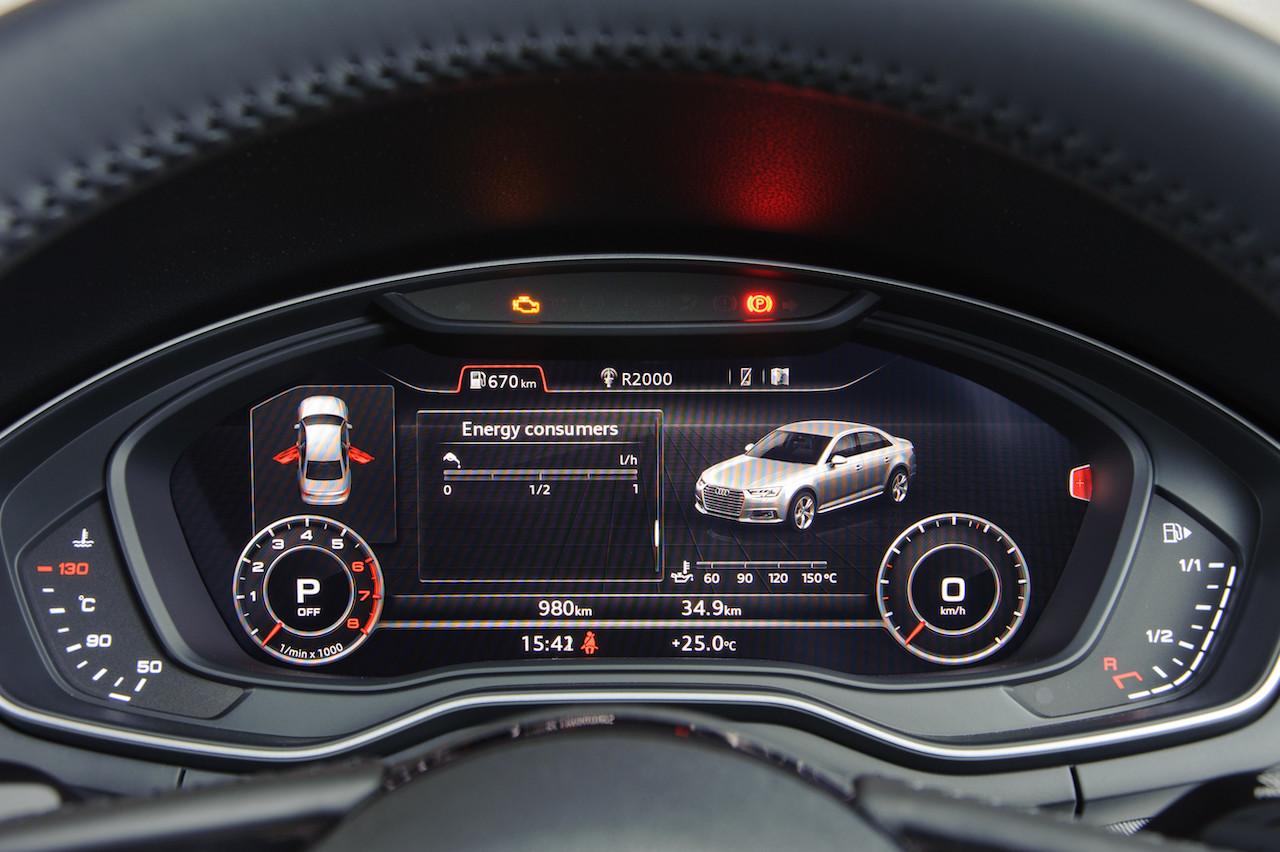
However, the really nice things, such as Audi’s digital cockpit, navigation, matrix LED headlights, a Bang & Olufsen premium audio system, head-up display, parking sensors and a rear-view camera all only appear on the options list. Be careful when ticking those option boxes, though, because it’s very easy to add R150 000 worth of toys to your new A4 – this is the German way, after all!
Pricing
The base 35TFSI opens the range with a list price of R531 000, going all the way up to R618 467 for the most-expensive 40TDI - before options. The least-expensive 40TFSI starts at R565 500, but includes “Sport” trim as standard.
Truth be told, the best value would probably be a 40TFSI Sport with options ticked for the digital dashboard, navigation, B&O audio upgrade, Matrix LED headlamps, and parking assistance features. Specified in this way, your A4 40TFSI will set you back R689 874, but it will give you most of the nicest gadgets.
Into the future
Given the Volkswagen Group’s current emphasis on electrification, it’s safe to assume that future A4s will feature at least some measure of electric power, with diesel engines due to be retired for the next generation. While it’s unlikely that we’ll see a fully-electric A4 in the next generation, there will most likely be hybrid tech at play, along with engines which will be further downsized and optimised.
Or maybe there won’t even be any A4 in two generations’ time, as E-Tron (Audi electrified brand) starts muscling in on the brand’s traditional strongholds. It’s a guessing game at the moment, but judging by how quickly SUVs and Crossovers are taking over the traditional sedan market, the A4 might even be relegated to a fringe player. That would be a sad end to a line of such influential, significant cars, so let’s hope that the latter prediction doesn’t come true...