Cars are rather complex creations. Thousands of different components combine to create the machine that whisks you off to the shops, to work and on the school run. You know that cars need fuel to run, but that may be where your knowledge of cars and engines end. That's ok though, we're here to help you make sense of the technical jargon that one could encounter when reading a review or specifications list of a vehicle.
Related: Diesel or Petrol - Which is better?
While we're not going to dive into all the intricacies of the modern engine, we're going to look at the basics and the more common arrangements that power our cars. Breaking them down into different sections and you'll start to see how they all work together at the end.

The basics
The modern car engine is what is known as an internal combustion engine (ICE). The overwhelming majority of engines are known as 4-stroke engines and use something called the Otto Cycle.
Inside the engine are several pistons that convert a reciprocating (backwards and forwards or up and down) motion into a rotating motion using a crankshaft. Think of the pistons as syringes, moving back and forth in a cylinder. The Otto Cycle engine uses each of the four movements to complete a specific part of the cycle.
The first downward stroke ingests a mixture of fuel and air into the cylinder (like pulling back on the syringe, sucking in the air/fuel mixture); this is the intake stroke. Valves that allowed the mixture in close and the piston moves back up, compressing the mixture; this is the compression stroke. A spark then ignites this mixture, causing it to burn and expand; this is the power stroke and the one that is responsible for your forward propulsion. Finally, a set of valves open again and as the piston moves back up, the burned gasses are forced out of the cylinder. This is the exhaust stroke. The whole process starts again and continues as the engine runs.
Simplified, the four strokes are as follows: Suck, Squeeze, BANG!, Blow.

Displacement
Displacement is the measure of cylinder volume with the pistons at their lowest position. This is traditionally measured in cubic centimetres, litres, or in imperial measurement, by cubic inches. It's the total amount of air/fuel mixture an engine can theoretically consume.
Traditionally, the larger this number, the more power the engine would be able to make based on the simple reasoning that the more fuel you can burn, the bigger and more powerful the combustion stroke can be, resulting in more power.
These days it's common for smaller engines to produce more power than older, larger engines thanks to power adders (which will be discussed later in this article) and technological advancements in fuel injection technology.

Cylinder layout

Not all engines are created the same and engines can come in a variety of layouts. The most common layout of the cylinders is the inline arrangement. In this design, all the pistons are placed in a line and connected by the crankshaft that, in turn, connects to the gearbox and onto the driven wheels through a differential that allows for the two (or four wheels) to turn at different rates, enabling you to corner.

The V arrangement sees the pistons arranged in a V-shape with half the number of pistons placed in one bank, and the remaining pistons in the other. They connect to a common crankshaft to send the power to the gearbox. The V arrangement allows for more cylinders to be used in a smaller package and can promote a more balanced engine with smoother running.
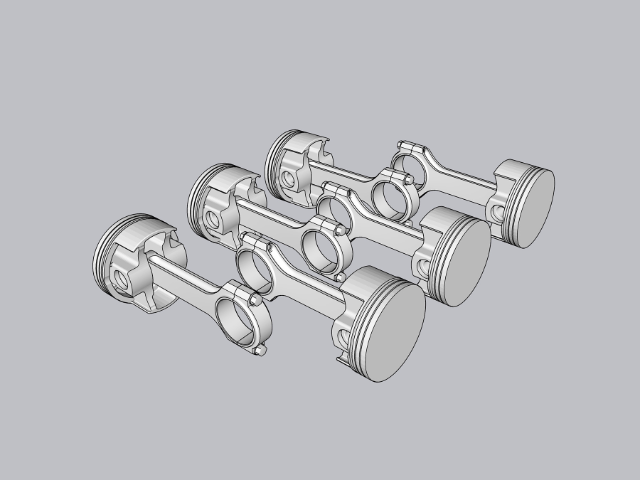
A flat arrangement sees the pistons opposed to each other, connected by a common crankshaft and operating in opposite directions. This type of engine is most commonly found in the original Beetle, Porsches, and Subarus with a few others also using the design to a lesser extent. The flat, Boxer, or horizontally opposed layout helps maintain a lower centre of gravity, allowing the car to handle better.

Number of cylinders
In the same way that larger pistons and cylinders can improve the power output of an engine, so can the number of cylinders. Engine designers will find the balance between piston size and the number of cylinders to achieve their desired power output.
Twin Cylinder: While twin cylinders used to be fairly common, only the Fiat 500 currently uses a twin arrangement in their 500 TwinAir models. These engines typically see the two cylinders arranged in an inline arrangement.
Three Cylinder: The surmounting pressure to downscale and downsize engines in order to produce less CO2 and use less fuel has seen many manufacturers going the way of three-cylinder engines. These engines will seldom have a displacement of more than 1.2-litres (or 1200cc) and will usually be accompanied by a power adder.
Four Cylinder: The four-cylinder engine is one of the most common engine types, with the cylinders arranged in an inline arrangement. While these engines can be as small as 1.0-litres (1000cc), they can also be fairly large and some are over 3.0-litres in displacement.
Five Cylinder: Less common than the four-cylinder, the five-cylinder engine adds one cylinder to the mix, giving these engines a rather unique sound. While most will be an inline arrangement, Volkswagen did employ a V5 engine. Five cylinder engines are typically found in some Audi and Volvo models and certain Fords.
Six Cylinder: Possibly the second most common number of cylinders, the six-cylinder is typically a smoother running engine with the additional pistons counteracting the vibration often found in engines with fewer cylinders. Six-cylinder engines can be arranged in both inline or V formation creating an 'inline-six' or a 'V6'. Inline-sixes are sometimes also referred to as 'straight-six' engines. BMW and Toyota are both renowned for their straight-six offerings while Ford is more synonymous with the V6.
Eight and more: While engines using 10, 12, or even 16 cylinders do exist, the largest number of cylinders you will typically find in a passenger car is eight. These are customarily arranged in a V-formation to create a V8 and many performance cars will opt for the V8 engine. Supercars will often employ V10 or V12 engines.
Oddballs: The list above caters for the more common engine arrangements but anomalies do exist. The Volkswagen VR6 engine is a combination of both straight and V configurations to create a narrow-angle V6 that only uses one cylinder head (like an inline-6).
From the same company comes the W16 as found in the Bugatti Veyron and Chiron. These engines combine two VR8 engines with a common crankshaft to create two banks of eight cylinders each.

Orientation
The direction and angle that an engine is positioned in the car has mostly to do with the drivetrain, whether it's front, rear, or all-wheel-drive as well as the design of the car. Rear-wheel-drive cars will usually have the engine positioned in a longitudinal orientation, where the engine sits in a straight line from front to back. This allows for the gearbox to be connected inline with the engine and send power down the most direct route to the rear wheels. Some AWD cars and some front-wheel-drive Audi models will use a longitudinal orientation though.
Transversely mounted engines sit sideways in the engine bay, running from left to right. The transversely-mounted engine allows for a smaller engine bay and a more compact design overall. These are usually found in front-wheel-drive vehicles and some AWD vehicles as well.

Induction
Earlier in this article, we mentioned power adders, these are ancillaries that help the engine produce more power from a smaller displacement by introducing extra air into the cylinders. The science dictates that the more air you can force into the cylinders, the more fuel you can add. The more fuel you can add, the bigger the combustion and the greater the power.
Naturally aspirated engines rely on the vacuum created when the piston moves down to suck the mixture into the cylinder. This limits the amount of mixture that can be ingested. By pumping air in artificially, you can dictate how much mixture gets burned. This is where turbochargers and superchargers come in. All they are are air pumps.

Turbochargers use the exhaust gasses rushing out of the engine to spin a bladed turbine wheel which is connected to a bladed compressor wheel via a shaft. This compressor wheel sucks in air, compresses it and blows it into the engine intake. Turbochargers not only help improve the power output but can help reduce fuel consumption if driven conservatively.
Superchargers come in a variety of forms but they all share the same method of operation. Where a turbocharger uses the waste gasses, a supercharger is driven off of an accessory belt. It still uses this to pump air into the engine. Most superchargers are positive displacement pumps which imply that the faster the engine turns, the more air gets pumped into the engine. The downside of this is that it requires engine power to turn the accessory belt and supercharger. This is known as parasitic loss.

Fuel
All engines require a fuel source in order to run but modern advances have seen us using less fossil fuel and start relying on renewable energy sources and cleaner-burning fuels.
Petrol
The staple of the passenger car, petrol or gasoline is a combustible fuel source that is derived from the distillation of crude oil. Petrol burns relatively clean but produces Carbon Dioxide CO2 as a byproduct along with water and nitrogen. The CO2 is the harmful gas and the amount of CO2 that an engine produces is taxed at the time of you purchasing a vehicle. 1-litre of burning petrol produces approximately 2.3kg of CO2. Petrol requires exceptionally high pressure before compression ignition occurs and an external combustion source is required in order to ignite it. Typically these are spark plugs. Petrol is the preferred fuel for quiet operation of engines.
Diesel
Diesel is the second most common fossil fuel and it too is derived from petroleum crude oil. The distillation process is simpler and diesel is easier to produce but produces more of the harmful exhaust gasses including CO2. Diesel engines operate slightly different to petrol engines but still rely on the same four strokes. The key difference is that the fuel is only injected into the cylinder when the compression stroke is nearly complete. Spraying diesel into the cylinder sees it ignited with the hot air and this prompts the combustion process. As a result, diesel engines are most often noisier than petrol engines but less diesel is used. Diesel also produces less power per unit that is combusted. It's for this reason that diesel is the preferred fuel for long-distance trucks, busses and passenger vehicles.
Hybrid
Hybrid vehicles combine both ICE engines and electric motors to propel a vehicle forward. Numerous different types of hybrid vehicles exist but the core principle is the same; a combination of electric motor and ICE with batteries supplying the power to the electric motor and usually petrol fuelling the internal combustion engine. Some Hybrid vehicles are self-charging and don't require an electrical outlet to recharge. A plug-in hybrid will self-charge but the best results come from plugging the batteries into an external electric source for charging.
Electric
Full-electric vehicles are fast becoming the next form of propulsion. In an Electric Vehicle (EV) there is no Internal Combustion Engine and the vehicle runs purely off of battery power. These vehicles need to be recharged by plugging them into a wall outlet or charging station like a call phone.