
5 Available upgrades for the Toyota Hilux
5 Available upgrades for the Toyota Hilux


By Martin Pretorius
With popularity comes ubiquity. Nothing confirms this statement more than seeing the masses of Hiluxes on our roads. They cover the whole spectrum from workaday delivery vehicles to plush status symbols, and combined with the Hilux’s sustained strong sales, it means that very few people would even notice one driving by – they sort of fade into the background just because they’ve become the background.
And that is a problem, if you’re shelling out upwards of half a million Rand to buy your dream bakkie. You definitely don’t want to blend in with the crowd, and it’s pretty annoying that you may see an identical copy of your pride and joy every few minutes. If only there was a way to make your Hilux stand out, something to set it apart from all the other ones out there...
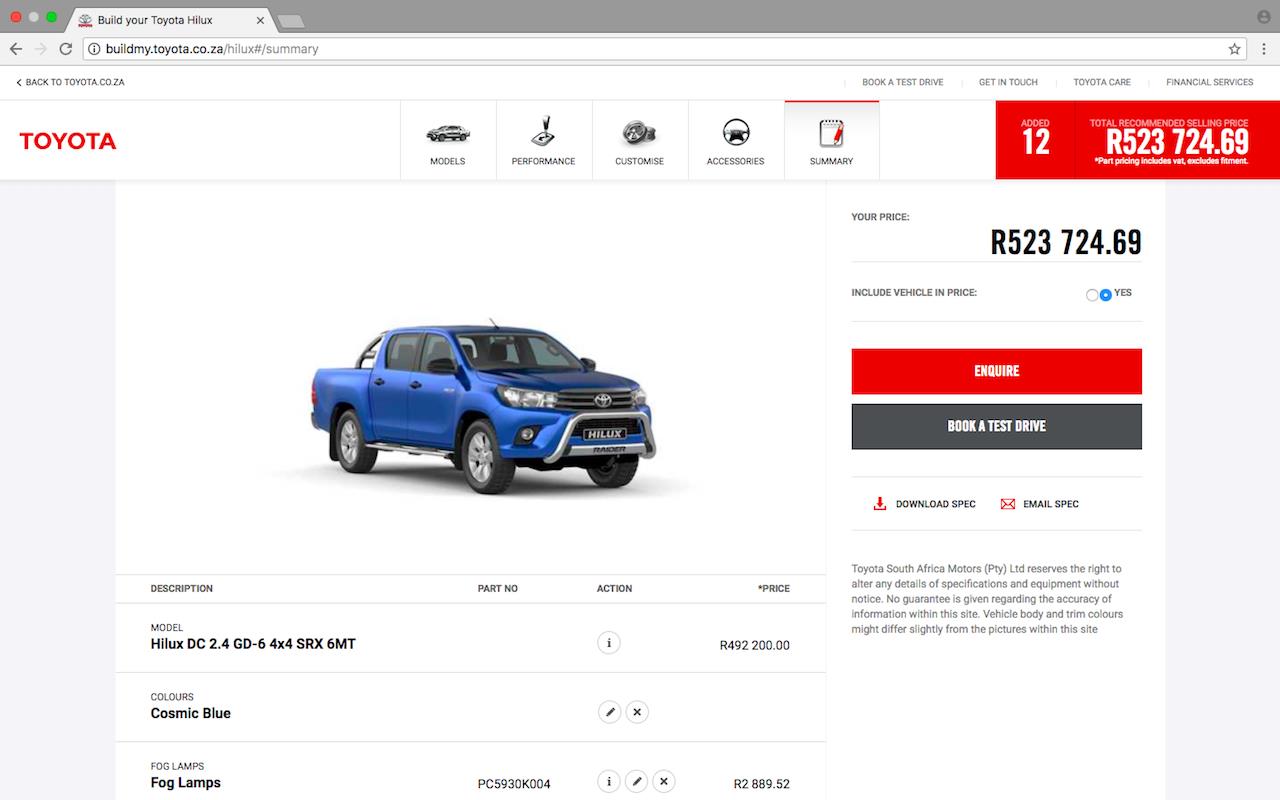
Well, we wondered the same thing, so we had a look through Toyota’s online configurator to find five ways to upgrade your Hilux. And just to make things more interesting, we decided to use a mid-range model as starting point: a 2.4 GD-6 Double Cab 4x4 SRX with a manual gearbox.
This will be particularly interesting to those buyers who want a double cab Hilux and need four-wheel drive, but can’t or don’t want to stretch their budgets to a full-blown 2.8 Raider or Dakar. It’s also worth considering that the 2.4 is actually a sweeter-driving engine than the 2.8 – it runs smoother, uses less fuel, and isn’t as far behind the larger engine in performance as you might think.
Please note that some of the options listed here may need other, supporting upgrades before they can be added to a car's specification sheet. Prices are current at the time of writing this article, but may change without prior notice.
1. Show your steel, but mind your step
Remember that the SRX trim level is pretty basic and unadorned. It features the wide-body fenders and front bumper, and though there is a black side step, it looks rather lost between those bulging wheel arches. The alloy wheels (recently added during a model update) look decent, though – and that’s a good thing, because we couldn’t find any sign of alternative wheel options on the website.
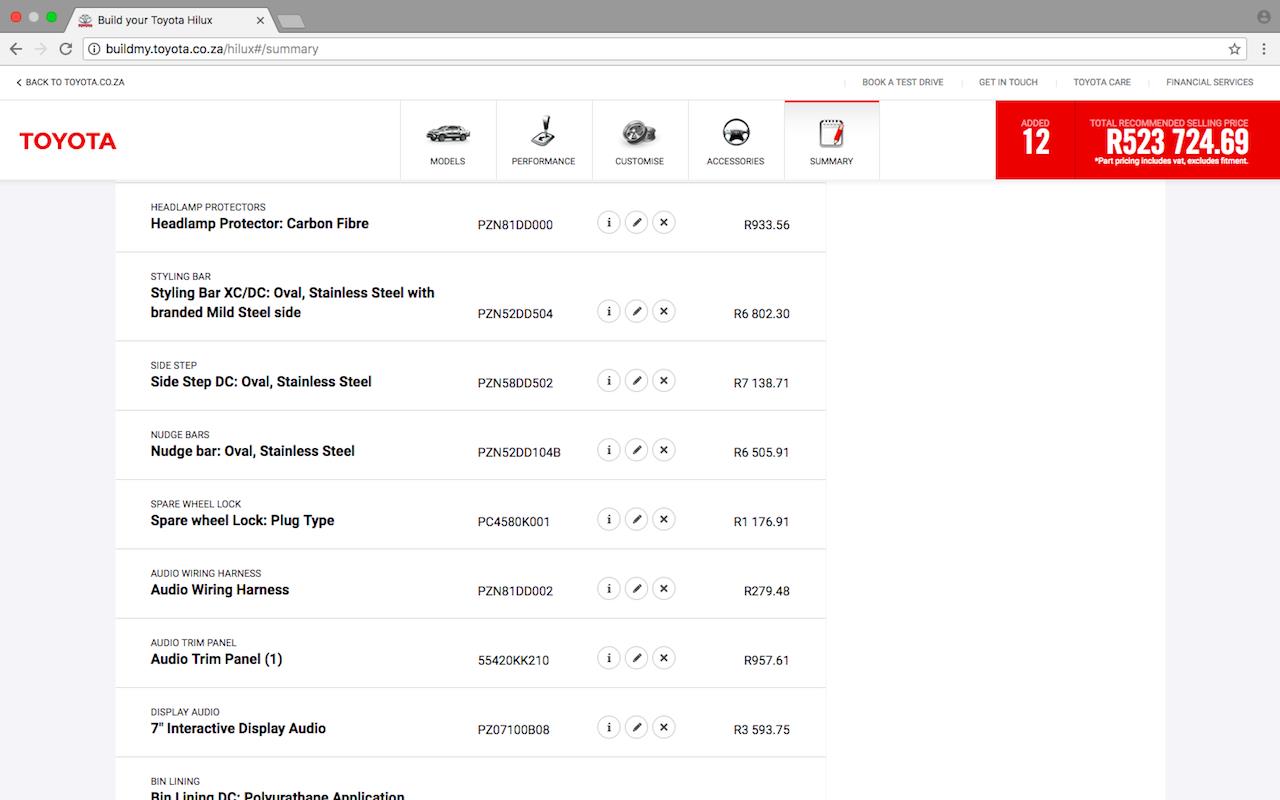
To upgrade the SRX to something a bit more imposing, a stainless steel nudge bar (R6 506) and a set of stainless steel side steps (R7 139) was specified. To round things off, a “styling bar” also got the nod – the least-expensive (R6 802) stainless steel unit from a wide selection on the site. Our SRX already looked a lot better than when we started out, especially as the nudge bar very effectively banishes the normal Hilux’s front grille overbite.
2. Shine a light on the road ahead
We’ve decided to add two options related to the lighting system. While the SRX doesn’t have any LED or Xenon components to its headlights, those big lenses are still vulnerable to damage and expensive to repair – especially on the roads where such a bakkie might often be found.
To keep this from happening, we spotted rather attractive headlight covers with a carbon fibre look in the accessories list. They are surprisingly expensive (R934 for the set), but will likely save you a lot of money in the event of an errant stone hitting a headlight at speed. We’ve also added fog lights – not because they really make a difference to the actual light reaching the road, but because they make the SRX’s face look a little bit less poverty-stricken.
3. Sounds good
While the SRX has a fairly decent audio system fitted as standard, there’s a reasonably affordable (R3 594) colour touchscreen audio system on offer as well. It looks a lot more modern, and offers improved smartphone connectivity.
This audio upgrade, while not identical to the standard item in the Raider derivatives, at least brings the infotainment system closer to modern standards, and means that the only convenience features still lacking compared to Raider spec are now reduced to cruise control, keyless entry, and LED headlights (all standard on the Raiders).
4. Protect your asset
One of the stranger omissions from the Hilux’s standard specification sheet is a bin liner – something offered by many of the smaller bakkie manufacturers, and very helpful to preserve the paintwork inside the load bin.
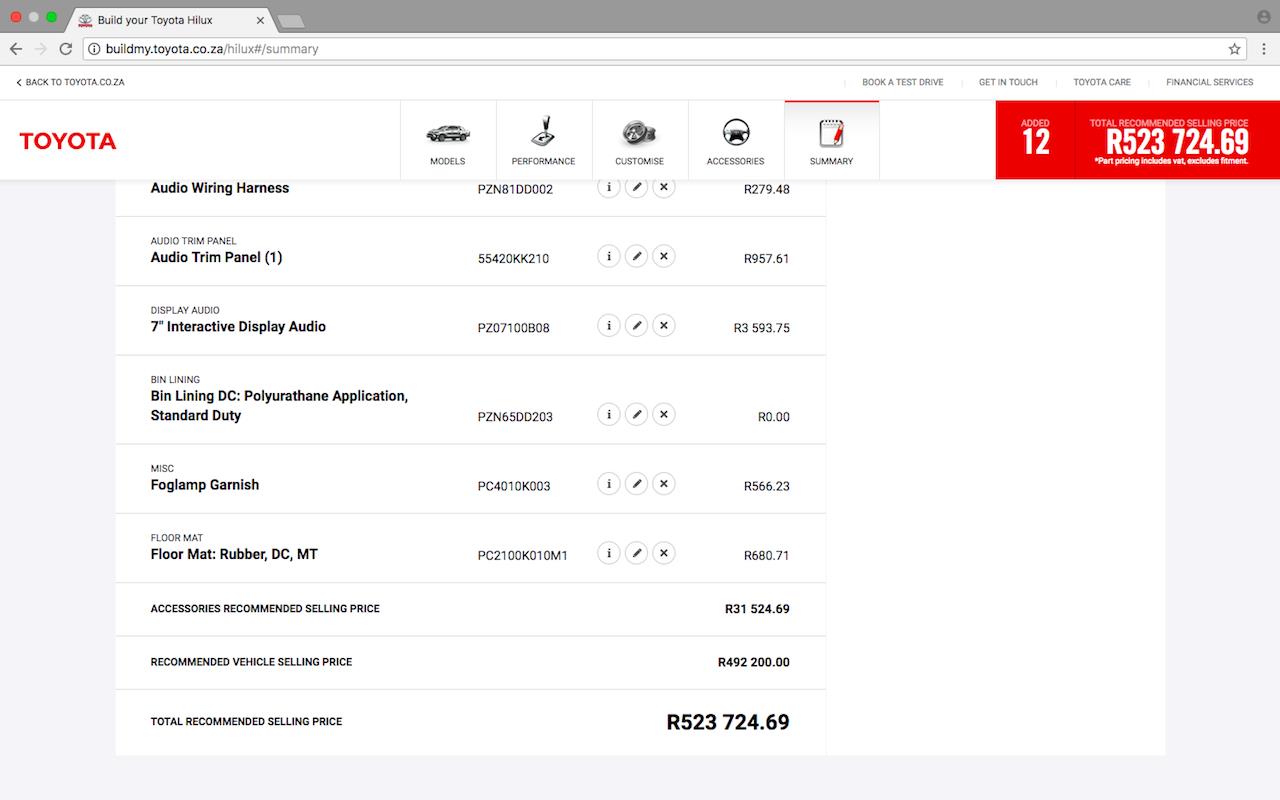
Toyota offers two Polyurethane bin liner options, with standard- and heavy duty grading respectively. If this double cab won’t be used to carry abrasive- or jagged loads, the standard duty liner will probably suffice.
5. Hang on to the spare wheel
Spare wheel security is a point of concern with most bakkies. Due to their location underneath the load bins, bakkie spare wheels are often (and quickly and easily) stolen in parking lots and at office buildings. The Hilux isn’t exempt from this problem, so it’s definitely a good idea to invest in a spare wheel lock.
Toyota has two types of spare wheel lock on offer, but the slightly less expensive “Plug Type” lock at R1 177 will probably pose enough of an obstruction to a would-be thief to persuade them to rather target another bakkie. There’s only a R10 price jump to buy a “Pad Type” lock, however, so you can choose whatever suits you best.
“Building” this virtual Hilux on the configurator, we ended with a much nicer-looking bakkie than the bare SRX we started with, with improved security and a better infotainment system, for the grand total of R 523 044. That’s slightly more expensive than the base price of a 4x2 (rear-wheel drive) 2.8 Raider, but remember that you’re getting 4x4 in your special 2.4 SRX. The cheapest 4x4 double cab Raider starts at R 587 600 – more than R63 000 dearer. You’ll mainly be missing out on some power, cruise control and a rear-view camera, but with that kind of saving, creating a personalised Hilux like this sure does look enticing to your wallet...