


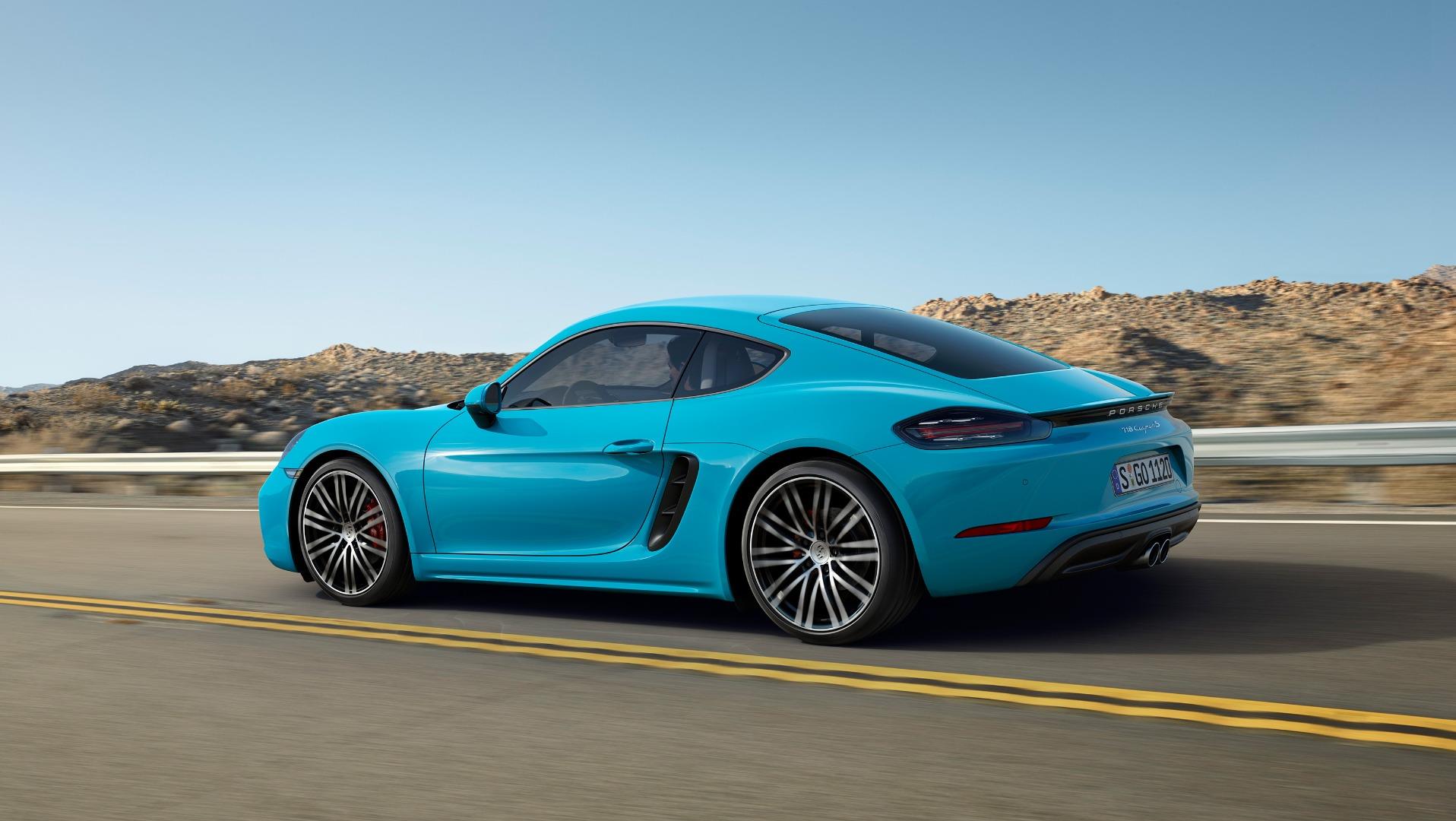
Porsche’s Cayman model was first introduced in 2006 as a new entry point to the wonderful world of Porsche sports car motoring. This still holds true today, although the Cayman isn't the most affordable Porsche anymore: the cheapest current derivative of the mid-sized Macan SUV is marginally less expensive than the entry-level Cayman. But, as a range, the Cayman line-up (along with its slightly more expensive Boxster open-topped sibling) is still seen as the entry-level offering.
The Cayman shares its layout and mechanical specification with the Porsche Boxster. This means it is mid-engined, with the engine located just behind the cockpit and ahead of the rear wheels (and gearbox). This layout contrasts to that of the famous 911, Porsche’s mainstay model for over half a century, which continues with a rear-engined layout (the engine mounted in the tail behind the gearbox).
Cayman evolution
The second-generation Cayman (981) was introduced in 2012, and retained its 6-cylinder mid-engined layout, although it grew significantly larger and its shape evolved quite considerably. Then, in 2016, came the big change for the Cayman line-up, when the release of the 4-cylinder 718 Cayman created some controversy.
The 4-cylinder versions of the Porsche Cayman (along with its open-topped Boxer sibling) were introduced in 2016, feature turbocharging, and still use a horizontally-opposed (flat) cylinder layout in spite of its lower cylinder count. This engine layout was in fact used in the very first Porsche of 1948, and continued in the 4-cylinder 356 series, which was produced until 1965. The 911, which first went into series production in late 1964, used a flat-6 layout, but was also available with an entry-level, 4-cylinder option named the 912.
There were many fans who mourned the loss of the special 6-cylinder sound in the Cayman. This was despite the fact that the new 4-cylinder models were in many ways superior to the out-going 6-cylinder models, with higher outputs, reduced fuel thirst, and cleaner exhausts.
The new Cayman and Boxster 4-cylinder models were badged as "718”: a name that had historic motorsport connections for Porsche, due to a 718 RSK racer that was highly successful in the late 1950s and early 1960s.
Latest 718 Cayman range includes 6-cylinder models
Perhaps as a nod to the “die-hard” 6-cylinder fans, Porsche recently introduced 4,0-litre 6-cylinder variants of the Cayman, in GTS and GT4 guise. However, it should be noted that in terms of straight-line performance, there is very little to choose between the Cayman S, and the GTS and GT4 models.
Related: New vs old Porsche Cayman GTS: what are the 4 main differences?
Current Porsche 718 Cayman model line-up
Porsche 718 Cayman. R957 000
This has a 2.0-litre 4-cylinder turbocharged engine producing 220 kW and 380 Nm of torque. It is available with a 6-speed manual or a 7-speed dual-clutch automatic gearbox. The price for both manual and automatic models is the same, but the automatic is quicker: the 0-100 km/h time takes 5,1 seconds (4,9 seconds for the automatic), and top speed is 275 km/h.
Porsche 718 Cayman S, R1 042 000
The Cayman S uses a 2,5-litre version of the 2.0-litre turbocharged 4-cylinder. It is again available in 6-speed manual or 7-speed automatic form, and both models cost the same. The 2,5-litre turbocharged flat-4 produces 257 kW and 420 Nm of torque. 0-100 km/h happens in 4,6 seconds for the manual, and 4,4 seconds for the automatic. Top speed is 285 km/h.
Porsche 718 Cayman GTS, R1 164 000
In January 2020, the special GTS model was uprated to 6-cylinder status. It uses a 4,0-litre normally-aspirated (non-turbo) flat-6 engine, producing 294 kW and 420 Nm of torque, and is only available in 6-speed manual form. The 0-100 km/h time is 4,5 seconds and top speed is 293 km/h.
Porsche 718 Cayman GT4, R1 468 000
The GT4 was introduced towards the end of 2019, and uses a retuned 4,0-litre flat-6 engine. It is rated at 309 kW and 420 Nm of torque, and is marginally quicker than the GTS, with a 0-100 km/h time of 4,4 seconds and a top speed of 304 km/h. Once again, it's only available with a 6-speed manual gearbox.
Which Porsche 718 Cayman model holds its value best?
Due to the very recent introductions of the GTS and GT4, it is not yet possible to ascertain how well these models hold their value in terms of re-sale. As for the 4-cylinder Cayman and Cayman S models, we would recommend that, if re-sale value is a major concern, you should opt for the automatic models. Porsche executives tell us that the demand for manual models is extremely low, and most customers in all Porsche models these days opt for the automatic (dual clutch) variants.
Impossible to rate trim levels for value-retention
As for re-sale values in general, Porsche says it is impossible to differentiate between the various trim levels as far as value retention is concerned. This is because each and every Porsche is sold with an option specification that makes comparing one trim to another extremely difficult. Many of these options are very expensive and when a Porsche is sold second-hand, all the options are listed.
A Porsche spokesman advised that, when choosing options, it is best to avoid outlandish colour combinations regarding body colour and upholstery. As a further consideration, we would add that because the 718 Cayman GTS and GT4 models are currently only available with a manual transmission, this would probably mean that re-sale value retention on these models would probably not be as high as they would on automatic versions of the 718, unless the enthusiast market turns it into a cult car...
Recommended next:
Shop for New and used Porsche 718 Cayman cars for sale here.
Which Porsche 718 Boxster retains its value best?