While very few models at the show pertain to the local market, I did spot a potential multi-fuel future that could be an option for the South African market's dual concerns of affordability and energy security. The displayed models highlight Suzuki's global strategy of pursuing carbon neutrality by offering a choice of powertrains, good news for a country like ours, where the adoption of New Energy Vehicles (NEVs) has been slow.
New Suzuki flagship headed to SA
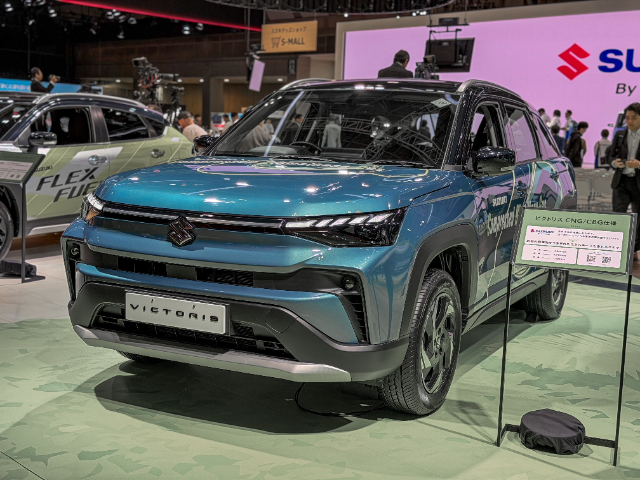
The brand has confirmed the introduction of a new model in 2026, and I will assume it's the Victoris. The Victoris at the show was the CNG/CBG specification (Compressed Natural Gas/Compressed Biogas), representing a more innovative, albeit infrastructure-dependent, path. Compressed Biogas (CBG) is a fuel from local waste sources.
If the Suzuki Victoris comes to South Africa, it will almost certainly be the 1.5-litre mild-hybrid petrol unit, the most widely used and readily available engine option globally. The Victoris is dimensionally and mechanically similar to the larger Grand Vitara, but with more aggressive styling and, in top-spec globally, more premium features. It is designed to be the bridge model in Suzuki’s Crossover/SUV lineup.
Comparison: Victoris vs. Fronx vs. Grand Vitara
The Victoris's primary role will be to create a three-tiered crossover/SUV strategy for Suzuki in South Africa:
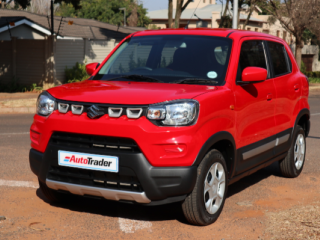
Fronx (style/value): This entry-level model is focused on affordability, coupé-SUV styling, and fuel efficiency due to its smaller size.
Victoris (tech/safety/value): Positioned as the family-friendly, high-feature option. It offers a much higher safety rating and advanced tech (like the 6-speed AT and potentially ADAS) at a price that should undercut the similarly sized Grand Vitara.
Grand Vitara (space/AWD): The flagship, targeting customers willing to pay a premium for a more conventional SUV look, superior refinement, and the option of the AWD system, which the Victoris may not offer in its initial launch.
The Victoris, with its expected strong safety rating and modern features, has the potential to become Suzuki's best-selling crossover, provided it is priced aggressively below the Grand Vitara. Should the model be sold locally, I estimate pricing to start from R350 000 and head up to just under R500 000, but time will tell.
Suzuki will also be updating its range's safety credentials throughout 2026
Fronx FFV concept: Is biofuel an option?
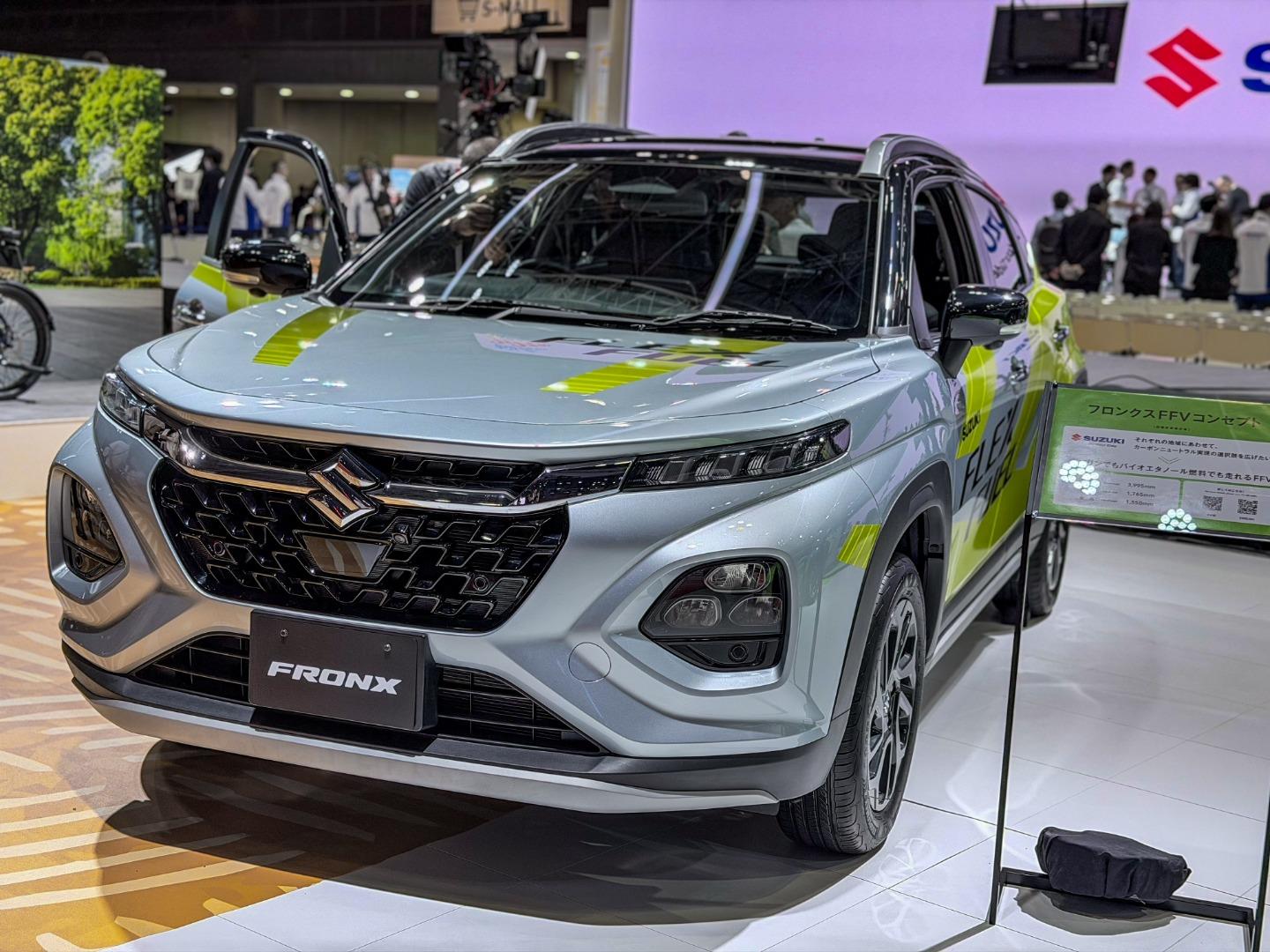
Suzuki showcased its Fronx FFV Concept. The current production Fronx is a popular choice in South Africa, with its coupé-SUV styling and value. The FFV (Flexible-Fuel Vehicle) variant, capable of running on a mix of petrol and bioethanol fuel, signals a major strategic shift.
• Relevance to South Africa: While South Africa's ethanol blending program is not as mature as Brazil's or India's (where this concept originates), the potential for a domestically produced, less volatile fuel source to supplement expensive petrol is enormous.
• The Practical Benefit: Should a viable bioethanol network emerge, a Flex Fuel Fronx could offer consumers a way to mitigate the impact of fluctuating petrol prices, providing an affordable and sustainable alternative that aligns with global green trends. The vehicle's dimensions, which fit neatly into the compact crossover segment, also make it ideal for our urban and extra-urban landscapes.

Bioethanol in South Africa
The Suzuki Fronx FFV (Flexible-Fuel Vehicle) concept is intrinsically linked to South Africa's highly aspirational, yet currently dormant, bioethanol blending mandate. While the South African government first proposed a 2% ethanol blend in petrol over a decade ago, and later regulated for up to a 10% blend (E10), the mandate has seen little to no implementation to date. This regulatory inertia is primarily due to the failure of key stakeholders—petroleum producers, agricultural entities, and the government—to agree on a sustainable, regulated pricing strategy for locally produced bioethanol. Consequently, commercial-scale bioethanol production for fuel is minimal, with existing plants focusing on industrial uses (alcohol, solvents) from molasses. Therefore, while a Flex Fuel Fronx would be a highly pragmatic, price-mitigating, and environmentally conscious solution for consumers, its viability in the short-to-medium term (i.e., before 2028) hinges entirely on the government resolving the economic bottlenecks and enforcing the mandatory blending policy to create the necessary market certainty and demand for local biofuel producers to invest. Without this policy shift, the Fronx FFV would serve only as a symbolic gesture of Suzuki's intent, rather than a commercially available option in the country.
XBee
The production model Suzuki XBee (pronounced "Cross-bee") on display showcases a unique, boxy, and characterful crossover design, potentially bridging the gap between the ultra-compact Ignis and the Grand Vitara.
• Relevance to South Africa: The XBee is unlikely to come to SA as most of our local Suzuki models, aside from the Jimny, are sourced from India. Still, with its rugged styling, practical wagon-like space, and what appears to be a modern, well-appointed interior, it would be a strong, quirky addition. It could appeal to younger buyers or those downsizing but wanting personality and space.
• The Practical Benefit: The XBee, which uses a mild-hybrid powertrain in Japan, would fit seamlessly into the growing demand for fuel-efficient and stylish B-segment crossovers.

Learning about Suzuki
While the trip was thin on product, it did provide some much-needed context for Suzuki as a brand. Here's what I gleaned from the experience:
Suzuki's pragmatism is a willingness to bypass immediate, costly EV mandates and instead invest in realistic steps for developing countries.
Engineering resilience: The engineering commitment to create durable vehicles that can operate reliably under various fuel and road conditions is essential for the South African environment.
Long-term vision: A corporate commitment that values global affordability and energy security over selling new metal, ensuring the brand can sustain its reputation for value and reliability well into the next decade.
- What you see is what you get: The brand is the antithesis of pretentious, focusing purely on affordable mobility that is cheap to run and will last a long time. This is why the brand has struck a chord with South African buyers, in my opinion, at least.
Understanding the company culture makes their multi-fuel strategy for South Africa seem not just pragmatic, but inevitable and authentic to the brand's DNA.