Opinion: How AMG and Ferrari's Electric Hyper-Saloons are Chasing Numbers and Losing the Plot
The electric era of hyper-performance has arrived with the Ferrari Luce and the Mercedes-AMG GT 4-Door Coupé. Both are physics-defying marvels of speed, yet their relentless pursuit of spreadsheet perfection exposes a deeper identity crisis. From polarising, wind-tunnel-shaped exteriors to artificial soundtracks mimicking lost V8 and V12 engines, these cars present a fascinating paradox. Here are my thoughts on the matter.


Automotive history is anchored by specific, visceral landmarks. When Ferrari won its first victory in Rome back in 1947 with Franco Cortese piloting the 125 S, it wasn't just the speed that birthed a legend—it was the mechanical theatre. The symphonic scream of a Colombo V12, the smell of unburnt fuel, and the unpredictable, living nature of a highly strung combustion engine became the pillars of Maranello's DNA. Similarly, the engineers in Affalterbach built Mercedes-AMG’s mythos on the brutal, thudding excess of hand-built V8 "Hammer" engines that felt distinctively mechanical and unhinged.
Fast forward to today, and we are witnessing the dawn of a radically different era. Ferrari has officially pulled the silk off the Ferrari Luce, a 783kW, five-seat, four-door electric tourer. Simultaneously, Mercedes-AMG has unveiled its new GT 4-Door Coupé, riding on the bespoke AMG.EA electric architecture and churning out up to 860kW.
No one doubts that these machines will be mind-numbingly fast. The AMG digits read like a fighter jet: 0–100 km/h in 2.1 seconds, a 600 kW charging capacity, and 2 000 Nm of instantaneous torque. The Ferrari Luce counters with a 2.5-second sprint to 100 km/h, 60 proprietary patents, and a slippery silhouette penned by Sir Jony Ive’s LoveFrom collective. Yet as both brands push the absolute boundaries of what is technically possible, a looming identity crisis emerges. In their pursuit of flawless digital performance, these new flagships are failing to capture the volatile, irreplaceable magic that made these brands legendary in the first place.
A caveat
To be completely clear, this is not an indictment of electric vehicles as a whole; in fact, I am a genuine fan of EVs in the right context. For daily commuting, urban runabouts, and high-tech family haulers, the instant torque, silent operation, and seamless efficiency of a battery-powered drivetrain are genuinely unmatched. However, when forced into the ultra-premium performance sector—a rarefied space historically defined by emotional theatre, mechanical soul, and the visceral symphony of an internal combustion engine—the EV formula reveals its flaws. In a realm where passion trumps practicality, replacing the living, breathing character of a bespoke engine with sanitised digital heft strips away the very magic that makes a high-end sports car from the likes of AMG and Ferrari worth celebrating.
Let's be entirely honest: a man with my questionable sense of style and even more precarious hairline has absolutely no business playing arbiter to the aesthetics of modern hyper-design. Furthermore, the likelihood of Maranello handing me the keys to a Luce is somewhere between slim and non-existent. My odds of securing a stint behind the wheel of the AMG are slightly better, though I fully expect them to plummet with every syllable of this critique.
But with those thoroughly sobering caveats out of the way, let us proceed.
The visual disconnect
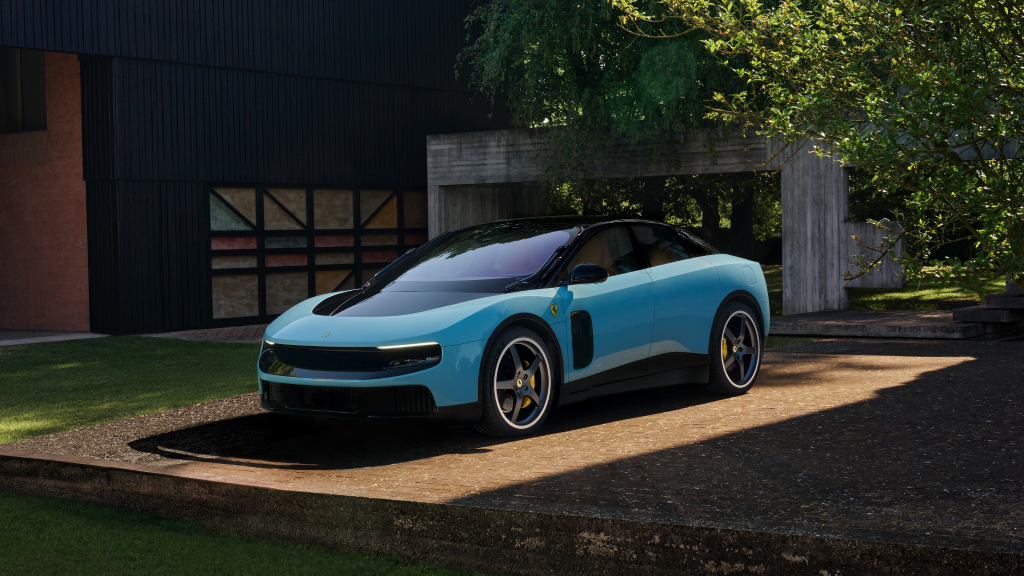
From an exterior perspective, both of these machines face a serious crisis of aesthetic identity. In their frantic quest to slice through the air and optimise every single kilometre of battery range, the designers have traded iconic brand proportions for jellybean-smooth efficiency.
The Ferrari Luce abandons the classic, predatory stance of Maranello’s mid-engine masterpieces for an ultra-pure, uncompromised glasshouse shell. Riding on cartoonishly massive 23-inch front and 24-inch rear wheels, it feels less like a traditional prancing horse and more like a high-concept spaceship.
The Mercedes-AMG GT, despite attempting to retain its long-hood sports-car DNA, is hamstrung by the realities of packaging a massive underfloor battery pack. Even though it sits lower than its predecessor, it features bulbous, muscular shoulders paired with a fastback silhouette that feels oddly heavy-handed, rounded off by a bizarrely futuristic turbine six-pod taillight arrangement.
Step inside, however, and the narrative becomes infinitely more palatable.
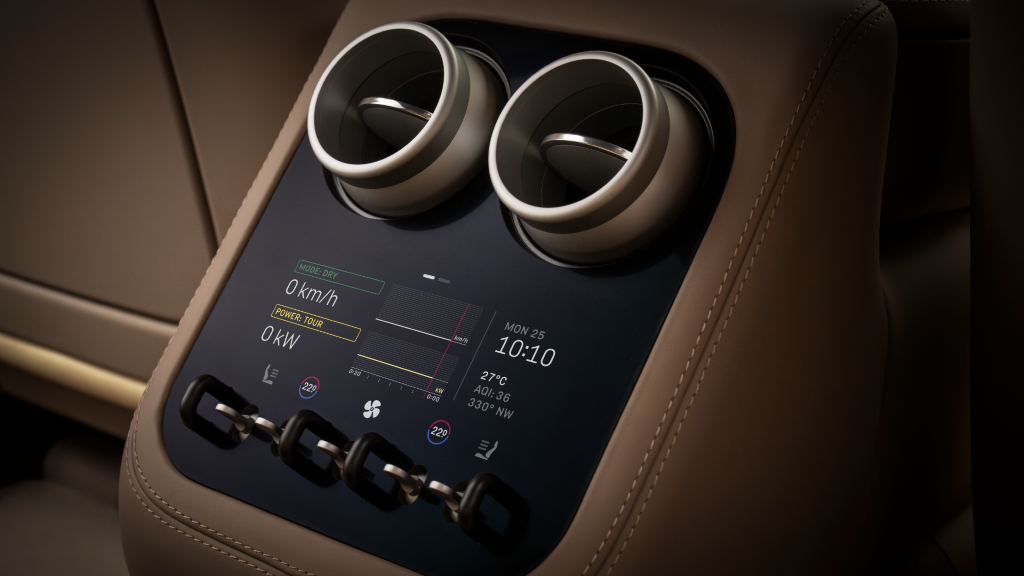
Once you cross the thresholds, both cabins transform into deeply considered, ultra-premium sanctuaries that successfully marry old-world luxury with staggering tech. Ferrari has wisely resisted the urge to go entirely digital, blending a brilliant Samsung Display layout with tactile, precision-engineered mechanical toggles, switches, and materials like recycled anodised aluminium and rich leather. It looks clean, rationalised, and spacious, entirely unburdened by a traditional transmission tunnel.
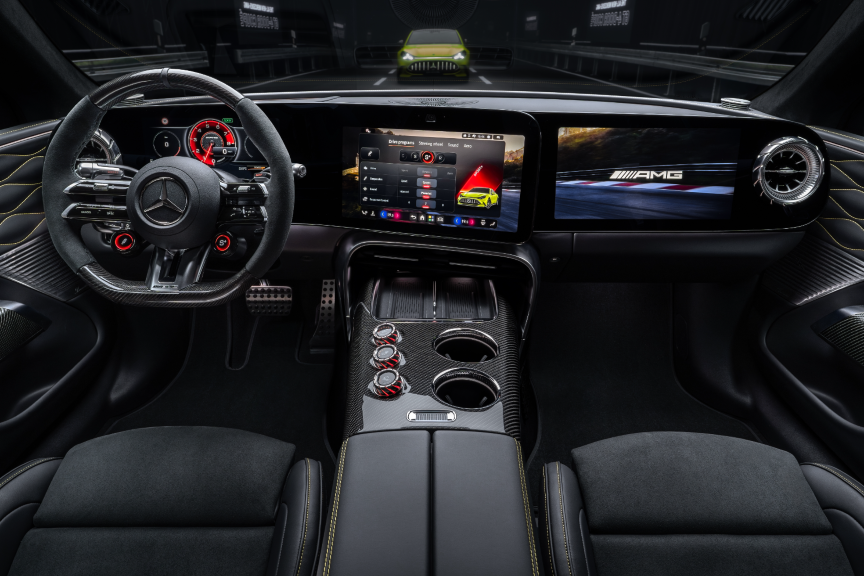
AMG counters with a spectacular, driver-focused command centre. The 10.2-inch cluster and 14-inch central monitor flow together under a seamless glass banner, anchored by beautifully chunky, tactile rotary dials on the centre console that feel genuinely expensive. Toss in the panoramic roof that plays with light overhead, and the AMG cabin looks like an incredibly desirable place to sit.
It is a bizarre paradox: both cars abandon their roots from an exterior design, but once you look at their respective interiors, they are far more on brand.

The illusion of acoustic authenticity
The most glaring casualty of this transition is the loss of an authentic automotive voice. For decades, you could identify a Ferrari or an AMG with your eyes closed. The new electric era replaces physical engineering acoustics with digital mimicry. As much as I enjoyed the latest four-cylinder hybrid C63 SE Performance, the loss of its V8 spelt its premature demise, despite it being an objectively better car than the model it replaced.
Ferrari’s electric guitar approach: Maranello has patented a system where a precision accelerometer at the centre of the axle captures the dynamic vibrations of the electric motors, filtering and amplifying them through internal and external speakers. Ferrari calls it "authentic and functional," but conceptually, it operates exactly like an electric guitar—taking a subtle kinetic hum and heavily altering it through a digital amp.
AMG’s V8 simulation: Mercedes-AMG goes a step further into nostalgia-baiting with its AMGFORCE S+ mode. It uses a real-time mixing system that draws on over 1 600 sound files to blast a synthesised version of the legendary petrol-powered GT R V8 into the cabin. It even simulates haptic gearshifts by briefly interrupting torque delivery to mimic a dual-clutch transmission.
While technically impressive, these systems highlight a fundamental paradox. If a brand has to engineer synthetic vibrations, artificial shifts, and digital exhaust notes to evoke emotion, it is admitting that the underlying electric powertrain lacks a natural soul. It transforms a mechanical masterpiece into a high-fidelity video game.
The homogenisation of speed
In the combustion era, character was defined by limitations and imperfections. An AMG V8 delivered a tidal wave of low-end torque that threatened to overwhelm the rear tyres at any moment. A Ferrari engine required you to chase the redline, building power progressively as the valvetrain sang its way to 9 000 r/min. They felt entirely unique to drive.
Electrification inherently homogenises performance. Because electric motors deliver maximum torque instantly, both the Luce and the AMG GT rely heavily on complex software arrays to artificially manufacture a personality:
Powertrain & Dynamic Profiles
| Specification | Ferrari Luce | Mercedes-AMG GT 63 4-Door Coupé |
| Powertrain layout | 4 radial flux motors (one per wheel) | 3 YASA axial flux motors (2 rear, 1 front) |
| Peak output | 772kW | 860kW |
| Peak torque | 990Nm | 2 000Nm |
| Artificial progression | Left/right steering paddles to manually step up torque acceleration curves. | Simulated traction interruption during fake gear changes. |
| Central control unit | Vehicle Control Unit (VCU) + Side Slip Control X | AMG RACE ENGINEER Core Chip |
When both cars utilise advanced computational matrices updating 200 times per second to dictate grip, torque vectoring, and active aerodynamics, the driver is separated from the raw mechanical reality. Speed is no longer something you manage with your right foot and your wits; it is a mathematical calculation flawlessly executed by a silicon chip. When every hyper-EV can do 0–100 km/h in under two and a half seconds with zero drama, extreme speed ceases to be a thrill—it becomes a utility.

Architecture and the luxury of space vs. pure purpose
The physical layouts of these cars further signal a shift away from uncompromising sportiness toward mass-market luxury.
Ferrari’s Luce boasts four doors and five seats—a historic first for a Prancing Horse sports car, made possible only because the absence of a traditional front-mid engine and rear transaxle opens up the floorpan. The battery pack acts as a structural element, increasing torsional rigidity by up to 35% compared to previous four-door models, but it pushes the kerb weight to a massive 2 260 kg.

AMG’s platform relies on high-tech, ultra-thin YASA axial-flux motors to save space, yet the car still tips the scales as a heavy, long-wheelbase grand tourer, complete with rear foot garages and a panoramic glass roof that switches from transparent to opaque at the touch of a button.
The weight of progress
While these vehicles feature cutting-edge carbon-fibre composites and advanced aluminium castings, the sheer mass of 106 kWh to 122 kWh battery packs forces them to rely on active roll stabilisation, independent rear-wheel steering, and active air suspensions just to mask their own weight in the corners. They are masterpieces of physics defiance, but they lack the lightweight agility that historically defined a true sports car.
Moving the benchmark, losing the magic?
There is no denying that the Luce and the all-electric GT 4-Door Coupé are triumphs of modern engineering. They deliver numbers that would have been laughed at as science fiction a decade ago. AMG's achievement of recharging 460 kilometres of range in 10 minutes via a 600 kW grid, and Ferrari’s implementation of individual wheel actuators that simultaneously control traction, steering, and vertical movement, are monumental milestones.
But automotive magic has never been a spreadsheet contest. The magic lies in the conversation between human and machine—the vulnerability, the mechanical feedback, the symphony of moving parts working in unison, and the distinct, irreproducible character of the brand's engineering philosophy.
By turning to digital avatars, synthetic soundtracks, and multi-motor torque that flawlessly manage every dynamic envelope, AMG and Ferrari have built the ultimate driving computers. They have successfully redefined the boundaries of electric mobility. But in doing so, they risk turning the ultimate automotive emotional experiences into sterile exercises in electronic perfection.