



The DBX is Aston Martin’s fourth car and first-ever SUV from the transformational Second Century Plan which is built on a completely new platform. An SUV from a luxury or performance car maker is not a radical concept, as we have already seen luxury SUVs making their way onto the scene, from the likes of Alfa Romeo, Bentley, Lamborghini, Maserati and Porsche. Ferrari also has announced plans for a utility vehicle. However, it is a high-risk undertaking for a small-volume, independent maker like Aston.
While the DBX performance SUV is not quite in the league of the Cullinan, it’s ready to take on the likes of the Bentayga, Cayenne, and the Urus.
Related: Find a list of the Most Expensive SUVs in SA here

Design
Despite the raised ride height and different body style, you can’t miss the distinctive grille, said to be the largest one ever on an Aston Martin. The DBX features daytime running lights at the bottom of the front bumper which have integrated air-ducts to aid aerodynamics and help cool the brakes with airflow that releases through the opening between the front tyre and front passenger door. The aerodynamics have played a key role in the styling of the DBX, just as it did with the DB11 sports car but in a slightly different way.

Along the sides, the DBX has beautiful lines and sculptured haunches and the 22-inch alloy wheels further enhance its profile. Frameless doors are becoming the new trend with newer cars entering the market, which also features on the DBX. The hidden side glass seals also add to the sleekness of the DBX.

At the controversial rear end, you either love it or hate it. It has a sporty kick-up, or “duck-flap” as I heard someone else call it, on the tailgate – when you see it from the side, you’ll know exactly what I’m talking about. It’s strikingly different for an SUV.

Similar to the Vantage and DBS, the DBX features the same rear LED light signature that stretches from one corner to the other.

Related: New Aston Martin Vantage lands in SA

Interestingly enough, there are no rear window wipers on the DBX as Aston’s engineers and designers have mastered the aerodynamics so thoroughly that the rear window will self-clean while on the move. I really want to see this, so I went searching online but sadly, I couldn’t find any official videos of this yet.

Inside the DBX
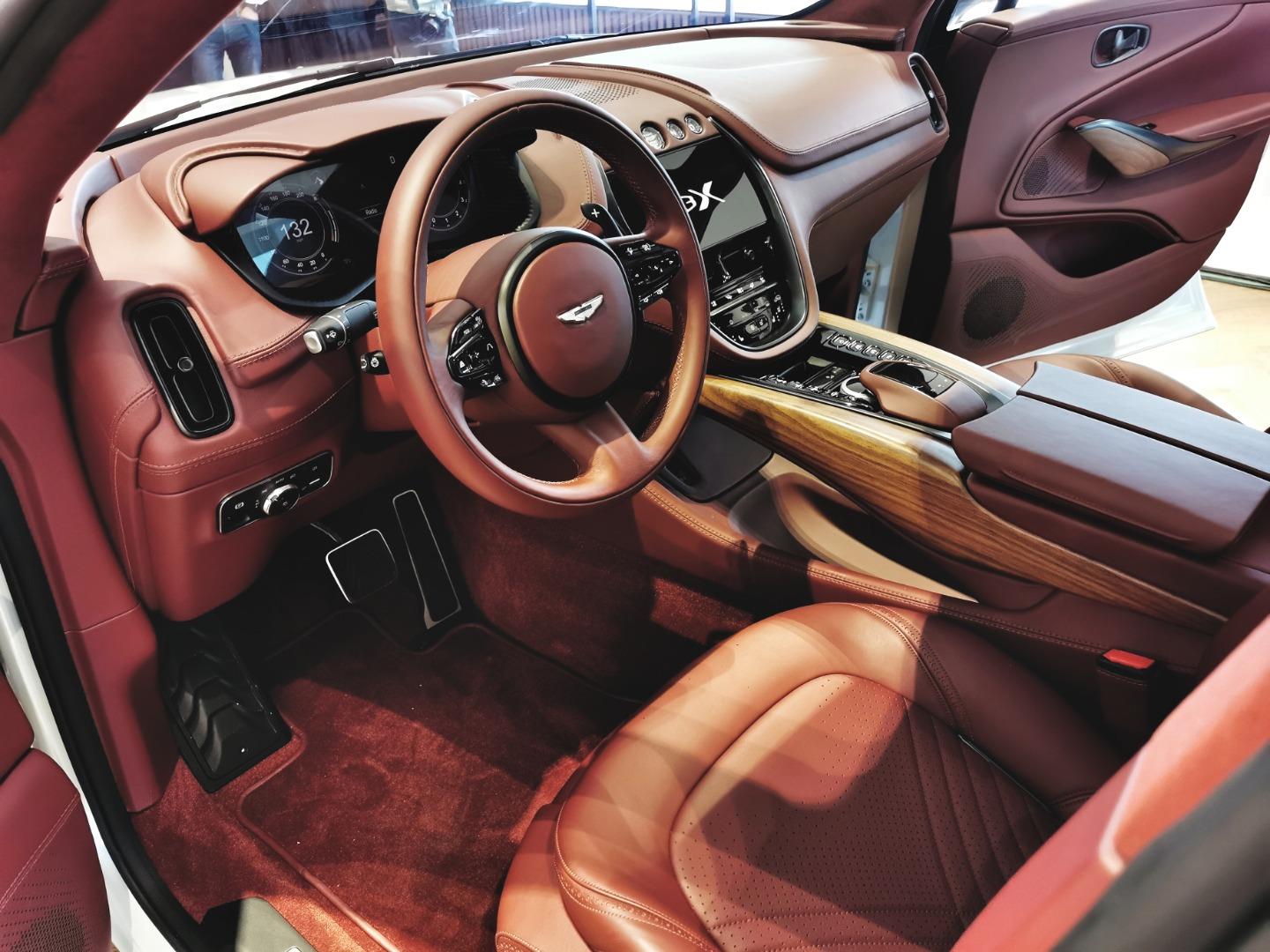
Every DBX will be handcrafted with some 200 hours of work. It’s a complete leather-trimmed cockpit with ‘class-leading interior space’ (headroom and legroom) even for the tallest of passengers. A contemporary range of exquisite wood, composite and metal veneers ensure that the cabin can be tailored to any taste.


A full-length glass panoramic roof brings in more light to the cabin and enhances the airy feel. An industry first, both the headlining and electric roof blinds is available in a luxurious Alcantara finish, providing a harmonious design, light obscuration and solar attenuation without compromising headroom.

In terms of infotainment, a 10.25-inch TFT screen sits elegantly flush in the centre console, while a huge 12.3-inch TFT screen provides a wealth of information to the driver. Since this was just a demo model and not a production model, we didn’t get to see what the real screen displays. Apple CarPlay will come as standard, as does a 360-degree camera system and ambient lighting that offers 64 different colours in two zones.


Interior storage, rear space and visibility were said to be the details at the forefront of the DBX development team's minds, which some say is arguably the first time Aston has put importance to this. When you look at the Rapide, you can seat more than two people inside, but the car isn't exactly beset with space.


Related: 7 extras you should retrofit on an Aston Martin DBS Superleggera
In the boot, there’s 632 litres of space, practical and cleanly designed, which can be expanded by means of the 40:20:40 split-folding rear seats. The boot space is bigger than the space you’d find in a Range Rover or Bentley Bentayga but is slightly smaller than that in a Porsche Cayenne. A narrow load sill and broad aperture maximise the practicality for a variety of luggage, such as suitcases, golf bags and other equipment.

Performance Specs
Like its Aston Martin siblings, the DBX is also made from bonded aluminium which makes its body structure very light and incredibly stiff. Like the Vantage, the DBX is also powered by a raucous twin-turbocharged 4.0-litre AMG-sourced V8 engine but you can expect the acoustics to be a bit different since it is, after all, an SUV. It puts out 404 kW (543bhp) and 700 Nm of torque.
The engine is paired to a 9-speed torque converter automatic transmission that sends power to all four wheels effectively with both an active central differential and an electronic limited-slip differential at the rear. This allows the torque to be moved precisely both fore and aft in the vehicle and also across the rear axle. Additionally, the DBX has a bespoke steering system that has been tuned to deliver sports car-like response.

Aston Martin claims that the DBX will rocket from 0 to 100 km/h in 4.5 seconds and manages a top speed of 291 km/h.
Fuel economy and emissions figures haven’t been released yet. However, the V8 features cylinder deactivation which cuts the number of cylinders firing when you're cruising to help save fuel. It’s also the first Aston to get a gas particulate filter.
Adaptive triple volume air suspension is fitted standard on the DBX. This allows the ride height to be raised by 45 mm or dropped by 50 mm which can be used for off-roading or loading purposes. According to the engineers, the triple-chamber air springs can develop 1400 Nm of anti-roll force on each axle, suppressing body roll effectively.
Key performance specs are as follows:
Engine: 4.0-litre twin-turbo V8
Power and torque: 404 kW and 700 Nm
0 – 100 km/h: 4.5 sec
Top speed: 291 km/h
Kerbweight: 2245 kg
Nürburgring lap times: 'Sub-eight minute'
Towing capacity: Up to 2.7 tonnes

Price
Aston Martin SA has begun taking orders for the DBX. It has a base price of R3.6 million and production models will start arriving between the second and third quarter of 2020.
To really entice buyers, the first 500 owners of this landmark model will benefit from an exclusive ‘1913 Package’. Fitted with a unique fender badge, sill plaques and an inspection plaque detailing its limited build-run, each of these first examples will be personally endorsed and inspected by Aston Martin Lagonda President & Group CEO, Dr. Andy Palmer.
In addition, each customer will also receive a unique build-book signed by both Aston Martin’s CEO and Chief Creative Officer Marek Reichman and an invitation to a regionally hosted Waldorf Astoria celebration cocktail party, hosted by a member of the Aston Martin Lagonda executive team.
