
Mercedes-Benz C-Class vs BMW 3 Series vs Audi A4: which one is the best value for money?
Mercedes-Benz C-Class vs BMW 3 Series vs Audi A4: which one is the best value for money?


Martin Pretorius
Luxury cars are, by definition, meant for those buyers who place a premium on the perception of affluence these cars afford them. Let’s be honest here: if luxury cars were judged as mere transport, a Corolla or Focus would get the job of moving people and stuff around done, just as effectively as a C-Class, 3 Series or A4 would.
But, for those with the financial means and discerning taste, premium-branded cars offer that something extra – that something which tells onlookers that they’ve made it quite a way up the corporate ladder already. However, if value were to somehow enter the equation, it poses an interesting question: which one of these three compact executive cars offers the best value for money?
These three competitors are by no means the only contenders in this prestigious market segment, mind you, but they are the biggest players in this class. If none of them tickles your fancy, you could of course also look at a Jaguar XE, Alfa Giulia, Lexus IS or ES, or a Volvo S60, and none of them will disappoint you. But for those who insist on something from the “German Big 3”, this comparison will show you where your monthly instalment will get you the most value.
For the purposes of this argument, we will ignore the higher-powered variants of each range, and rather consider the lower end examples of each model, with power outputs around the 130 kW mark. We will consider the derivatives with as little ornamentation as possible, to evaluate the cars in their basic specifications, and then touch upon available extra-cost options or up-spec trim levels. Finally, we will use the manufacturers’ configurators to “build” cars with roughly similar equipment. Hold on tight as we wade through the myriad of possibilities on offer from all three German manufacturers.
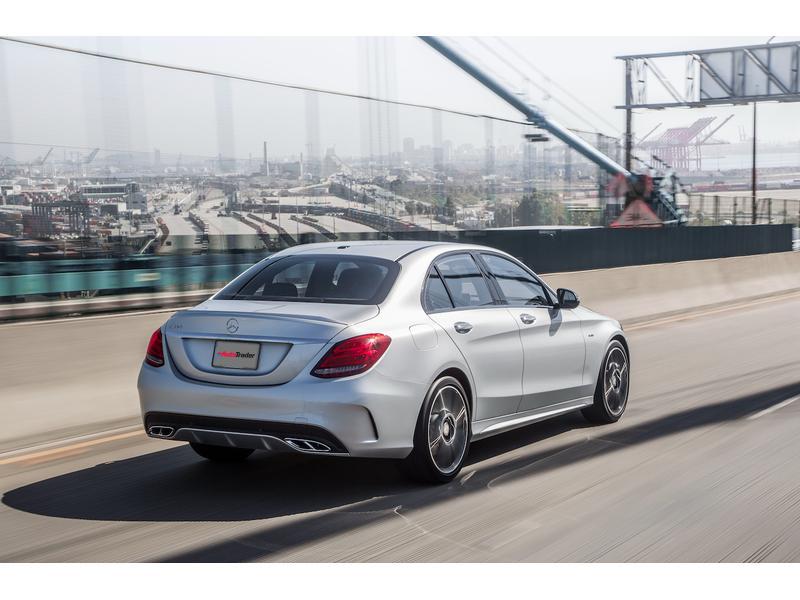
Our first contestant is the Mercedes-Benz C200, which features a new 1.5-litre turbo 4-cylinder petrol engine in conjunction with a bit of electrical assistance to arrive at peak output figures of 145 kW and 280 Nm. Even without the electric motor’s help, the petrol engine alone delivers 135 kW, which comfortably exceeds our 130 kW minimum requirement. Power goes to the rear wheels through Mercedes’ excellent new 9-speed automatic gearbox, and no manual transmission is available.
Standard Equipment
In base specification, the C200 has a list price of R640 136 before options, but despite its near-entry-level status, it’s not really lacking in standard kit. You get dual-zone climate control, cruise control, a colour infotainment system with Bluetooth connectivity and steering wheel controls, pushbutton start, and automatic control for the wipers and LED headlamps even without ticking any option boxes.
Safety credentials are solid as well, with 7 airbags as standard (with an upgrade option to 9), stability control, ABS brakes with automatic emergency braking, and a 5-star Euro-NCAP safety rating. Parking sensors and a rear-view camera are optional, however, as are blind-spot monitoring and lane-keeping assistance.
As expected, the options list stretches for pages upon pages. Among the nice things you can add are a panoramic sunroof, a digital dashboard, head-up display, navigation, adaptive cruise control, electric seat adjustment, leather upholstery (synthetic leather is standard), and even air suspension.
Building “our” C200
We ticked the boxes for the full driver assistance suite, which adds blind-spot monitoring, surround-view cameras, the parking assistance system, and adaptive cruise control, along with the digital dashboard, navigation and the mid-level audio system upgrade. Thus equipped, our C200 saw its price jump to R740 428 (a jump of more than R100 000 from the base car), but upped the ante with a bunch of nifty luxury features. Sure, you can order your C200 with nothing extra, but you can have a really nice one if you’re able to lay down some extra cash.
To fit in with our power output requirement, we went straight for the new-generation BMW 320d in standard “Luxury Line” trim. Note that this new-generation 3 Series launches in South Africa in the beginning of March 2019, so the car at which we’ll be looking is right at the start of its product cycle. This comparison thus becomes a product preview for the new 3 Series as well.
In addition, the 320d will be the base model at launch (the 320i will arrive later), so this will be the only diesel-engined car in this comparison. Nonetheless, the 320d offers 140 kW and 400 Nm, sent to the rear wheels through an 8-speed automatic gearbox, with no mention of a manual gearbox option as yet.
Standard Equipment
In base trim, the new 320d costs R649 253 before options. Included in the standard specification are dual-zone climate control, LED headlamps, cruise control, a colour infotainment display with a colour digital dashboard, Bluetooth functionality, steering wheel controls, satellite navigation, pushbutton start, automatic controls for headlamps and wipers, and parking sensors front and rear.
As expected, safety features amount to a full house, with disk brakes with ABS and EBD, stability control, 6 airbags, and an expected 5-star Euro-NCAP safety rating (the outgoing model scored 5 stars in 2012, so there’s little reason to suspect that the new one will do any worse).
Optional extras run the whole gamut from heated seats front and rear with front electric adjustment, active cruise control, a heated steering wheel, panoramic sunroof, extended BMW Concierge Services, a complete suite of driver assistance systems, various audio system upgrades, surround-view cameras, and even active BMW Laser headlights – and that list merely scratches the surface.
Building “our” 320d
We ticked option boxes for the full driver assistance suite (which includes the surround-view camera, cross-traffic alert, blind-spot monitoring and adaptive cruise control), preparation for Apple CarPlay, the Hi-Fi loudspeaker audio upgrade, BMW Live Cockpit Professional (which goes hand in hand with the driver assistance system). This brought the price up to R724 353 (an increase of R75 100 over the base model), and gives you most of the must-have safety- and convenience features. That’s actually not a bad price for the latest-generation 3 Series loaded with the nicest options.
Our minimum power requirement immediately ruled out the entry-level “35TFSI” A4 variant, so we decided to use the “40TFSI Sport” as starting point. It’s equipped with a 2.0-litre turbo petrol mill which delivers 140 kW and 320 Nm, which places it mid-pack in this comparison’s power ratings. The A4 is only available with front-wheel drive, and the only available transmission is a 7-speed dual-clutch automatic.
Standard Equipment
Included in the A4 40TFSI’s standard equipment list are dual-zone climate control, Xenon headlights, automatic headlight/wiper operation, and colour infotainment system with Bluetooth connectivity and steering wheel. It costs R565 500 before options.
Safety credentials are again beyond reproach, with 6 airbags as standard (8 airbags as an option), stability control, disk brakes with ABS and EBD, and a 5-star Euro-NCAP crash test rating.
The really nice things only appear on the option list, however. Buyers can select Audi’s excellent digital dashboard, a head-up display, a comprehensive suite of driver assistance systems, navigation (which also upgrades the infotainment to a touchscreen), along with parking assistance, and city assistance (which also upgrades the cruise control to an adaptive system with stop-go technology).
The choices are bewildering, and there is a large measure of overlap between options and their supporting upgrades, so make sure that the option box actually gives you everything you want.
Building “our” A4 40TFSI Sport
“Sport” trim is the most-basic specification level for 40TFSI variants, so it already comes with the sports seats you’ll need to pay extra for in the other two contenders. To this we added the full driver assistance suite (which includes navigation, the touch-screen MMI Plus interface, and the digital dashboard as supporting upgrades), the first-level audio system upgrade, along with Matrix LED headlamps (which yet again comes with a host of other upgrades).
These options aren’t cheap, and bumped the price of our A4 to R692 598, an increase of almost R140 000 over the base price. Then again, once you’ve ticked these boxes, your A4 will have just about every possible bell and whistle, and a few more besides.
Verdict
The result of this comparison was a bit of a surprise, to be honest. The Audi costs the least before options (and by quite a margin too), but that’s also partly because its standard specification sheet isn’t quite as comprehensive to start off with. Bringing the A4 up to spec parity with the other two (which are priced very close to each other in basic form) will see you shelling out about as much as either of the others will cost you, so there’s not much in it when you’re looking at the lower-trim cars.
But it gets really interesting when you start adding the high-tech options on offer, because both the BMW and the Mercedes-Benz gets very expensive, very quickly as soon as the toy count goes up. When you load them all with a similar selection of luxury- and convenience items, the Audi wins by virtue of its significantly lower price tag: more than R30 000 less expensive than an equally loaded new BMW 320d, and more than R50 000 less expensive than a C200 in similar trim.
In mitigation, the forthcoming new 320i will likely cost a fair chunk less than its diesel sibling, and might achieve price parity with the Audi when it arrives. But until then, the Audi is a clear value leader, and has to take the crown with the best value for money among this trio.