
BMW i8 Roadster – Is this the most dramatic-looking car on the planet?
BMW i8 Roadster – Is this the most dramatic-looking car on the planet?




By Stuart Johnston
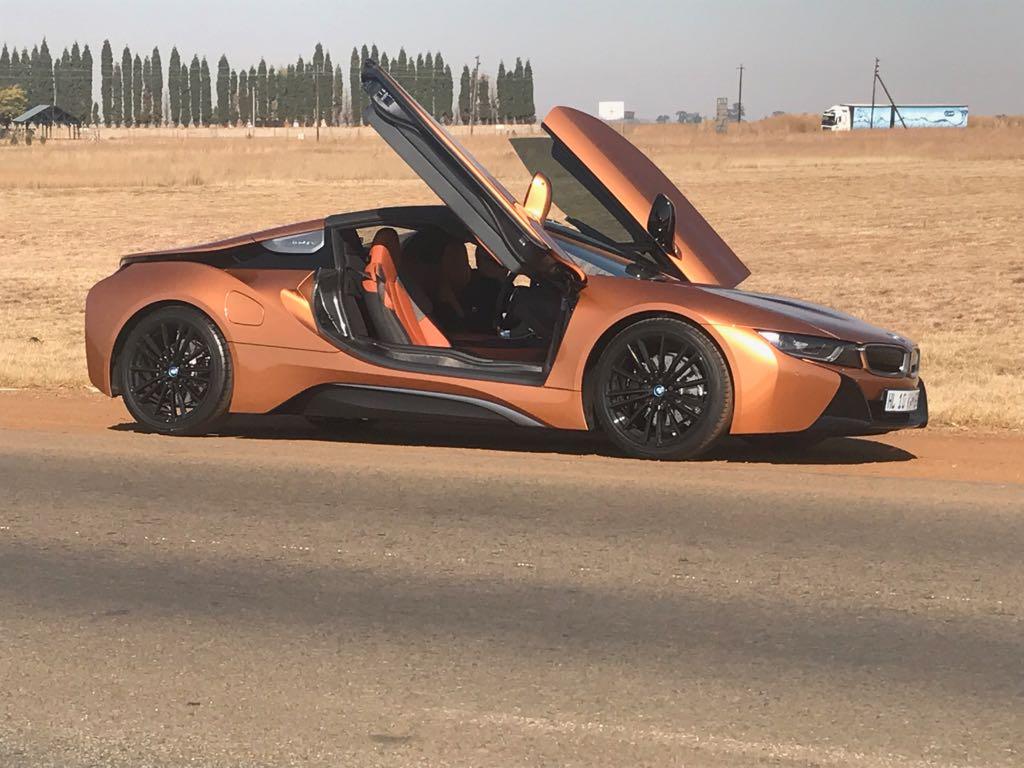
The roadster version of BMW’s techno-marvel i8 has, in one fell-swoop, produced what may be the most dramatic-looking car on Planet Earth. Chopping the top off the car emphasizes the drama of the rear flanks with its inward-curling winglets towards the tail light section, and those rear buttresses stand out as a celebration to all classic roadsters of the mid-engined variety in the past 50 years!
But where are the engines located?
Most of our readers by now will know that the BMW i8 employs one smallish petrol engine and two electric motors to power this sensational-looking car. And, apart from the folding canvas-top, the Roadster is identical in all other ways to the i8 Coupé, launched here in 2015.
The three-cylinder turbocharged petrol engine, which has a small capacity of 1,5 litres, is mounted in the middle of the car, ahead of the rear wheels but behind the driver. One of the electric motors is also mid-mounted, located close to the petrol engine, that produces 170 kW.
The second electric engine is mounted in the front of the car. The petrol engine is mated to a six-speed automatic transmission that powers the rear wheels of the car, while the two-electric motors use a second two-speed automatic gearbox to send power to the front wheels. So the car is all-wheel-drive, but there is not a direct mechanical connection between the front and rear wheels, only an electronic one. The car’s main computerised “brain” uses the three engines to send power to either the front or rear axles according to wheel slip sensors, or when directed to do so when the driver flattens the accelerator and signals that maximum power is called for.
How much power?
The electric engines produce a total of 105 kW, and 250 Nm, while the turbo three-cylinder petrol motor produces 170 kW. BMW thus claims a combined output of 275 kW for this car.
This is not a huge amount of power for a car that looks like the most super of supercars, but it is enough to give the roadster ( at 1 595 kg, slightly heavier than the coupé) a 0-100 km/h sprint time of 4,6 seconds and an electronically-limited top speed of 250 km/h.
Those are figures short of the ultimate supercar performance figures right now, but impressive nevertheless.
Does it feel fast?
In our brief drive in the Roadster on roads that were limited to a degree by traffic and speed limit constraints, we can tell you that the car feels fairly quick on all-out acceleration, accompanied by a rather raucous induction and exhaust noise. That little 1.5 turbo motor sounds more like an old-school hot six-cylinder than a shrill three-cylinder. Mid-range overtaking is impressive, without being mind-boggling.
Fuel consumption. Or should that read “energy consumption”?
BMW claims the following for “energy consumption: Electric power consumption, combined: 14.5 kWh/100 km, petrol consumption, combined: 2.0 l/100 km, CO2 emissions, combined: 46 g/km. Electric range: 53 km.
On the shortish (but nevertheless interesting) drive that we undertook from Rosebank to a Pretoria BMW dealership, we would estimate that the consumption was way over that two-litres/100 km figure, and probably closer to six litres/100 km, given that we had the petrol engine engaged for about 95 per cent of the trip, and working quite hard at that on occasion.
The performance on the new Roadster and the new Coupé, launched at the same time, has been up-rated by a bigger battery (also mounted mid-ships in the transmission module) and resultant greater electric output, up by 9 kW.
What’s it like to drive on our roads?
The ride is pretty good. If you select sport mode you get lots of rorty audio inside the cabin from that threw-cylinder motor, when the top’s down. The top, by the way, takes just 15 seconds to raise or lower at a touch of a button, and you can operate the top up to a speed of 50 km/h, which is handy because you don’t have t pull over to the side of the road to open or close it.
With the top down, there is an experience of a slight lack of rigidity through the steering wheel on rougher roads, but most people won’t be bothered by this, or even notice it.
Cruising on the highway at 120 km/h, the car feels rather ordinary, and I wish the steering imparted a bit more feedback.
As for other sensations, well, this car attracts mega-attention from people on the side of the road and passers-by! If you always wished you were a rock star, this is the car for you!
Charging it up
This configuration of car is a plug-in hybrid, which means that to get the best performance out of that battery-fuelled electric motor-pack, you need to keep the battery charged up. There is some re-charging of the battery when you back off the throttle, or brake. But if you let the battery run low by accelerating hard and often, after a while you won’t get the full 105 kW punch from the electric side of the powertrain.
This means charging the car, and BMW will sell you your own wall unit for this to install in your garage at home. In addition, BMW SA has increased the number of charging units at dealerships in the major centres for their i-rage of cars, so you can pop into an i-accredited BMW dealership and top up the battery.
At our lunch stop at Melrose Arch (a swanky shopping centre in Jo’burg) we made use of a permanent charging station located in the High Street by BMW. To top up here, you simply use the BMW i card, after hooking up the charging cables (located in the small boot) to the public charger. And this charge is free of… errr.. charge from BMW, in other words it won’t cost you any money.
Talking of money...
How much? The new BMW i8 Roadster costs R2 329 300, some R230 000 more than the i8 Coupé. That’s a lot of money, but in fact for the kind of attention-getting power this car has, it’s quite cheap, considering cars like a McLaren or a Ferrari cost much, much more (okay they are much faster too). Overall there is a feeling of top-quality BMW engineering about the car that is reassuring. And for now, a hybrid like this makes much more sense for South Africa than any pure-electric car, where covering long distances on battery power alone is always going to be a cause of “range anxiety”.