
The Legends of Rosslyn – Celebrating BMW's heritage in style
The Legends of Rosslyn – Celebrating BMW's heritage in style




By Martin Pretorius
It's not easy to find the words to describe a visit to the Vilakazi Precinct in the heart of Soweto. On the one hand, there's a gravitas about the place which could only stem from its proximity to a number of national landmarks. Nelson Mandela lived here, Archbishop Tutu still does, and many significant events in our history played out around the area. But the main avenue is also a place abuzz with modern life and fashionable people, drawn here by restaurants as wildly divergent as Wandies Place and Les Delices de France, and the upbeat atmosphere all around.
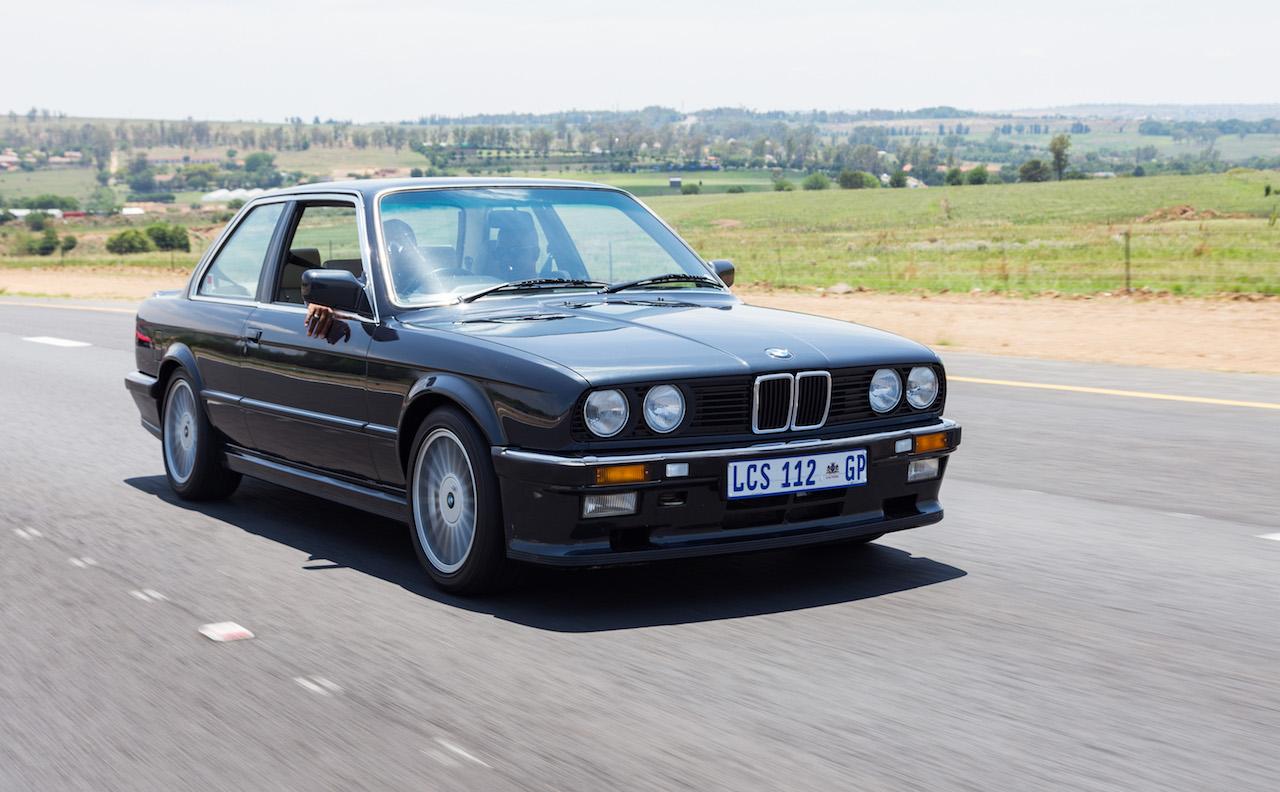
And what better accompaniment to this uniquely local rhythm than the roar of a classic BMW engine? I'm behind the wheel of a local legend, and every metre we progress along Vilakazi Avenue is met with appreciative cheers, amplified every time I blip the throttle of the gunmetal grey BMW 333i. And blip the throttle I must, very often, because the road is littered with speed humps, and out of respect for the health of the perfect Alpina body kit and suspension, I proceed at a snail's pace.
The People's hero
This may just be the ultimate chariot for a tour of Soweto. So ingrained is the people's adoration for the Gusheshe (as the E30 3-series is known here) that showing up in a pristine example of the “last number” (another local colloquialism, roughly translated as “highest spec”) E30 is an occasion worth celebrating. Every so often, someone shows up with a phone, wanting to take a picture or record the exhaust note. I dutifully oblige, and tickle the straight six with my right foot. Swooning is inevitable.
It's easy to understand why. With a reputation forged over many decades, the BMW E30 has earned its place in local culture - one its successors aren't close to achieving yet. Just about anyone who's interested in cars around here loves it, be it as a status symbol, for spinning, or as a blank canvas for some classy customising.
A shared crown
The E30 legend is based on two locally-developed range-toppers, both of them born from the need for something similar to the European-market M3. The E30 M3, with its screaming 16-valve 4-cylinder engine and dog-leg gearbox, never came to South Africa, because it wasn't feasible to re-engineer it for right-hand drive markets. This didn't bother the folks at BMW South Africa too much, though. They already had a habit of developing performance versions of locally-produced BMWs, with the M1-engined 745i then about midway through its life cycle.
After looking at the available options, they settled on a favourite South African pastime: fitting the largest possible engine into the lightest possible body. The engine chosen was the 733i's 3.2-litre 12-valve M30 straight-six, using various parts from the Alpina B6 to make it fit into a two-door E30 body. So crammed was the engine bay, that buyers had to choose between air-conditioning and power steering! Power was sent to the rear wheels through a limited-slip differential and a 5-speed manual gearbox, and the wheels were the obligatory multi-spoke Alpina items. It was all rounded off with an angular bodykit. Very high style for the 1980s, understand?
Driving the 333i
Back in the day, the 3 Series was a really small car, rather than the spacious carriage it's become over the years. That means that it's also quite small inside, with narrow footwells (thanks to the transmission hump) and shoulder room which barely misses falling in the “cramped” category. But strangely, it doesn't feel oppressive at all, thanks to the large glass area right around and slim windscreen pillars. There's no need for a reversing camera, because you can actually see the rear edge of the boot spoiler from the driver's seat. Modern safety regulations demand sturdy roof pillars, and it really is nice to survive a crash, but it sure was pleasant to be able to see out the windows...
But that's not what the 333i is about. It's main mission was really to be a South African muscle car, so the main focus is on its drivetrain. Piloting a 333i is a very involving experience, reliant on manual labour to make the machine work with the driver. This particular 333i had the air-conditioning box ticked, so the steering is unassisted, and thus heavy and long-winded. The clutch is likewise stiff, and the gearshift is notchy and vaguely obstructive. And while there's an “ABS” sticker on the instrument cluster, the brake feel is vague, and the braking power on offer won't pass muster in a modern car – a legacy of the 3 Series' translation to right-hand drive.
Old-time performance
But that's what performance cars were like, back then. None of the 333i's contemporaries were particularly easy to drive either, and they all had some flaw somewhere. But those flaws were ignored, because many things could be forgiven at the temple of speed. And in its day, the 333i had plenty of that, even if a modern hot hatch such as a Polo GTI will run away from it with embarrassing ease.
Most of that speed comes from a lot of torque for the era – 285 Nm, to be precise. The power output was equally impressive, with 145 kW still creating reasonably enthusiastic motivation in a car with a kerb weight comfortably below 1300 kg. That's about as much as a Corolla Quest weighs, in case you were wondering. As a result, the 333i is brisk even by modern standards, with a quoted 0 – 100 km/h sprint in 7.4 seconds and a top speed of 228 km/h.
It's all about the feel
There's nothing that sounds quite like a BMW M30 engine. It could be just the bassy undertone, but an old big-block BMW 6-cylinder sounds unlike any other “six” they've ever made. Imagine a faraway rumble overlaid with an emotive howl, as the chunk of tuned cast-iron and aluminium reaches for its modest redline just on the far side of 6000 r/min.
The torque output isn't massive, but it comes with an even, deep-chested delivery which makes the acceleration feel utterly effortless. Meanwhile, there's satisfaction to be had by mastering the dog-leg gearbox's notchy shift (first gear to the left and back instead of to the front, as we're used to).
Cornering is great fun, and although the steering ratio is pretty slow, it accurately relays messages from the tyres to the driver's fingertips. That heavy engine gives a somewhat nose-led feel to the handling balance, but there's enough torque to cancel understeer with a judicious bootful of throttle. Again, it's nowhere near modern standards in terms of outright ability, but the important thing is that it feels pure and engaging even at low speeds. I wish modern cars were more like this...
Enter the new generation
Impressive though the 333i was, it wasn't really suitable for motorsport, and that's where BMW South Africa had to devise a new plan. This time, they chose a much less-exotic route, by keeping the 325i's basic drivetrain in place. The smaller, lighter M20 engine was better-suited to motorsport regulations, and the normal 5-speed manual gearbox was easier to operate than the heavy-duty item in the 333i.
The engine was however massaged somewhat and stretched to 2.7-litres, again using Alpina bits, realising successive power increases to eventually peak at 155 kW in its ultimate 325iS Evo 2 form. I had opportunity to get some wheel time in a 145 kW version, finished in gleaming silver and sporting the original, full M-Technik bodykit. This particular car was recently restored by a team at the Rosslyn factory, and is so original that it still features a Grundig radio, probably the one with which it left the factory 60 000 km ago.
Small block, big heart.
Much of the 333i driving experience translates to the 325iS as well, except that the brakes are somewhat sharper (though still not great), and the gearbox with its conventional gate is easier and smoother to operate. Oh, and thanks to that smaller engine, there is room for air-conditioning AND power steering, and that makes life a lot easier.
The engine's character is somewhat different, though. There's clearly a lot less torque on tap, and it has to be wound up tight to deliver its best performance – and then it's roughly on par with (or maybe just a little quicker than) the older 333i. It still delivers one of the best engine sounds out there, though. Some things will never change.
The last and the first
Joining the 325iS and 333i on this drive around Johannesburg was the last of the 1 191 604 (how's that for exact book-keeping!) 3 Series cars built at Plant Rosslyn over the last 35 years. It's a white 340i, and... well, it drives exactly like any other 340i, so there's no real need to describe it here.
It's still a historically significant car, though, just like the metallic blue X3 xDrive30d which also featured in our convoy. This specific X3 is the very first car to roll off the newly-installed production line, and marks the start of a new era for Plant Rosslyn and demonstrates BMW's multi-million Rand investment in our economy. About this car: the 30d derivative is surely the pick of the bunch (if you can afford it). The engine and sweet 8-speed automatic gearbox suits the X3's gentlemanly character as perfectly as the M30 suited the E30. BMW clearly knows a thing or two about straight-sixes...