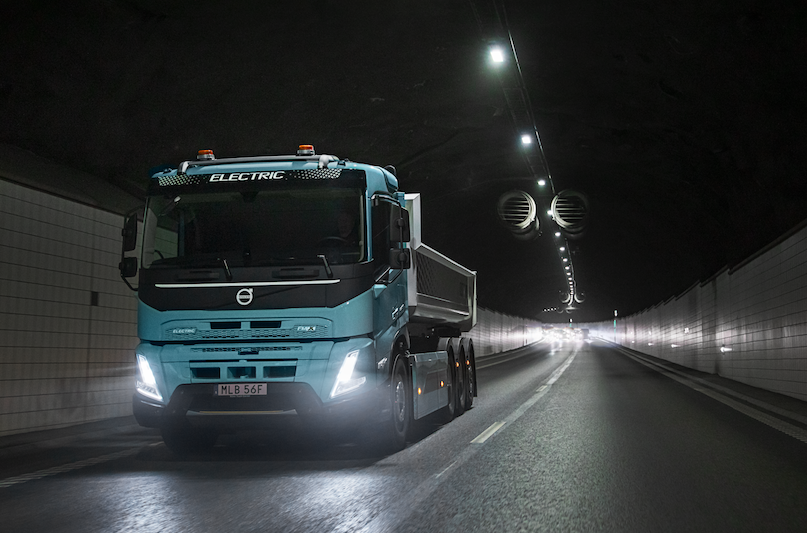
What are these new trucks like to drive? Martin Schatzmann (Executive Editor of TIRtransNews; he also represents Switzerland on the International Truck of the Year jury) drove them in Gothenburg and very kindly shared his driving impressions with us.
Introducing the heavy hitters
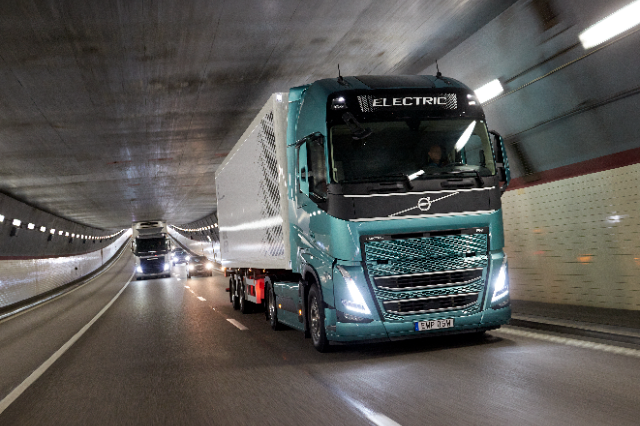
Volvo and its sister company Renault have long been working on the electrification of trucks. The company wants the CO₂ emissions of its trucks in 2030 to be half of what they were in 2019. And, ten years later, they should be zero. The overriding goal is road transport that doesn’t emit any CO₂ by 2050.
Its first step was the introduction of liquefied natural gas (LNG) trucks in 2017. Then Volvo launched medium electric trucks two years ago (its vehicles are manufactured at the Renault Trucks plant in Normandy, in Blainville-sur-Orne).
Since 2019, Volvo has sold more than 200 FL Electric and FE Electric trucks across Europe. “Most of these have gone to Norway, followed by Sweden, Germany and Switzerland,” Schatzmann reveals.
Incidentally, the same drivetrain from the FL and FE is also used in the North American-made Volvo VNR truck, which has been in series production in the US since March 2021.
Now Volvo is also launching trucks in the heavy segment – specifically electric versions of the FH, FM and FMX. The company has already received its largest electric truck order ever – for 100 Volvo FM Electric trucks from DFDS, Northern Europe's largest shipping and logistics company. The deal is one of the largest ever for heavy electric trucks worldwide.
The trucks in a nutshell
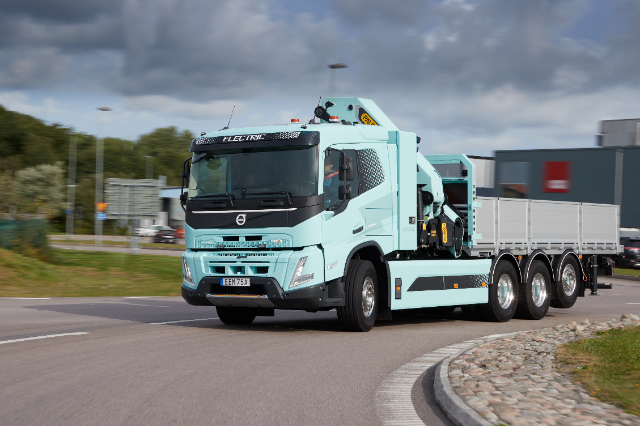
The FH Electric is ideal for regional and intercity transport, the FM Electric is a versatile truck for heavy local transport and regional distribution and the FMX Electric is perfect for cleaner and quieter construction transport. The trucks have a range of up to 300 km. The battery capacity is up to 540 kWh and the gross combination weight (GCW) is up to 44 tonnes.
Exterior
The trucks look the same as their diesel-engined siblings – they also boast the signature V-shaped headlights, bigger iron mark and bold design that we saw when Volvo introduced its new heavy-duty trucks last year. Obviously, the big exception is the lack of a diesel tank.
Interior
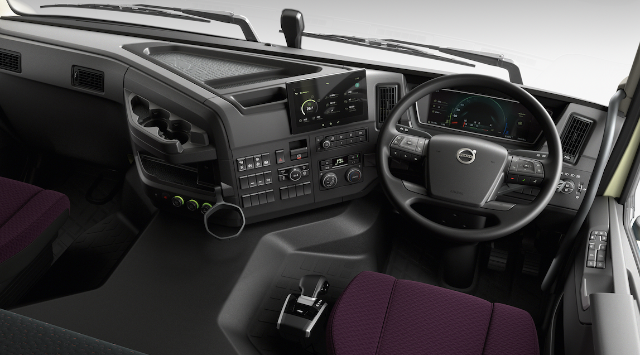
Exactly the same applies to the interior; it’s identical to that of its diesel-engined counterparts. This is a good thing; the interior of Volvo’s latest heavy-duty trucks has received widespread acclaim.
The driver’s workspace is centred around a modern dashboard, which features a fully digital 12-inch high-resolution instrument display and includes a fixed cup holder and an open storage space with motion-sensor controlled lighting. The instrument display allows the driver to choose between four different screen views, depending on the driving situation and the information they prefer to have displayed.
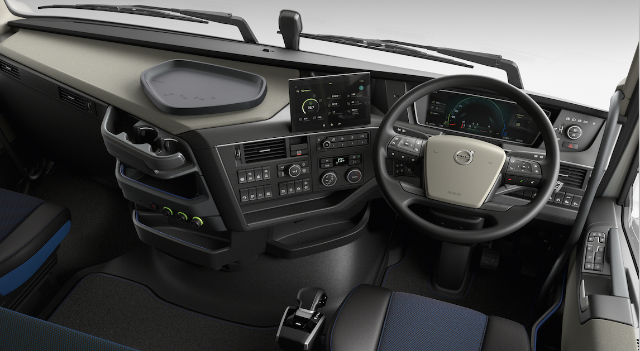
An optional nine-inch side display can provide infotainment, navigation assistance, transport information and camera monitoring. The display, which is easy to reach, allows the driver to interact in numerous ways: with the buttons on the steering wheel, through voice control, or directly via the touchscreen and display control panel.
Drivetrain
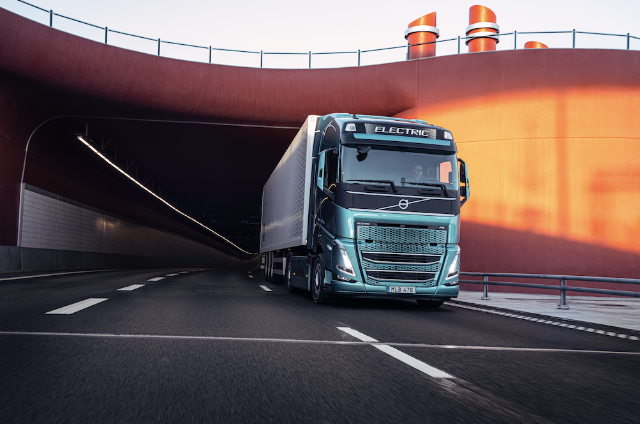
The electric motor, which was "borrowed" from the bus division for the FL and FE, is also being used in the heavy electric trucks. In FL and FE, the motor is used alone or in a package of two; in the FH, FM and FMX, the package normally comprises three motors. Together, these generate 490 kW (666 hp) of continuous power and 2400 Nm of maximum torque.
The lithium-ion battery in these heavy-duty trucks is produced in Ghent, Belgium, the Volvo plant that has been CO₂-neutral since 2017. According to Anna Thordén, Product Manager Electromobility at Volvo Trucks, one pack has a capacity of 90 kWh and weighs around 500 kg. By comparison, the first batteries in FL/FE had 49 kWh capacity three years ago. "Since then, the energy density has more than doubled, but the manufacturing costs have more than halved," says Thordén, summing up the progress in battery production.
Depending on the application and vehicle dimensions, the heavy EVs can be equipped with three to six battery packs, thus offering between 270 and 540 kWh capacity. For special applications, the truck can also be equipped with only two packs (180 kWh).
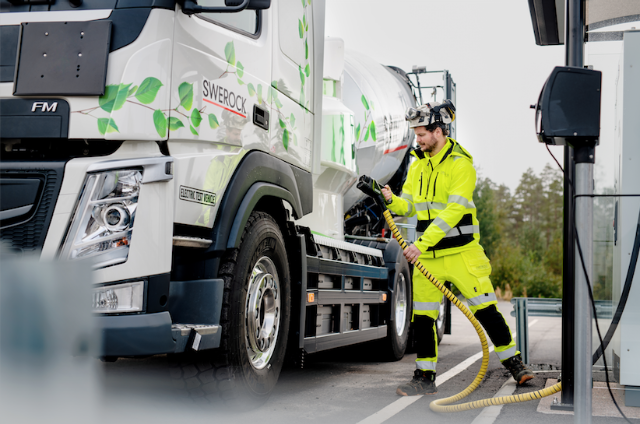
When hooked to fast chargers, the batteries can be recharged to 80% in one hour 25 minutes, and to 100% in just under two hours.
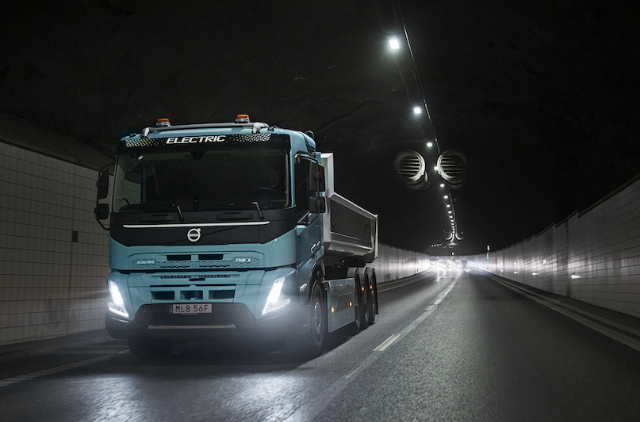
As is typically the case with electric trucks, the ride in the FH Electric and FMX Electric is exceptionally quiet. “During development, the engineers were not satisfied with eliminating engine noise, but placed great emphasis on reducing negative frequencies and vibrations,” explains Schatzmann.
The results are impressive. “We drove through the suburbs of Gothenburg quietly and undisturbed by superfluous vibrations, enjoying the peace and quiet in the cab. We encountered little wind noise even at 80 km/h on the bypass motorway,” he notes.
While the truck is super silent, Volvo has installed the sound generator required by law in its e-trucks, which alerts pedestrians and cyclists to the approaching truck when it’s travelling below 20 km/h.
Transmission
While new single- and two-speed gearboxes have been developed for FL and FE Electric, Volvo uses its familiar 12-speed automated I-Shift transmission for the heavy trucks. The hardware of the transmission remains untouched, but the transmission control has been adapted to the electric motors. “Because of the high starting torque of electric motors, the e-trucks always start in seventh gear, and the control system only selects a lower gear when the vehicle is heavily loaded and on a steep incline,” explains Schatzmann.
The I-Shift is located in the same position in the vehicle, regardless of the diesel or electric version.
Schatzmann says he was worried that the I-Shift transmission would destroy the otherwise rapid start-up familiar from the electric drive due to interruptions in the traction load. “But they vanished into thin air in no time. In fact, the FH and FMX practically always started in seventh gear and only made the first, smooth gear change to ninth after a large increase in speed. Fifth gear was only used once, when we had to climb a short but steep incline a few seconds after setting off on the flat. As soon as we reached the top, we were back in the upper half of the 12-speed gearbox,” he reveals.
In addition, the transmission PTO remains the same for the electric versions (up to 150 kW), so there is no need to compromise on operational capability. “Volvo Trucks’ declared goal is to bring the variety of heavy-duty electric trucks onto a par with that of diesel units. In addition to the gearbox PTO, a 40 kW electric PTO with 600 volts direct current (DC) or 400 volts alternating current (AC) is also available. It can be used, for example, for operating refrigeration units,” explains Schatzmann.
Safety
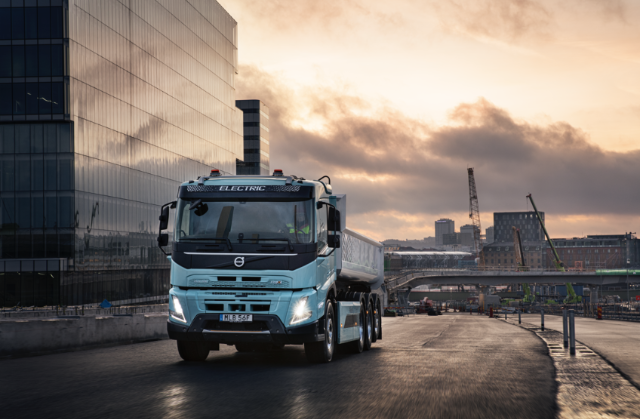
As per the diesel-engined Volvos, the electric trucks boast safety features par excellence. The FH, for instance, is the world’s first heavy-duty truck with adaptive high beam headlights. Other safety features on both trucks include downhill cruise control, which sets a maximum speed to help prevent unwanted acceleration when travelling downhill; an improved Adaptive Cruise Control (ACC) that works at all speeds, even down to zero km/h; and an Electronically controlled Brake System (EBS).
Verdict
Series production of these trucks only starts in mid-September 2022, anad so we obviously don’t have any pricing details. We also don’t know when the trucks will come to South Africa. “We are currently looking into local testing of electric trucks and should start that in the next two years. Sales will be determined by various factors – most importantly the investment and availability of charging facilities en route or at customers’ facilities. Our optimistic outlook is possible sales to start within three years,” says Joe Pretorius, Brand Manager: Volvo Trucks at Volvo Group Southern Africa.
But Volvo doesn’t mess around. When the company does something, it does it right. And it’s normally quite hungry for market share. So, when Volvo’s electric trucks do arrive in South Africa, you can bet your bottom dollar that they will be priced right and that they will represent a super-appealing proposition.