
Porsche and sustainability
Sustainability is Porsche’s middle name; the company is doing a lot to save the planet. It is harvesting green energy from wind, water, and solar sources. The Zuffenhausen-based sports car manufacturer has launched Porsche Impact, an emissions calculator, which helps customers to offset their personal Porsche carbon footprint. It is investing billions of euros (around 6 billion to be precise) in the development of electric cars. It’s even revealed a leather-free version of its new Taycan electric sports car.
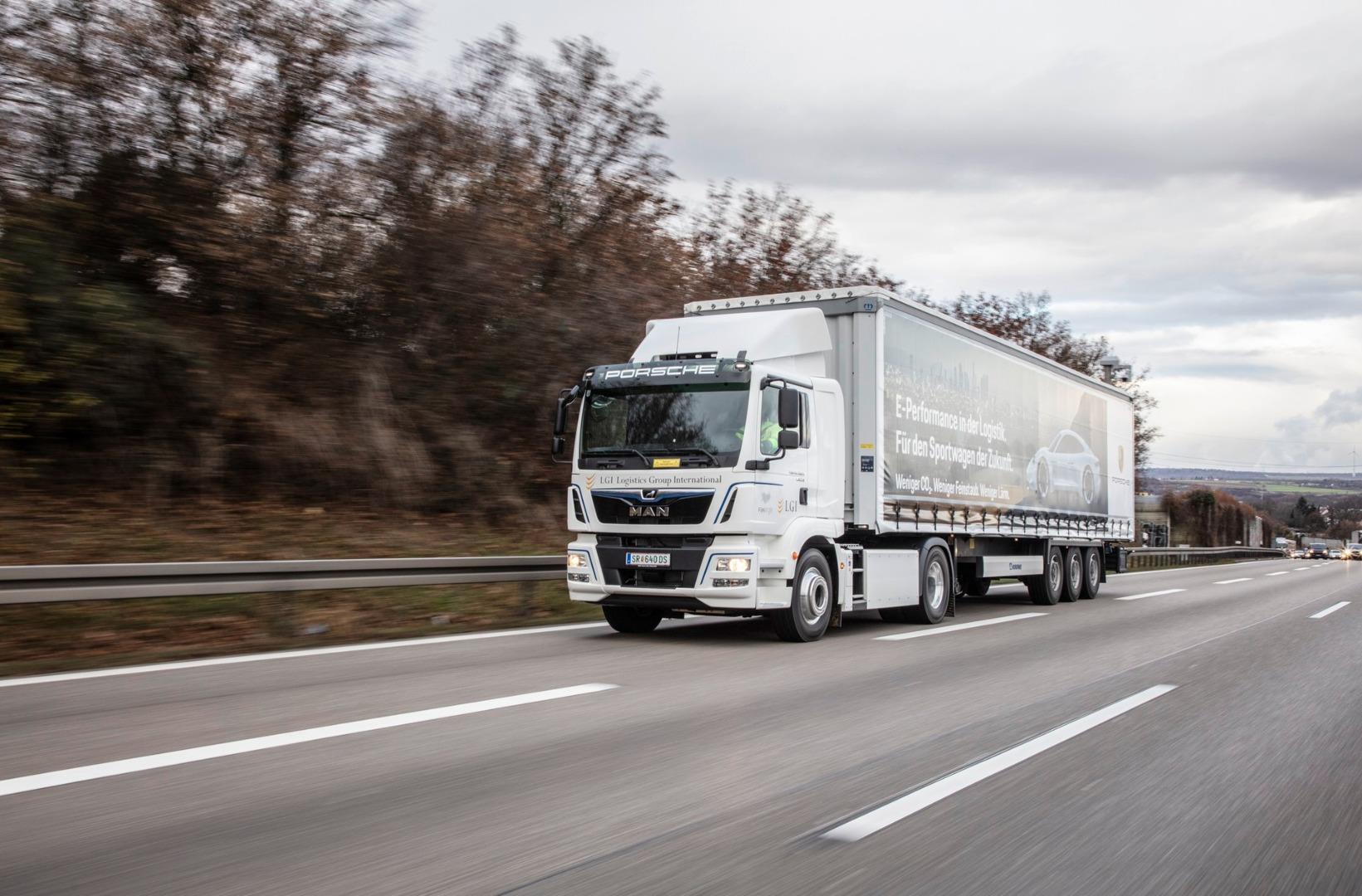
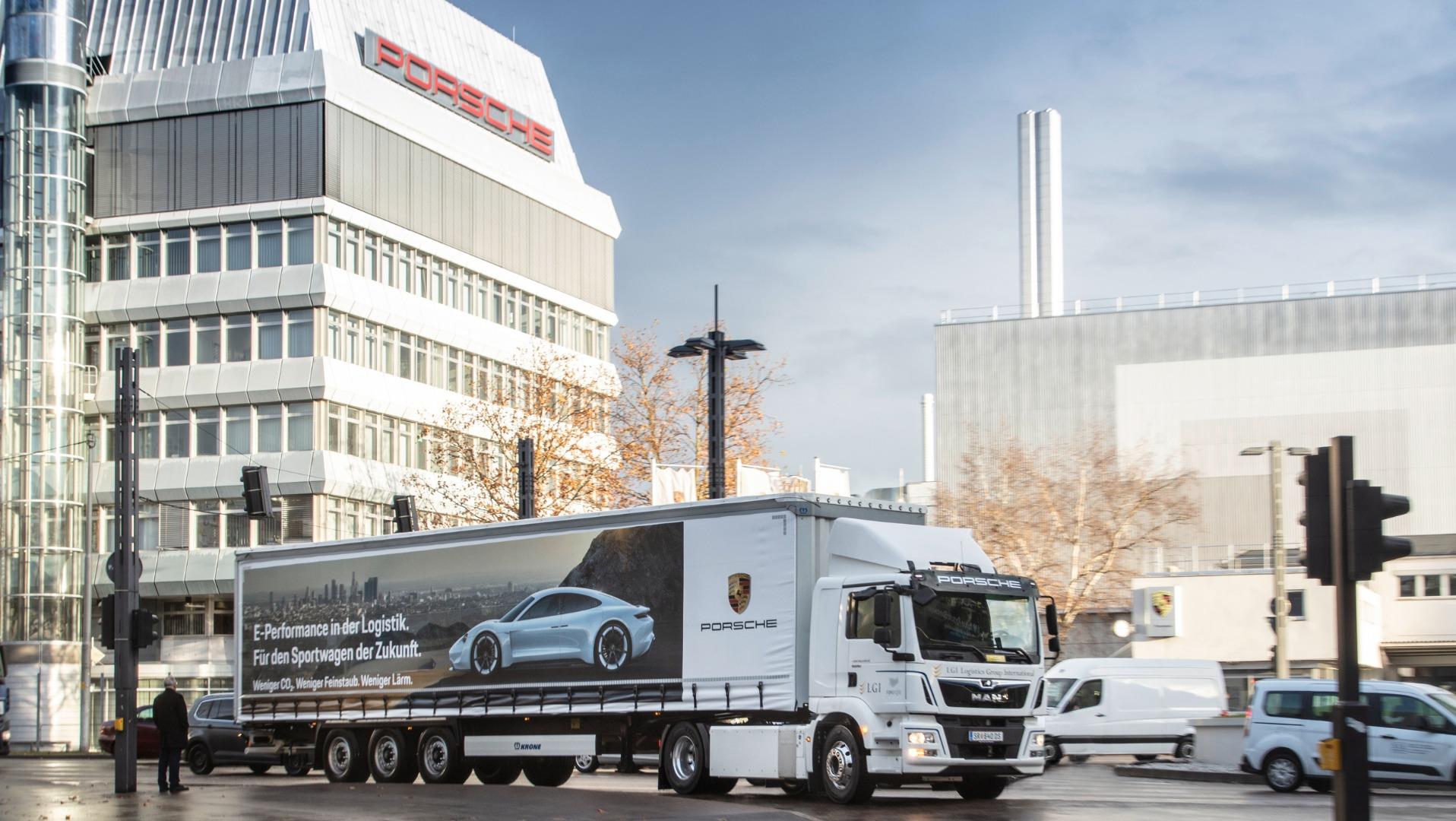
But the company has decided that this is not enough, so it’s turned its attention to transport – specifically trucking – and it’s taken delivery of a fully electric MAN eTGM.
The zero-emission vehicle is doing daily duty at Porsche, where it delivers parts for the Taycan model from the company’s central warehousing site at Freiberg am Neckar to the factory at Stuttgart Zuffenhausen. It’s only a distance of about 19 km – but the company is saving over 30 000 kilograms of CO2 that would otherwise be emitted into the environment each and every year.
MAN enters the picture
MAN has been working on e-trucks for quite some time. Back in September 2016, we saw its very first e-truck, a TGS semitrailer tractor, at the IAA Commercial Truck Show in Hannover. Last year, the company handed the first nine MAN electric trucks to member companies of Austria’s Council for Sustainable Logistics. Those trucks are being tested by a number of leading retailers and transport companies in that country. Like Porsche, MAN belongs to Volkswagen – so it made sense to go shopping for an e-truck at a sister company, so to speak. It chose the MAN eTGM 18.360 4x2 LL, which has a gross vehicle mass (GVM) of 32 tonnes.
Behind the wheel
There’s one big difference to the exterior of the eTGM versus the regular TGM; the e-truck has lithium-ion batteries with a storage capacity of 149 kWh that are fitted beneath the cab on the side of the frame and are used to store energy. It has eight battery packs – consequently, the range is around 130 kilometres (it’s possible to extend this range to 200 km by fitting more batteries). What I like about the batteries is that they can be charged to 80% within 45 minutes. So, in theory, a driver could do this during his lunch hour if need be.
Otherwise, the exterior of Porsche’s truck looks much like a regular TGM; you can easily spot that’s it’s a MAN, thanks to the lion perched on the radiator grille. It’s more of the same inside too – with the lion appearing on the steering wheel. The cabin is a good place to be; the seat is comfortable and easily adjusted and all the controls are well positioned. It’s easily on par with other makes of truck.
The one big difference between the interior of a regular TGM and the eTGM is the display in the cockpit. It doesn’t just show you things like speed; it also keeps the driver informed about the batteries’ current energy level. (Incidentally, it is possible to charge the batteries with either AC – 22 or 44 kW – or DC – 150 kW). That same control panel also shows you when recuperation of the recovery of brake energy takes place (when decelerating, the vehicle’s motive energy is converted into electrical energy and fed back into the battery; all you need to do is tap the brakes and then you can sit back and watch this happen…) One of the benefits of this procedure is reduced wear and maintenance – because there’s no abrasion to the brakes.
Another big difference between a normal TGM and the eTGM is, of course, the start-up procedure. As is the case with all electric vehicles, the eTGM starts in virtual silence. It takes about five seconds for all the systems to kick into play. I say “virtual silence” because you can actually hear the air compressor, which makes a bit of a hum. It’s certainly a lot quieter than a regular diesel-powered truck, though.
Once the truck is ready to rock and roll, it’s a simple case of popping it into “drive” … and then sitting back and, quite frankly, enjoying the ride. The electric motor, located in the centre of the frame, outputs 264 kW and delivers up to 3 100 Nm of torque to the drive wheels and it’s a real blast to drive – because, as is always the case with e-trucks, the torque is available immediately. The vehicle that I drove was not loaded, and so I cannot comment on its performance under load – but I’m sure it’s more than capable.
The ride sure is comfortable, thanks to the fitment of air suspension on the front and rear axles. The steering, which – like the air-conditioning system and air compressor – is electric-powered, was responsive. Once the air compressor shuts up, it’s extremely quiet out on the road. In fact, the only noise that I could hear was coming from the tyres.
I thoroughly enjoyed my time behind the wheel; maybe I should apply for a job at Porsche!