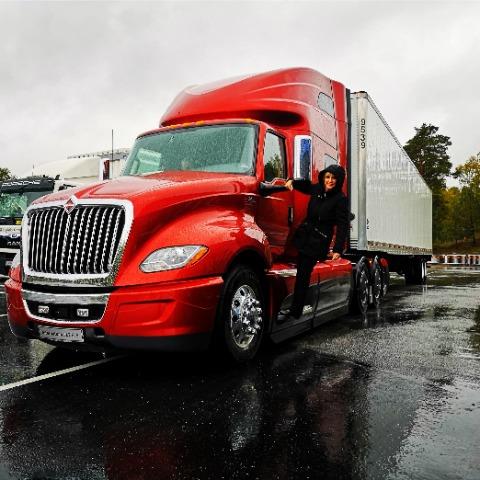
Introducing the XCIENT Fuel Cell
Hyundai really knows its stuff when it comes to fuel-cell vehicles. The company introduced the world’s first mass-produced fuel cell electric passenger vehicle, the ix35, and the second-generation fuel cell electric vehicle, the NEXO (it sold over 10,000 of these in 2023). Today, no other company sells more hydrogen-powered vehicles.

In 2019, Hyundai leveraged its decades of experience, know-how in fuel-cell technology, and mass-production capabilities – and it launched the XCIENT Fuel Cell. One year later, it shipped the first 10 units of the Hyundai XCIENT Fuel Cell to Switzerland. This was followed by another 37 units. The 47 units operating in Switzerland since October 2020 have achieved a cumulative mileage of over six million kilometres. XCIENT Fuel Cell trucks are now operating in various countries around the world, including Germany, Switzerland, South Korea, New Zealand, Israel and the United States.

The XCIENT Fuel Cell trucks are assembled at Hyundai's Jeonju Plant in Korea, a facility specialising in the production of commercial vehicles. Spanning an area of 103,000m2, this plant is responsible for manufacturing 11 different commercial vehicles, encompassing medium- to heavy-duty trucks, vans, buses, and specialised commercial vehicles.

In addition to internal combustion engine vehicles, the plant manufactures various eco-friendly commercial vehicles, such as those powered by compressed natural gas, battery electric vehicles, and fuel cell electric vehicles, such as the XCIENT.
Since its establishment in 1995, the Jeonju Plant has produced approximately one million trucks and around 300,000 buses.
The truck, in a nutshell

The XCIENT is a truck that is equipped with a 180-kW hydrogen fuel cell system and it can travel over 400km on a single charge. Two models are available. There’s a 4x2, with a Gross Vehicle Mass (GVM) of 19.5t and a Gross Combination Mass (GCM) of 38t. There’s also a 6x2 with a GVM of 27t and a GCM of 42t.
Exterior

The Hyundai XCIENT Fuel Cell looks quite a lot like a regular XCIENT with a diesel engine – but the grille is a lot funkier and more modern. We really like the LED lighting. Under the mesh-type V-shaped grille, there are fixed grille steps to provide the driver with a secure foothold for service checks.
Interior
The interior of the Hyundai XCIENT Fuel Cell – which, again, looks a lot like the interior of the diesel version – is practical, and it’s a good place to be. The design elements clearly prioritise functionality as opposed to luxury, and there’s a driver-centric layout offering easy access to essential controls and information.

Ample storage spaces and compartments are provided. The materials used look robust and durable – so they should stand up to the rigours of commercial use.

There are analogue gauges on the dash, and there’s a central infotainment system on the right of the steering wheel (the truck we drove was left-hand drive). The infotainment system is controlled by an 8-inch touchscreen that allows for intuitive menu scrolling and feature selection. It’s nicely angled towards the driver, so it’s easy to see. The steering wheel and dashboard house lots of individual switches to control various functions – anything and everything from answering the phone to turning on the aircon. All these switches are logically positioned and easy to access.

We liked the convenient wireless smartphone charger, which obviously eliminates the need to clutter the cab with cables. The system includes safety circuitry that automatically shuts off the charging current to prevent a device from overheating.

We found the driver’s seat slightly too hard. Other than that, the interior gets the thumbs up.
Drivetrain
The truck is equipped with a 31kg H2 (350 bar) hydrogen tank, 72kWh battery (24 kWh x 3ea), 180kW fuel cell system (90kW x 2ea) and a powerful 350kW/2,237Nm e-motor, which provides torque delivery that matches any diesel powerplant in a comparative vehicle weight class. This is matched to an automatic transmission (five forward and one reverse gear).

The truck is a pleasure to drive. Our test truck wasn’t loaded, so we can’t comment on how it performs under load. However, we have no reason to believe that it will come up short in this department.
As is also the case with electric trucks, we thoroughly enjoyed the low-down torque, the smoothness of the drive and the lack of noise in the cab. It obviously knocks the socks off any diesel truck in this department!
Safety
The XCIENT Fuel Cell is equipped with all sorts of active and passive safety systems. There’s Vehicle Dynamic Control, which, upon detecting wheel slippage, stabilises the vehicle by automatically regulating torque output and braking individual wheels, thus helping the driver maintain directional control and reducing the risk of a rollover. Forward Collision-Avoidance Assist automatically applies the brakes whenever it detects the risk of a collision with a pedestrian, vehicle or cyclist. Smart Cruise Control maintains the speed preset by the driver and ensures that the truck is always a safe distance away from the vehicle ahead. There are many more run-of-the-mill safety features, too – like Lane Departure Warning and Hill Start Assist.

However, some operators have specific concerns about operating a fuel cell vehicle. What about those? Well, if a crash happens, power is automatically cut off to the high-voltage cables, and the hydrogen tank is shut off to minimize the risk of electric shock and secondary events. Furthermore, the hydrogen tanks have passed the 1.5-m drop, penetration, fire and burst pressure tests to meet the most stringent European standards.
Verdict
This is a superb vehicle that would certainly find favour with South African transport operators. It smiles on the environment, and operators will smile too at its many features – the ability to be refuelled in eight to 20 minutes, for instance.
But its deployment in this country is dependent on a number of factors – most importantly, an efficient hydrogen supply and refuelling infrastructure. Government incentives would also help.

Then, of course, there is the purchase price, which Hyundai hasn’t divulged. In the United States, where state and federal clean-vehicle subsidies are in place, Hyundai reckons that there is a cost parity with current diesel models over a service life of six to eight years. If the same can happen in South Africa, there’s no reason why the truck shouldn’t be a big success here.