
It’s tough out there
The Hino 700 Series competes in the toughest sector of the commercial vehicle market: the extra-heavy segment. It’s a sector dominated by the Europeans. Just to give you an idea, MAN clocked up 217 sales last month, Mercedes-Benz reported 257, Scania recorded 188 and Volvo achieved 347. Frankly speaking, the Japanese really battle to reach big numbers; Isuzu achieved 31 sales last month, Hino managed 24 and UD Trucks notched up 84. The European trucks have a reputation for offering better driver comfort (than their Japanese counterparts). Is this reputation truly deserved?
Putting it to the test

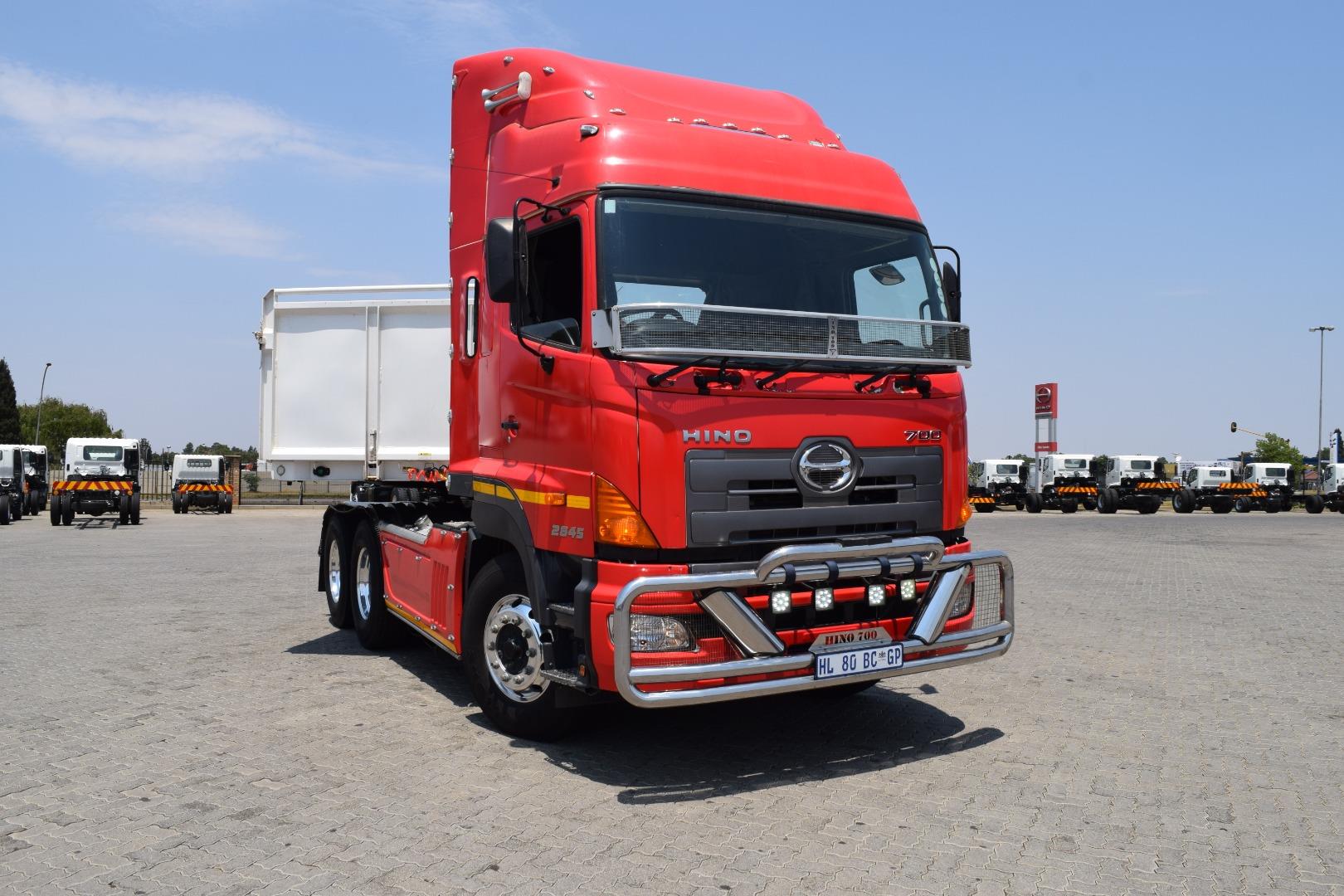
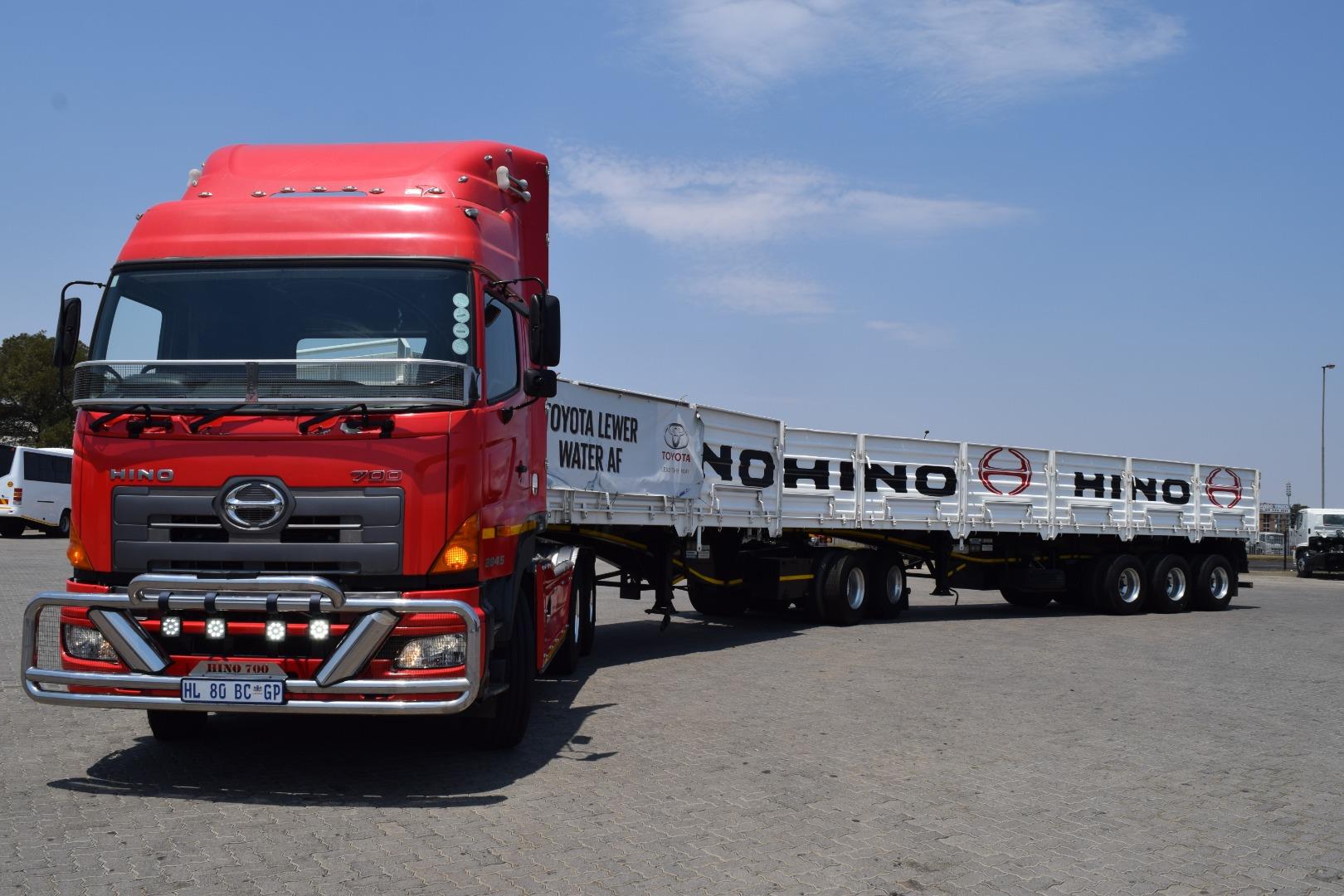
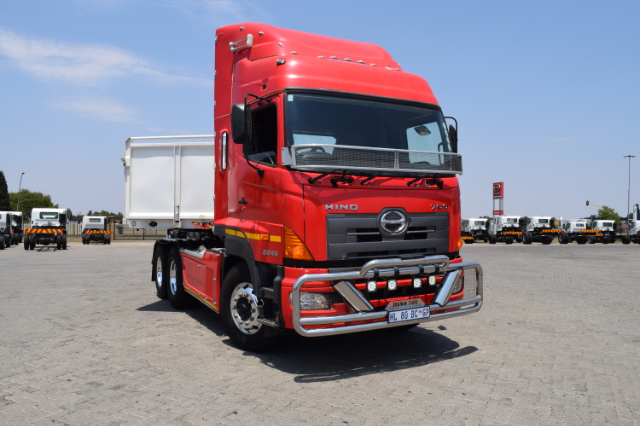
In order to answer this question (and many others), we put a model within the Hino 700 Series to the test. The entire range consists of tippers, freight carriers, mixers and truck tractors (both in 4x2 and 6x4 guise). Because 6x4 truck tractors make up the bulk of the extra-heavy-duty market, this is what we decided to test. Our specific test truck was a 2845 truck tractor, which has a GCM of 65 tonnes, a GVM of 28,3 tonnes and a V-rating of 25,5 tonnes. It comes with steel or air suspension.
The 2845 is equipped with a turbo intercooled six-cylinder in-line 13-litre Hino common rail engine that delivers 331 kW of torque at 1800 r/min and 2157 Nm of power at 1100 r/min. It is matched to a 16-speed ZF ASTRONIC AMT transmission. I’m pleased to report that more and more Hino customers are opting for automatic transmissions. This is one of my bugbears; to be perfectly frank, I fail to understand why any transport operator would ever want a truck with a manual transmission (it makes absolutely no sense whatsoever). Hino customers are tending to agree with me – thanks to the fact that the autos offer lower fuel consumption and no clutch replacement (and the subsequent downtime), operators are fast moving in this direction. They also tell me that the drivers prefer the autos, they’re less stressed and less fatigued, which results in less vehicle damage and fewer accidents.
Behind the wheel

Okay (cue the trumpets) I will jump off my automatic transmission hobbyhorse and tell you about my experiences with the rest of the truck. First of all, the stuff that drivers really tend to notice (since it’s their second home): the cab.
At the outset I need to say that it’s very easy to get in and out of the cab. There are three steps and they’re well placed and easy to use. The door opens wide enough so that you don’t have to twist your body when entering or leaving.
Once inside the cab, I wasn’t quite as impressed though. Truck drivers like a cab that is really high (so that they can stand up straight), and the floor should be completely flat (so they can walk through the cab). The 700 Series has neither of these attributes. In fairness, I could stand up straight, but a tall man wouldn’t be able to manage this. I also prefer it when the gear lever is mounted to the dashboard although, I guess, when one doesn’t have a walk-through cab, it doesn’t really make a difference.
I liked many of the other features of the interior though. The seat is fully adjustable, and the tilt and telescopic steering column works perfectly well (it’s manually adjusted). I had enough padding in the seat that I think I would have been comfortable on a trip from Johannesburg to Cape Town.
The instrumentation is clear and quite modern looking. It’s nice. It’s very easy to read and all the controls are within reach. I also like the many, many storage areas. There are two cupholders right next to the driver’s seat, there’s a storage console in the centre of the cabin, there are storage areas for paperwork in the doors and there are also lots of storage areas above the windscreen (some with nets and others with actual doors).
My test truck was upholstered in a practical dark grey. I didn’t much like the carpets; they looked a bit cheap. But the double sleepers were very comfortable indeed; I could have easily had a snooze.
The general impression is that of a cab that is utilitarian and functional.
Good safety features
Safety features on the 700 Series are good. Included in the line-up are an airbag on the driver’s side, a shock absorbing and collapsible steering column, and side impact door beams that protect the driver/passengers in the event of a collision. ABS is standard on the 700 Series – with an automatic slack adjustment system.
The driving experience

Speaking of brakes, one of the first things I noticed on my test drive was the brakes. I was joined by a Hino representative when I tested the vehicle and, the first time I dabbed the brakes, I nearly put the poor man through the windscreen. They are super sharp! He just laughed and told me that I would soon get used to them and he was quite right. However, they’re quite different to the brakes on European trucks, that’s for sure.
I was very impressed with the performance of the engine; it is very low-revving, which is obviously good for fuel economy, but it’s super willing. In fairness, my test truck was not loaded. However, even with a load, that engine wouldn’t battle. It’s surprisingly quiet; in fact, there was minimal noise in the cab.
Oh, and that ZF gearbox is magnificent; there’s a reason why it’s so popular the world over. It really takes the guess work out of driving an extra-heavy vehicle. The transmission selects and shift gears in the fully automatic mode and ensures that the truck maintains green-band driving at all times. In semi-automatic mode, manual gear selection is possible. I never felt the need to do this, though. The gearbox did a terrific job throughout my test.
Something else worth a mention is the fact that the 700 Series has an additional differential lock on the first rear axle, which prevents unwanted wheel spin. The entire system consists of locks on both rear axle one and two as well as an inter-differential lock. This directs the driving force, freeing the truck from an otherwise unmanageable situation.
Conclusion
The 700 Series comes with a 36-month, unlimited kms (on-road) warranty and a 24-month, unlimited kms (off-road) warranty. It also has a 36-month rust perforation warranty. Furthermore, Hino really rocks it when it comes to customer satisfaction; the company has just announced that it has made a clean sweep in all four categories – combined, sales, parts, and service – in the Data Track Comparative Customer Satisfaction Monitor (CCSM) for the second quarter of 2019. This is the fourth successive quarter where Hino has come out top in the combined score in this benchmark for the local trucking industry. I mention this because customer satisfaction must surely be a consideration when buying a truck.
Is it reason enough to select a 700 Series? Maybe not. But this is a solid truck, which should not be crossed off a shopping list – especially if an operator can save some precious pennies when making the purchase.