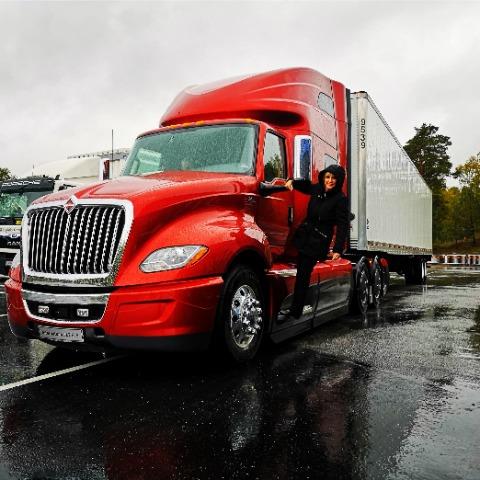
Introducing the XF Hydrogen
Netherlands-based DAF Trucks is a company that is especially successful in the truck market in Europe. It produced around 60 000 trucks last year and, as in previous years, DAF was the 2021 heavy-duty market leader in the Netherlands (28.5%), the UK (29.4%), Poland (24.3%), Hungary (24.8%), Bulgaria (23.8%) and Portugal (19.0%). DAF also remained the undisputed market leader in Europe in the heavy-duty tractor segment. DAF sold 8,600 trucks outside the European Union last year (this includes sales in South Africa).

The company is owned by PACCAR, which is headquartered in Bellevue, Washington, USA and also produces Peterbilt and Kenworth trucks.
The truck in a nutshell

There are lots of opinions about the future of trucking. Some say it belongs to fully electric trucks. Others say pure hydrogen trucks. Others believe the future lies with hybrids.
DAF and its parent company PACCAR are hedging their bets – and they’re exploring lots of different options including electric, hybrid and – in the long term – hydrogen.
But the companies aren’t keen to ditch internal combustion engines, maintaining that the combustion engine – which is already very clean – is destined to become even cleaner in the future and more sustainable too, thanks to the arrival of new generations of fuels.
“When cities decide to allow only those trucks that do not produce any emissions into their centres, the only option currently available is a fully electric driveline. But when a truck has to drive long distances and operate under zero emissions in urban areas, a combination of diesel and electric comes into play: hybrid.
“However, the electric driveline is not yet an option for long-distance haulage due to its limited range. That is why the modern and efficient diesel engine is still the best choice. Diesel engines remains the best choice for now and the near future,” DAF’s website points out.
Hydrogen is also an option in the medium and long term for powering trucks – especially over long distances. And there are two different options in this regard. (In both cases, a 100% reduction in CO2 emissions can be realized if green hydrogen is used.)
The first option is employing a fuel cell that uses hydrogen to generate electricity to power the electric motor. This has been the option of choice to date for most truck manufacturers. Alternatively, you can use hydrogen as a fuel for the combustion engine. There are considerable advantages to this choice. From a technical point of view, it’s relatively easy to adapt the regular internal combustion engine. Very significantly though, with this option, no batteries are needed and therefore no rare resources are utilised. These are just some of the advantages of the XF H2 concept truck over its fuel-cell siblings.
Exterior

With the exception of the hydrogen tanks and related equipment, the truck looks like a regular XF. So, it has the same aerodynamically tapered cab that features a curved windscreen and digital cameras instead of mirrors. Highly energy-efficient LED lighting is used throughout the truck, with special attention paid to the state-of-the-art low and high-beam headlights. These include the signature daytime running lights that make the New Generation DAF recognizable in all conditions.
Interior

As is the case with the exterior, the interior is the same as a “regular” XF. Premium soft-touch materials and leather are used extensively throughout the interior. One of the most eye-catching features is the fully digital instrument panel, which can be customized to the driver’s personal preferences.
Drivetrain

Now this is, of course, the big news when it comes to the truck. While its parent company (PACCAR) is exploring fuel cell technology, DAF developed an internal combustion engine – a Paccar MX-13 – that runs on hydrogen. Modifications to the internal combustion engine include replacing the injection units with engine spark plugs, changing the pistons for better combustion, fitting an electric turbocharger and replacing the intake with a hydrogen gas injection system. Compared to the fuel cell hydrogen solution, the combustion engine option has transient capabilities (eliminating the need for a large energy storage system). Other advantages include the lower cooling capabilities needed and lower sensitivity to hydrogen purity.
Inside the chassis, there are four hydrogen tanks, good for 90 litres and 10 kg of hydrogen, which is refuelled at 350 bar. The right side of the chassis is still empty. There, in the future, an after-treatment system can be mounted that will allow the powertrain to meet Euro 7 or even better. At the moment, the H2 concept truck can achieve a range of 120 km (which obviously won’t have transport operators too excited), but DAF thinks it can get that to a far more practical 600 km.
On the road, it feels a lot like a diesel-engined truck; it’s hard to discern a big difference in the driving experience.
Transmission

The engine is mated to a regular ZF Traxon, and it drives very smoothly. But Ron Borsboom, director of product development at DAF Trucks, sees clear areas for improvement. "If we could build in a boost, for example by adding a small electric motor and a couple of batteries, we could transfer the torque even better and faster, and we could recover energy through brake recovery. With such a hybrid drive, you could even plug in and drive into urban zones fully electric,” he recently told TTM.NL.
Safety

The XF range – and indeed the H2 concept truck – feature a large windscreen and large side windows with ultra-low belt lines for unequalled direct vision. Also new is the DAF Digital Camera system that can replace the main and wide-angle mirrors. The DAF Corner View system offers maximum view of the area around the cab’s A-pillar on the co-driver’s side. All vehicle lighting now includes full LED technology for optimal view and visibility.
DAF’s “Hands on the Wheel, Eyes on the Road” philosophy results in class-leading ergonomics. All driving-related functions are operated from the steering wheel and the steering column stalks. Secondary driving functions are operated from physical switches, logically positioned on the dashboard, within easy reach of the driver.
Verdict

Will this prototype truck ever see the light of day? If so, will it sell in large volumes? DAF estimates that it will be another five to seven years before the H2 concept truck is ready for market launch. When that happens, if it is priced right, there’s no reason to believe that it won’t succeed – but it will face strong resistance from “conventional” hydrogen trucks and maybe electric trucks too… However, the most important implication of this development is not the sales potential for this actual truck. Rather, it could mean that the internal combustion engine still offers huge potential for the transport industry, especially in the heavy-duty long haul transport segment – so long, of course, that it’s running on hydrogen and not so-called “dirty” diesel.
Photographs by TTM.NL, Sytse Dijkstra and Florian Engel.