
Volvo investing in the future
Volvo investing in the future


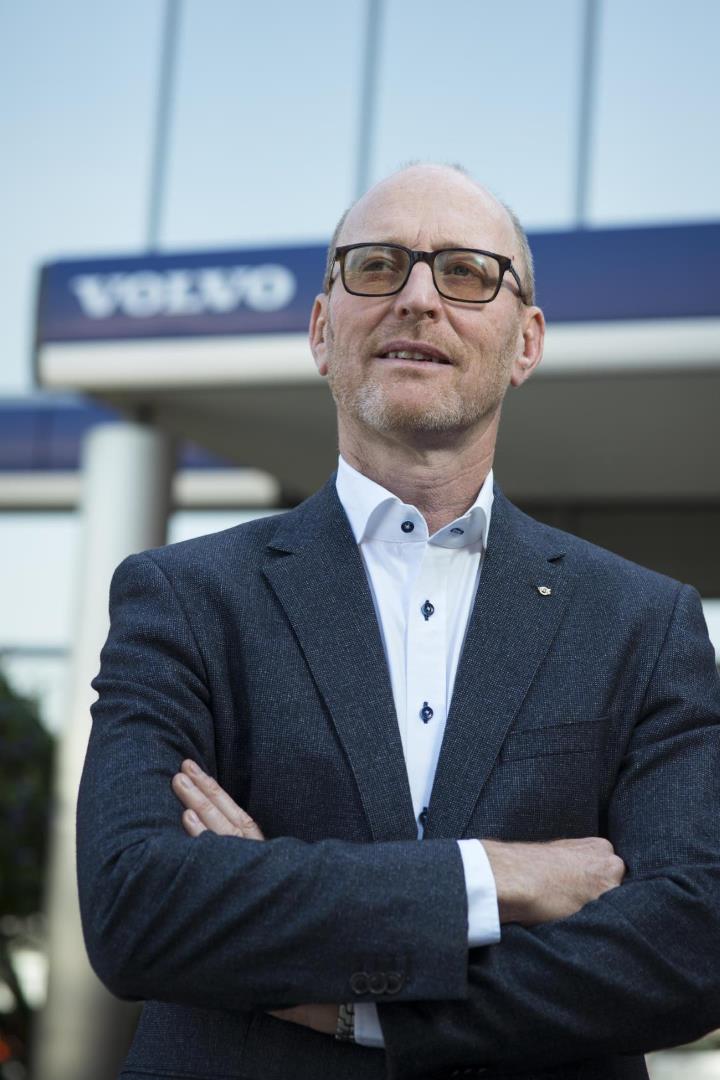
By Colin Windell
It was 18 years ago to the day (February 14) the Volvo Group launched in South Africa and the celebration of that event was the revelation the sales figures for 2017 in South Africa were the best ever in the same year the company achieved its best results on a global scale.
In fact, according to Torbjörn Christensson, president of the Volvo Group Southern Africa, this trend is already continuing in 2018 and the biggest problem facing the sales team is stock because it cannot build gearboxes quick enough to get the vehicles onto the road.
Global sales last year showed there was something of a boom building and he says: “South Africa should boom with the rest of the world, it is now just down to political stability.”
A thorny issue indeed and while the country and world awaited news of the Zuma resignation, several people attending the press conference had their phones silently tuned to news broadcasts . . . just in case.
In addition to the sales growth, Volvo Trucks Southern Africa concluded 2017 as the commercial vehicle brand with the top Customer Satisfaction rating in the industry-wide Scott Beyers survey.
Volvo Trucks moved up from a combined third position with a CSI rating of 97,87% in 2015, to the top spot in 2017 with a 98,51% CSI Rating.
“Over the past two years, we have made a concerted effort to make our customers our top priority.
“We truly aim to understand our customers’ business and to focus on transport solutions that make our customers successful and create value for society as a whole,” says Christensson. “During 2018 customers will remain the top priority across all our business areas, as we will continue to work hard to earn the trust and confidence our customers have placed in us.”
Locally, Volvo Group is represented by Volvo Trucks, Volvo Bus, Volvo Penta as well as the UD Trucks brand. Close to a thousand staff are employed by Volvo Group in Southern Africa through various representative offices, brand headquarters, as well as two factories in Durban and Rosslyn, shared back office support and a Regional Distribution Centre for parts.
Volvo Trucks has 25 dealerships across Southern Africa, with a new site which opened in Zambia during 2017. New facilities are also currently being developed in Port Elizabeth, which will be fully operational during the first half of the year. The company is planning to upgrade its facilities in Durban during 2018.
At the end of 2017, Volvo Trucks secured a 16,25% market share with 2 074 extra heavy trucks sold, earning the manufacturer the third spot in the heavy duty commercial vehicle market segment.
Later this year, Volvo Trucks will be introducing Dual Clutch I-Shift transmissions for EURO 3 engines locally. This technology has been available for Euro 5 and 6 markets in Europe for some time, but now the benefits will be available to customers here in Southern Africa.
“The dual clutch transmission provides seamless gear shifting to give uninterrupted acceleration. So, the vehicle does not lose any speed during gear changes. This is especially advantageous in areas where there are a lot of curves and hills, where many gear shifts are required,” explained Christensson.
On the Volvo Bus side, deliveries increased by 1% to 61 units during 2017. Locally, Volvo Bus introduced two new models in South Africa, the 9411R and B8R, with Volvo Bus now holding a 34% share of the rear engine bus vehicle segment.
Volvo Penta, the supplier of engines and complete power solutions for marine and industrial application, experienced its most profitable year in its history. With sales split 50/50 between marine and industry segments, orders increased by 17% and deliveries by 11% to a total of 704 units for 2017.
“In South Africa, Volvo Penta has secured a 50% market share of the local industry power generation segment, with robust growth in industries such as mining, construction, dewatering and agriculture,” said Christensson. “Volvo Penta also achieved record uptime hours in the underground mining segment, confirming its dominance in this industry segment.”
For the Volvo Group, technology means the aspiration to move forward, constantly working together to improve and do better. It means creative and innovative thinking, evolutionary and revolutionary problem solving to conquer the challenges the world is facing today.
As the world’s population continues to grow exponentially, the demand for transportation will continue to increase congestion and pollution. Safety also remains a constant concern, as all road users need to be protected.
One of Volvo Group’s major objectives is to tackle climate change and to reduce any adverse impact on the environment from the company’s products and operations.
“Energy-efficient products and solutions means significant savings for our customers and at the same time reduced impact on the environment,” says Christensson. “Volvo Group works with continuous improvements supported by measuring and target-setting as well as considering the use of alternatives to minimise the above aspects’ environmental impacts. The latest developments and technologies are all targeted at achieving exactly that.”
Volvo Group expects more accelerated developments in the transportation industry in the next ten years, compared to what was achieved during the past three decades.
“In the automotive industry, there is a focus on specifically three big technology trends, namely connectivity, vehicle automation and electromobility,” explained Christensson. “As we speak, some of these once futuristic technologies are in the process of becoming a reality in cities across the world.”
Currently, Volvo Penta is driving innovation to introduce modern technologies in hybrid, electro-mobility and digitalisation. In Singapore, 50 Volvo Bus hybrid units were put in operation and the company is also in the process of testing electric autonomous buses in that country.
Electromobility is continuing to become a reality. Volvo Trucks recently announced it would begin selling fully electric trucks in the European markets in 2019. These will be medium duty vehicles aimed at urban distribution operations.
“There are restrictions in major urban centres on the times that delivery vehicles may operate, fully electric vehicles would not be subject to these restrictions. So, for example, transporters could re-stock stores at night,” says Christensson.
Earlier in in 2018, Volvo Trucks begun delivering FM and FH heavy duty trucks equipped with Liquified Natural Gas (LNG) engines. The new trucks from Volvo running on LNG offer the same performance as Diesel, but with 20-100 percentage lower CO2 emissions (depending on specific fuel used). At present this is only being offered in a Euro 6 compliant package in the European markets, but with time and as the infrastructure for LNG matures in other parts of the world, this technology will be adapted accordingly.
“With all the technology and innovations currently being researched and implemented, Volvo Group believes traffic jams might be all but eliminated by 2030 and vehicles will no longer be an environmental threat.
“In addition, through our more than 50 years of intensive research and investment in safety, truck accidents will also be extremely rare by then, as our knowledge, expertise and technology continue to focus on active safety and driver support systems to prevent the risk of accidents.”
Volvo Group has also invested SEK 1 million in the establishment of a new driver academy in South Africa.
“This new state-of-the-art training facility will be aimed at specifically unemployed truck drivers, where they will opportunity to update and hone their knowledge and skills. This database of highly-qualified drivers will then be made available to our fleet owners to address the great shortage of skilled truck drivers in the industry,” said Christensson.
The training, which is scheduled to start in March 2018, will involve a year-long learnership and will be NQF-aligned.
During 2017, Volvo Group Southern Africa invested more than R25-million in training more than 2 381 employees and dealer staff. This included a diesel mechanic apprenticeship programme, learnerships and bursaries.
Looking at the year ahead, Volvo Group is aiming to increase sales by 5% in South Africa and other African countries.