Four macro trends
According to Marco Liccardo, Chief Technology & Digital Officer at the Iveco Group, there are four macro trends that are set to transform the entire transport ecosystem.

It will come as no surprise to anyone within the transport industry that the first trend is that of electrification; this is the word on everyone’s lips nowadays –and Liccardo told IToY jurors that over 35 new etruck launches are expected by 2024. “In order for electric vehicles to succeed, the target must be total cost of ownership parity with diesel vehicles,” he explained.

The next trend is that of digitalization – and Liccardo predicted that 80% of commercial vehicles would be connected, with 100 trillion sensors being employed for this purpose by 2030.

The third trend is that of automation, and Liccardo said that this would have benefits when it comes to both safety and productivity. “Collisions will drop by 15% by 2030 as a result of automation,” he predicted. He also said that there were driver benefits. “This is important; we need to make the job of a driver much more attractive,” he noted, alluding to the dire driver shortage.
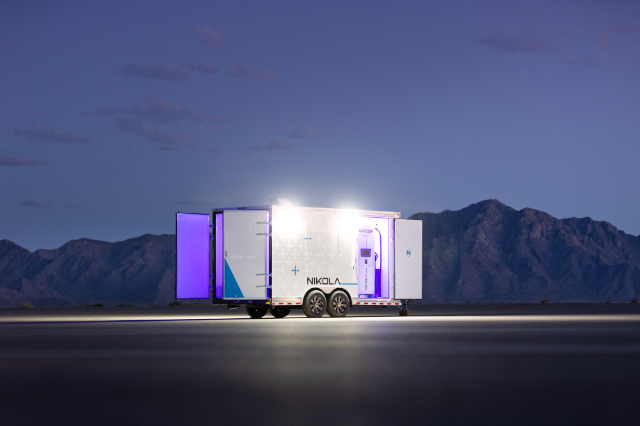
The fourth trend is the transformation of original equipment manufacturers (OEMs) into business solution partners. “We will see a growth in new services on the part of OEMs – such as ‘Pay Per Use’ instead of outright purchase and growth in Mobility As A Service. In future, OEM profits will be split into three – with one-third coming from new vehicle sales, one-third coming from aftersales and one-third coming from data-enabled services,” he predicted. As a result of these new business models and overall improvements in efficiency, he said industry profits were set to grow by over €4 billion by 2030.
Alternative propulsion
Given the first macro trend, it was interesting to hear Liccardo’s predictions when it comes to alternative propulsion – and he spoke in great detail about the power mix in Europe by 2035 (we reckon that these trends will play out eventually in Africa…albeit with some considerable delays in implementation).
Liccardo predicted strong growth in the zero-emission vehicle market. “It was 7% in 2025, it will be 40% in 2030 and it will grow to 70% in 2035. The big loser will be diesel, which will drop to below 60% before 2030 and have a mere 28% share come 2035. We believe that gas is still a valuable low NOx and CO2 option. This market is expected to recover in the mid-term, mainly driven by the increased availability of biomethane. Battery electric vehicles (BEVs) will grow fast – to 35% already in 2030 and up to 50% in 2035, with a substantial impact on volume already from 2025. Fuel-cell electric vehicles (FCEVs) will have a slower start, growing to 22% in 2035,” he told the IToY jurors.
Iveco’s solutions
Given these trends, what are Iveco’s solutions when it comes to alternative propulsion? In the urban delivery sector, it will offer vehicles fuelled by CNG and bio-CNG, with BEV coming in about a year. When it comes to regional distribution, the strategy is C-LNG/bio C-LNG, followed by BEV in 2024 and FCEV two or three years later.

Within the construction segment, Iveco will promote the use of CNG and bio-CNG until 2025, followed by BEV.

In the long-haul sector, the strategy is LNG/bio-LNG until 2025, followed by FCEV thereafter. “Long-haul is by far the biggest sector and therefore the biggest CO2 contributor. These vehicles are key to decarbonize road transport, representing more than 60% in volume and 70% of CO2 emissions in the EU heavy truck industry. Fuel cells are the best solution for ranges of 500 km and more,” noted Liccardo.
Nikola enters the fray
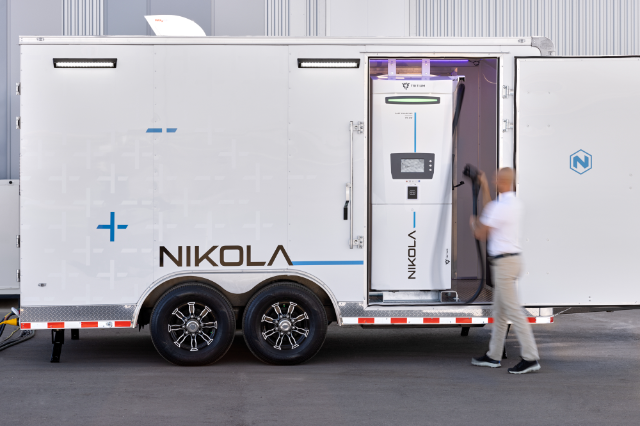
As we have previously reported, Iveco will be offering BEV and FCEV long-haul vehicles in conjunction with its partner, Nikola. The Nikola Tre, which is based on the Iveco S-Way, was on the Iveco stand at the IAA Transportation and the company has already started taking orders for the European 4x2 Artic version of the BEV. It has a zero-emission range of 530 km and the first trucks will be delivered to customers next year. Commercial deliveries of the FCEV – with a zero-emission range of 800 km – commence in 2024. The BEV has a payload of 22.5 t while its FCEV counterpart is good for a load of 24.7 t.
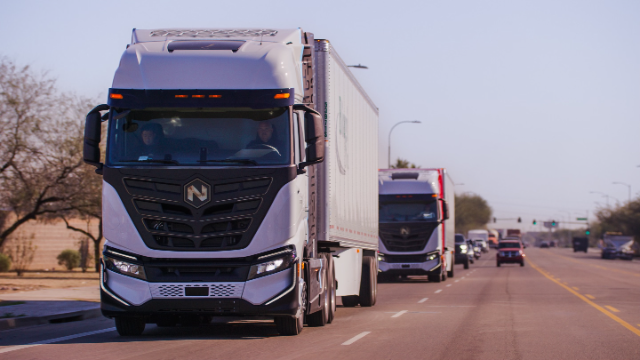
While both vehicles are super interesting, Giuliano Giovannini, Head of Medium & Heavy Trucks Product Management at Iveco, shared some fascinating titbits of information about the FCEV. “In developing this vehicle, we have fully exploited the mass and dimension regulations, and it has a total length of 18 m (versus the 16.5 m of the BEV). This includes the aerodynamic nose of the vehicle. In order to maximize payload, we have opted for a 6x2 configuration,” he told IToY jurors. Furthermore, the FCEV charges in a mere 20 minutes (versus the BEV’s 80 to 90-minute charging time).
We shall watch the development and rollout of these vehicles with great interest. Hopefully, we will see them in South Africa one day…